PHOENIX, Arizona — Employees at Nourish Phoenix were left utterly astounded when a massive, fully loaded U-Haul truck pulled up to their loading dock, packed to the ceiling with tens of thousands of essential baby supplies. What started as an ambitious local collection initiative had materialized into an avalanche of kindness, spearheaded by an extraordinary young philanthropist who has been changing her community since she was just seven years old.
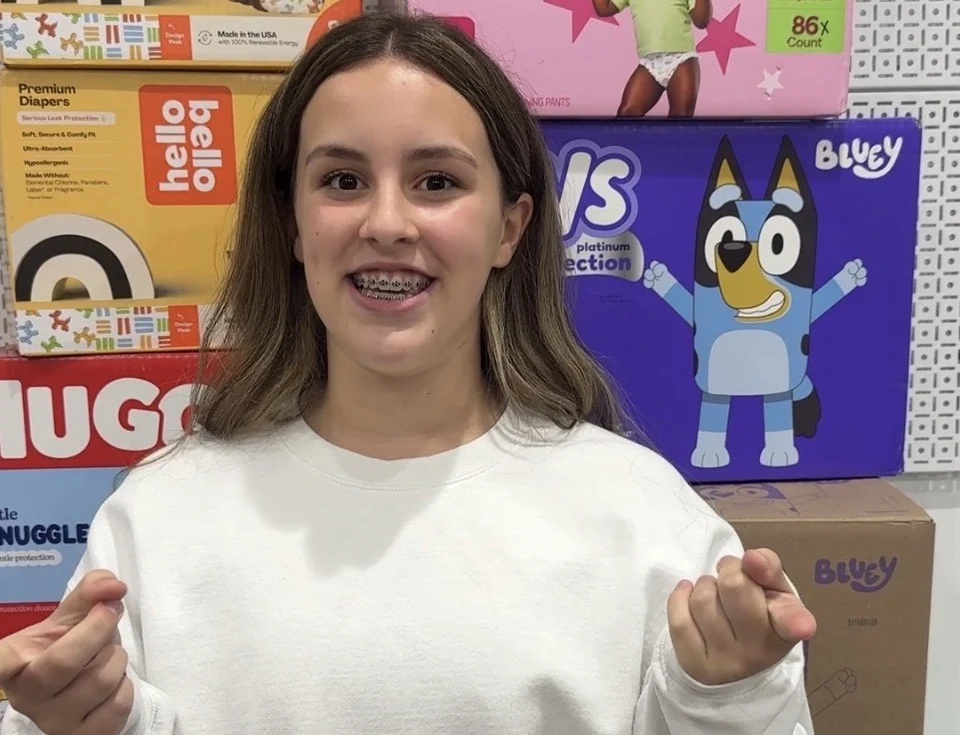
The delivery marked the triumphant conclusion of the 5th annual "Sloan’s Diaper Drive," organized by 12-year-old Sloan. While her initial goal for this year’s campaign was an already impressive 22,500 disposable diapers, the community’s overwhelming response shattered expectations. By the time the dust settled and the final cardboard boxes were counted, Sloan had amassed a staggering 30,000 diapers—transforming her family home into a literal obstacle course of Huggies, Pampers, and popular character-themed brands until the moving truck finally arrived to haul it all away.
Main Facts: The Scope of Sloan’s 5th Annual Diaper Drive
The sheer scale of Sloan’s latest philanthropic endeavor defies expectations for a child her age, highlighting a profound grassroots effort that has steadily grown over half a decade.
- The Beneficiary: Nourish Phoenix, a historic community food and clothing bank located at 510 S. 9th Avenue, which has served vulnerable families in the Phoenix area for decades.
- The Yield: A record-breaking 30,000 disposable diapers collected, well surpassing the initial target of 22,500.
- The Delivery: The volume of the contribution was so immense that it required a commercial U-Haul moving truck to transport the goods from Sloan’s residence to the charity’s headquarters.
- The Origin: Sloan began this ambitious community service project when she was just seven years old, meaning she has dedicated nearly half of her young life to alleviating diaper need in Maricopa County.
- The Core Issue: Disposable diapers remain one of the most chronically requested yet severely under-donated items at food banks nationwide, as government assistance programs like SNAP (Supplemental Nutrition Assistance Program) and WIC (Women, Infants, and Children) legally cannot be used to purchase diapers.
Chronology: From a Curious Volunteer to a Community Leader
To truly understand the phenomenon of Sloan’s Diaper Drive, one must look back at how the initiative blossomed from a simple moment of childhood curiosity into a multi-thousand-dollar community operation.
2018–2019: The Spark of Awareness
Long before she was organizing moving trucks, Sloan was simply a compassionate kid doing what her parents taught her: giving back. While volunteering alongside her family at Nourish Phoenix, stocking shelves and organizing donated food parcels, the then-seven-year-old noticed a glaring anomaly.
While the canned goods, cereals, and clothing racks were orderly and filled, a particular section of the facility’s shelving unit remained entirely bare. Confused, Sloan asked the staff why that specific space was empty.
The answer changed the trajectory of her childhood. Warehouse workers explained that the empty space was reserved for diapers—and that they were perpetually out of stock. They informed the young volunteer that diapers were among the most urgently requested items by struggling parents, yet they were notoriously difficult to keep on hand because federal assistance programs do not cover them, and regular food drives rarely target them specifically.
The Inception of the Drive (Age 7)
Refusing to accept that babies in her community were going without basic hygiene necessities, Sloan decided to take matters into her own hands. With the help of her parents, she launched her very first neighborhood diaper drive. It was modest by comparison to today’s operations, but it planted the seed for what would become an annual tradition. Every year, as Sloan grew older, her network expanded, her ambitions heightened, and the community rallied behind her vision with increasing fervor.
The Pandemic and Scaling Up (Ages 8–10)
Even through the logistical hurdles of the COVID-19 pandemic, Sloan found creative, socially distanced ways to keep her drive alive. Utilizing social media, word-of-mouth, and drop-off boxes coordinated through local schools and neighborhood groups, she steadily increased her totals year after year. What began as a few hundred packages ballooned into thousands, transforming from a family project into a recognized local charity effort.
August 2026: The U-Haul Milestone (Age 12)
Culminating at the close of August, Sloan’s 5th annual drive reached an unprecedented crescendo. Setting a benchmark goal of 22,500 diapers, she leveraged half a decade of community trust and local media attention. Donations flooded in from local businesses, school peers, family friends, and complete strangers moved by her longevity and dedication. The donations arrived in such volume that they eventually filled every walkable inch of her household. When the U-Haul truck finally arrived at Nourish Phoenix at the end of the summer, it carried a tangible monument to a pre-teen’s determination.
Supporting Data: The Hidden Crisis of Diaper Need in America
Sloan’s initiative shines a bright, necessary light on a silent public health crisis hiding in plain sight across the United States: diaper need.
According to the National Diaper Bank Network, 1 in 2 U.S. families struggle to afford enough diapers to keep their babies clean, dry, and healthy. This condition, known as diaper need, carries severe cascading consequences for both infants and parents:
- Health Impacts: Without an adequate supply of clean diapers, infants are left in soiled garments for extended periods, leading to severe diaper dermatitis (rash), painful urinary tract infections, and chronic skin infections.
- Economic Barriers: Disposable diapers cost upwards of $80 to $100 per month per baby. For low-income families, this expense forces agonizing compromises between purchasing food, paying utility bills, or buying infant hygiene products.
- The Childcare Catch-22: Most licensed daycare centers, early Head Start programs, and nursery schools require parents to provide a daily supply of disposable diapers—often ranging from six to ten changes a day—before they will accept a child.
- Employment Obstacles: Without access to reliable childcare due to a lack of diapers, parents are frequently unable to maintain steady employment or attend school training programs, deepening the cycle of generational poverty.
- The Policy Gap: Despite being as essential to infant health as food and shelter, diapers are classified by the federal government alongside luxury goods like alcohol and tobacco, meaning they cannot be purchased using SNAP benefits or WIC vouchers.
By addressing this specific logistical bottleneck at Nourish Phoenix, Sloan’s annual contributions do much more than provide comfort; they actively unlock economic mobility and health security for dozens of local families.
Official Responses and Perspectives
The extraordinary community response to Sloan’s drive elicited deep gratitude from the organizations she supports, as well as profound pride from her family.
Speaking with local media affiliate ABC 15 as the drive concluded at the end of August, Sloan articulated a remarkably mature philosophy on civic duty and human empathy:
"If we have the ability to give someone something that they might not have or need, it’s really important to do that."
For Sloan, the math of compassion is simple: if you possess an abundance while another lacks a fundamental necessity, the moral imperative is to bridge the gap.
Her mother, beaming with pride throughout the chaotic, box-filled final days of the collection, shared her admiration for her daughter’s relentless compassion:
"My little girl: she’s just so special, she has such a big heart, loves helping and giving back."
Staff members at Nourish Phoenix echoed these sentiments, expressing deep awe that a middle-schooler possesses the organizational acumen, public speaking confidence, and sheer grit required to coordinate a logistical operation the size of a moving-company route. To the warehouse workers who welcomed Sloan as a curious seven-year-old volunteer years ago, seeing her return as a seasoned philanthropic leader orchestrating a U-Haul delivery was nothing short of cinematic.
Implications: The Ripple Effect of Youth-Led Philanthropy
Sloan’s Diaper Drive serves as a powerful case study in the transformative power of youth-led community activism. While large corporate charities and government interventions are essential for macro-level economic stabilization, local grassroots movements led by ordinary individuals—and in this case, children—demonstrate that meaningful change often starts at the most localized level.
1. Inspiring the Next Generation of Givers
When children see someone their own age taking on monumental societal challenges and succeeding, the psychological barrier of "I’m too small to make a difference" is instantly dismantled. Sloan’s journey proves that youth are not merely the leaders of tomorrow; they are active, capable change-makers today. Her peers in Phoenix have watched her transform a simple classroom-sized concept into a major regional distribution event, proving that civic engagement can begin at any age.
2. Educating the Public on Forgotten Needs
Many well-meaning citizens donate canned goods and winter coats to food banks without ever realizing that infant hygiene products are excluded from safety-net funding. By constantly keeping diaper need in the local news cycle and on social media feeds, Sloan’s campaign educates thousands of donors who might otherwise remain oblivious to the struggles of young parents in their own neighborhoods.
3. Strengthening Community Resilience
In an era often dominated by headlines of division and hardship, stories like Sloan’s act as a vital social glue. The collective effort required to fill a U-Haul truck—neighborhood associations pitching in, local businesses offering drop-off spaces, families buying an extra pack of Huggies during their weekly grocery run—builds a tighter, more empathetic local community fabric in Phoenix.
As Sloan prepares for her middle school years, her annual tradition shows no signs of slowing down. Having successfully conquered the 30,000-diaper milestone with a U-Haul truck, the community eagerly watches to see what new heights this driven young philanthropist will scale next. One thing is certain: wherever Sloan directs her compassion, hope is sure to follow.