ORANGE COUNTY, CALIFORNIA — In what marine biologists are calling a monumental and entirely unexpected wildlife event, olive ridley sea turtles have made history by laying eggs on the Southern California coast for the first time ever recorded.
The extraordinary development, first brought to light by comprehensive reporting in the Los Angeles Times, unfolded in late September along the sun-drenched shores of Orange County. While subtropical marine species occasionally drift north during strong El Niño cycles, the decision of these vulnerable reptiles to crawl ashore in broad daylight and establish nests represents an unprecedented milestone in American marine biology.
What began as a pair of shocking beachfront encounters quickly transformed into a high-stakes, multi-agency wildlife rescue operation as scientists raced against a looming hurricane-driven storm system to save the historic clutches.
The Main Facts: A Historic First for the West Coast
The unprecedented events center on the olive ridley sea turtle (Lepidochelys olivacea), a species renowned for its massive synchronized nesting aggregations—known as arribadas—in tropical and subtropical regions such as Costa Rica, Mexico, and Nicaragua. Prior to September, a nesting event of this species had never been documented anywhere along the United States West Coast.
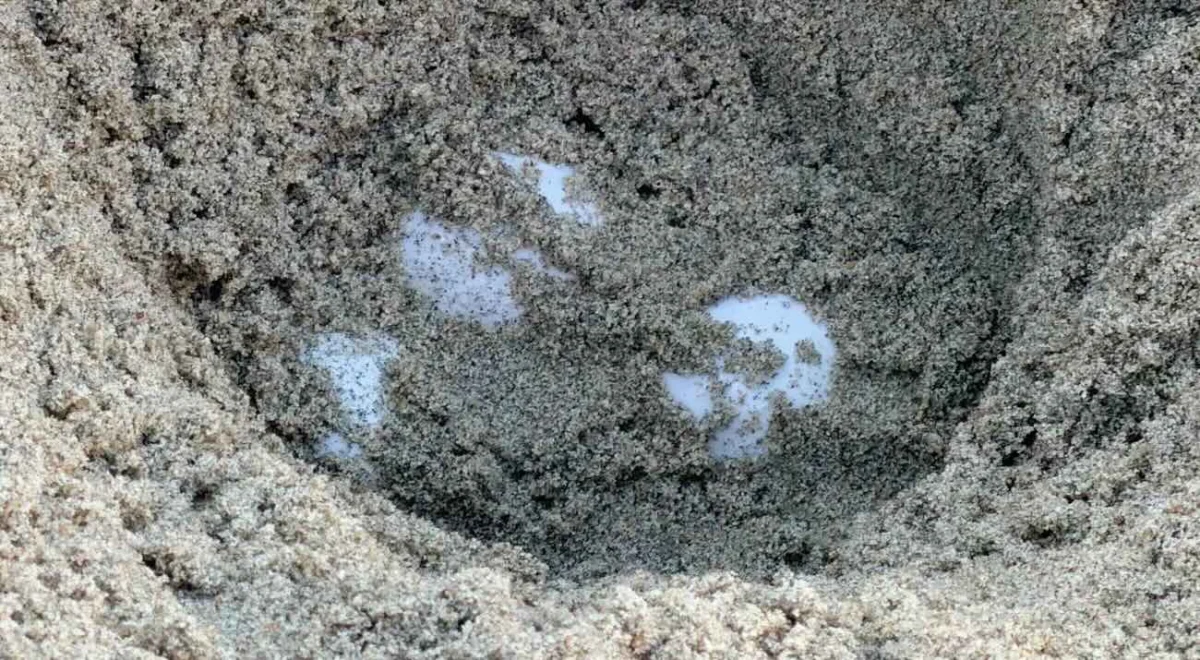
The first sighting occurred in plain sight on Seal Beach. In the middle of the day, a female olive ridley—her shell and flippers bearing the unmistakable signs of a long pelagic journey and her belly swollen with unlaid eggs—braved the shoreline. Astonishing beachgoers and leaving lifeguards momentarily speechless, she hauled her heavy body out of the surf, labored up the dry sand, dug a secure egg chamber, deposited her precious clutch, and lumbered back into the Pacific Ocean.
She left behind nothing more than a faint, flipper-scratched trail in the sand and a handful of bewildered witnesses.
Just three days later and a mere eight miles north, the phenomenon repeated itself on the bustling shores of Huntington Beach. Another olive ridley sea turtle repeated the historic maneuver, stunning locals and drawing immediate attention from municipal safety officials.
While individual olive ridleys have occasionally been spotted swimming off the coast of California—usually riding the warm currents of anomalous weather patterns—nesting behavior has never, until now, been part of the regional ecosystem.
Chronology of Events: From Surprise Discovery to Emergency Rescue
The unfolding saga played out rapidly over a dramatic six-day period, shifting from joyful disbelief to emergency intervention.
Day 1–3: The Initial Discoveries
When the first turtle came ashore at Seal Beach, local authorities initially struggled to process the rarity of the event. However, when the second turtle hauled out onto Huntington Beach just 72 hours later, the Huntington Beach Fire Department’s Marine Safety unit immediately recognized the ecological significance of the occurrence.
Lifeguards and municipal authorities swiftly escalated the situation, contacting federal wildlife experts at the National Oceanic and Atmospheric Administration (NOAA) and the U.S. Fish and Wildlife Service (FWS). Federal biologists rushed to the locations, establishing wide protective cordons with security tape to keep the public at bay and erecting specialized mesh netting over the nesting sites to protect the delicate subterranean chambers from predators and human disturbance.
Day 6: The Race Against Hurricanes
The celebration was short-lived. Just as conservationists were settling into the reality of hosting the first-ever California-born sea turtle hatchlings, a severe meteorological threat emerged on the horizon.
Monitoring weather models, meteorologists and wildlife officials realized that a dangerous confluence of extreme high tides and severe ocean swells whipped up by hurricanes Polo and Odalys was barreling toward the Southern California coastline. Forecasts indicated that the hurricane-driven waves would inundate and inevitably obliterate both the Seal Beach and Huntington Beach nests, washing the eggs away before they could develop.
In response, NOAA and FWS wildlife officials executed the first emergency sea turtle egg rescue in California history. Biologists carefully exhumed 204 fragile eggs from the two known nests. The eggs were packed meticulously into polystyrene coolers filled with ambient sand to replicate their natural environment, loaded into vehicles, and driven on an emergency transport run to the Aquarium of the Pacific in Long Beach.
Supporting Data and Ecological Context
To understand the magnitude of this event, one must examine the biology and typical distribution of the olive ridley sea turtle.
Conservation Status: The International Union for Conservation of Nature (IUCN) currently lists the olive ridley sea turtle as Vulnerable, facing threats from historical egg harvesting, incidental capture in commercial fisheries (bycatch), marine pollution, and the loss of nesting habitat.
Geographical Range: Typically found in warm tropical and subtropical waters of the Pacific, Indian, and Atlantic oceans, their primary North American nesting strongholds are located along the western coast of Mexico and Central America.
Clutch Size: Across the two Orange County nests, a total of 204 eggs were successfully recovered and secured.
The Climate Factor: Scientists point to abnormal ocean temperatures as the primary catalyst for this northern migration. Back-to-back marine heatwaves off the coast of Baja California have fundamentally altered local waters, creating a thermal bridge that may have guided or driven the reptiles thousands of miles north of their traditional range.
Official Responses and Expert Perspectives
The unexpected arrivals have captivated the marine science community, sparking intense debate and collaboration among federal agencies, local municipalities, and public aquariums.
Lindsey Peavey Reeves, a senior scientist with the National Marine Sanctuary Foundation who has spent two decades studying olive ridley sea turtles, expressed her profound astonishment to the Los Angeles Times.
"I have been expecting to see subtropical species present off the coast of Southern California, which is typical during El Niños," Peavey Reeves noted. "However, I wasn’t expecting to see olive ridley sea turtles nesting in Orange County."
Corine Purtill, the journalist who broke the initial story and followed up on the rescue efforts, highlighted the broader geographical milestone:
"After that, the hatchlings will crawl to the ocean, where they will become the first known sea turtles to start their lives in California waters."
Following the emergency relocation of the clutch to the Aquarium of the Pacific, federal biologist Jonathan Snyder of the U.S. Fish and Wildlife Service addressed the media regarding the high-stakes decision to move the eggs.
"We had to make some quick decisions," Snyder said on Friday at the aquarium. "This is the decision that we made, and I think it’s the best one for species recovery."
At the aquarium, the recovered eggs were transferred into advanced, climate-controlled incubators specifically calibrated to mimic the exact thermal and physical properties of a natural sandy beach ecosystem. Biologists are monitoring the clutches daily, though it remains undetermined whether the eggs—subjected to unexpected transport and unusual environmental conditions—will ultimately prove viable.
Implications: Climate Adaptation and the Future of Marine Life
Beyond the immediate drama of the rescue operation, this unprecedented nesting event carries profound implications for marine ecology in an era of rapid global climate change.
As global ocean temperatures continue to rise, marine species are increasingly forced to adapt to shifting environmental baselines. Historically, animal ranges are thought to expand or shift over centuries. However, the sudden appearance of nesting olive ridleys in Southern California demonstrates a rapid behavioral shift in real-time.
Whether these turtles were actively driven north by expanding thermal boundaries or simply followed warm-water currents that mimicked their native southern latitudes, their journey highlights an extraordinary capacity for biological flexibility. In the eyes of many conservationists, this adaptability serves as a powerful vote of Darwinian confidence—a glimmer of resilience as marine ecosystems worldwide face an uncertain and volatile future.
For now, scientists, conservationists, and beachgoers alike are watching the incubators at the Aquarium of the Pacific with bated breath. If the eggs hatch successfully, these little terrapins will write a brand-new chapter in marine history, cementing their legacy as the first native-born California sea turtles and offering a resilient symbol of hope for our changing oceans.