"I get so overwhelmed that I do nothing." It is a confession whispered in the dark of a home office, a silent admission made while staring at a cursor blinking on a blank screen. It is a phenomenon that transcends industries, affecting everyone from high-level executives to students, yet it is almost never addressed as a mechanical error in the way we process tasks.
For many, the morning begins with perfect clarity. You open your laptop at 9:15 a.m., acutely aware of your priorities. By 9:50 a.m., the narrative has shifted. You have read the same three emails twice, opened a spreadsheet only to close it, checked the news, and ultimately moved nothing. Not one thing. The work is not cognitively difficult; you could explain the requirements to a colleague with ease. Yet, you remain perfectly still.
This stillness is not a failure of character. It is not laziness, and it is not a lack of discipline. It is a "definition problem"—a systematic breakdown where the brain, overloaded by ambiguous inputs, enters a state of protective, paralyzing stasis.
The Chronology of the Freeze
The "freeze" typically follows a predictable, destructive arc.
The Accumulation Phase: It starts with a light week. You handle your responsibilities with relative ease. However, as the pile grows—a contract to review, a doctor’s appointment to schedule, a deck to build, and a friend’s message left unanswered since Tuesday—the cognitive load shifts from manageable to overwhelming.
The Threshold of Inaction: Once you cross a certain threshold of open loops, your working memory hits a wall. The pile of tasks begins to feel sentient, looming larger with every passing hour. You tell yourself, "I’ll start in ten minutes," but those ten minutes become two hours.
The Evening Regret: As the day concludes, the weight of the unfinished list transforms into a personal indictment. You feel like a person who has "wasted" the day. This creates a feedback loop: because today was "wasted," you feel even more pressure to be perfect tomorrow, which raises the stakes, increases the anxiety, and ensures that the cycle repeats the next morning.
The Cognitive Science of "The Pile"
To understand why we freeze, we must look at the limitations of the human brain. Psychologist Nelson Cowan’s research into working memory suggests that the human capacity for holding information is remarkably limited—roughly three to five "chunks" of data at any given time.
When you have eleven open, undefined loops, you are effectively asking your brain to juggle more than it can hold. The "freeze" is the brain’s way of saying the container is full. The common advice—to "just prioritize" or "get disciplined"—fails because it ignores this biological reality. You are not fighting a lack of motivation; you are fighting a physiological constraint.
The Failure of Conventional Tools
We have all tried the "repairs":
- The App Trap: You download a new task management application, spend hours configuring it, and abandon it within a week.
- The 5 a.m. Experiment: You attempt to overhaul your sleep schedule to gain more "productivity hours," only to burn out by day nine.
- Time Blocking: A popular method that works perfectly until the moment the block arrives, at which point you realize you still cannot bring yourself to start the task because the task itself is a mystery.
These tools assume the hard part is when to work. For those trapped in a state of overwhelm, the hard part is knowing what the first move actually is.
The "Boring" Solution: Downgrading the Task
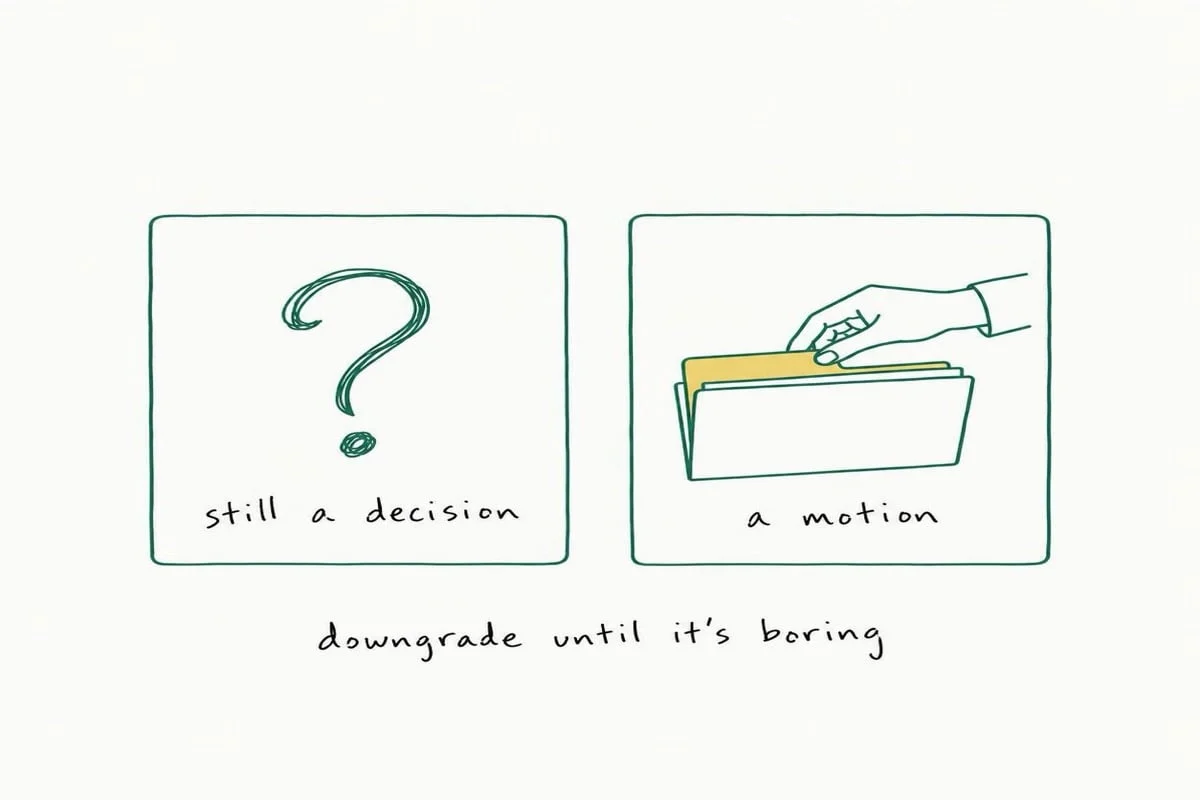
The primary reason we fail to start is that our "to-do" lists are written in the language of questions rather than actions. Items like "Sort out the insurance," "Handle the vendor contract," or "Write the report" are not tasks. They are abstract, high-stakes decisions masquerading as chores.
Every time you look at "Sort out the insurance," your brain must decide: Which company? Do I have my policy number? What if they ask for a document I don’t have?
This is where the Downgrade Method becomes essential. A task is properly downgraded only when a "reasonably competent stranger" could execute it without asking you a single question.

- "Do the taxes" fails the test.
- "Open the folder marked ‘2025’ and move all PDF files to the ‘Pending’ desktop folder" passes.
Boring is not a sign of low standards; it is a sign that the thinking has already been done. If you feel dread, you haven’t downgraded far enough. There is still a decision hiding in the step.
Supporting Data: The Power of Implementation Intentions
The efficacy of this approach is backed by decades of behavioral research. A meta-analysis of 94 independent studies involving over 8,000 participants found that individuals who used "implementation intentions"—if-then plans that specify exactly when, where, and how a task will be performed—saw a significant performance advantage (d = 0.65) over those who merely set goals.
By writing a three-line "card" on a sticky note, you offload the cognitive burden from your working memory to paper. The formula is simple:
- When: (e.g., "When my coffee is finished…")
- Where: (…at my desk…)
- The One Motion: (…I will open the vendor contract and read only section 4.)
- Done when: (…section 4 is read.)
This simple act of externalizing the plan reduces the intrusive thoughts that often accompany unfinished tasks. It clears the "noise" from your mental workspace.
Implications for Workflow Management
When we accept that the freeze is a "load problem," the way we structure our workdays must change.
1. The End of the "Long List"
Writing a list of ten items is an act of self-sabotage. Ten items circling in your head are ten items plus the exhausting effort of holding them. One card—one single motion—is all that is required to break the inertia.
2. Identifying the "Hidden Decision"
Often, a task stays on a list for weeks because of a single, unmade decision. Perhaps you are waiting for a colleague, or you are unsure which template to use. By writing, "What I have not decided is __," you isolate the blocker. Once the blocker is identified, the motion becomes clear: you either send an email to get the missing information or you commit to a 20-minute block on your calendar to make the final choice.
3. The "Productive" Fallacy
We often think the goal of a work session is to be productive. When you are in a state of paralysis, that is the wrong goal. The goal is to stop the day from being "lost." If you complete one motion—even if it is just sending one email—you have successfully navigated the friction.
When the Freeze Becomes Persistent
While an "ordinary" overwhelm freeze often lifts once a task is sufficiently downgraded, there are instances where the paralysis is deeper. According to the National Institute of Mental Health (NIMH), if you experience difficulty concentrating, an inability to make simple decisions, or trouble completing daily tasks for more than two weeks, it is time to consult a health professional.
The clinical literature supports behavioral activation—scheduling concrete activities to improve mood—but it is important to distinguish between situational procrastination and underlying mental health challenges like anxiety or ADHD. If the "freeze" is accompanied by persistent hopelessness or intrusive thoughts, the solution is not a productivity hack; it is professional support.
Conclusion: The First Motion
The next time you find yourself stuck, do not reach for a more complex planning system. Do not try to reorganize your entire life. Instead, take the item that has been on your list the longest, identify the decision that is preventing you from starting, and strip the task down until it is so boring that it feels ridiculous.
Write it on a physical card. Set a timer. Perform the motion. Then stop.
A day does not need to be a masterpiece of output to be a success. It only needs to be a day where you moved something forward. When the world feels like it is closing in, the smallest, most boring action is often the most radical act of control you can take.