By [Your Name/News Agency Name]
For many, the years between 45 and 55 represent a profound turning point. Children are becoming more independent, parents may require increasing care, careers plateau, and the body begins to signal the undeniable passage of time. Amidst this complex interplay of responsibilities and physical changes, a persistent internal question often arises: "Is this it?" It’s a period not of breakdown or a desperate dash for a sports car, but a critical window for re-evaluating and rebuilding life. This phase, often mischaracterized as a "midlife crisis," is more accurately understood as a "midlife transition"—a normal developmental stage ripe for strategic re-architecture, not radical reinvention.
The Misconception: Crisis vs. Transition
The prevailing narrative surrounding midlife often conjures images of dramatic upheaval: sudden affairs, impulsive career changes, and the abandonment of established lives. This "crisis" framing, while potent for storytelling, is fundamentally flawed and, more importantly, it deprives individuals of the unique opportunities this decade offers.
A midlife transition, as defined by developmental psychologists like Daniel Levinson, is a natural phase of adult development. It typically begins around age 40-45 and involves a deliberate reassessment of one’s life choices and whether they still align with personal values and aspirations. It is a period of introspection and re-evaluation, not a collapse of well-being.
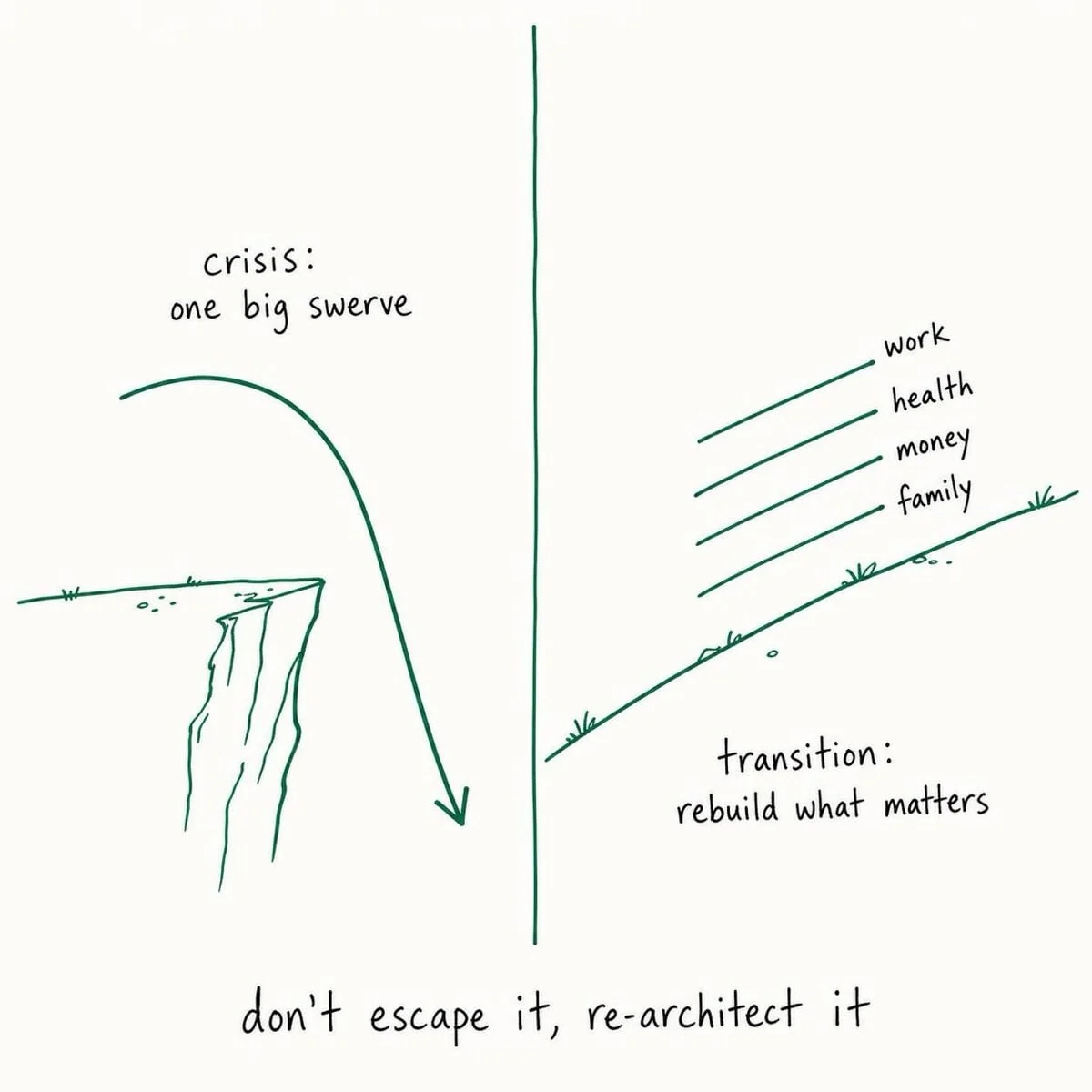
The crucial distinction lies in the approach to change. A midlife crisis attempts to escape one’s current life through a singular, often disruptive, act. In contrast, a midlife transition focuses on rebuilding and refining the existing structure of life, emphasizing the core components that truly matter—work, health, finances, and family.
The data overwhelmingly supports the prevalence of the transition over the crisis. Research indicates that only 10-20% of adults report experiencing a disruptive midlife crisis. Even in these instances, the crisis is often triggered by specific external events, such as job loss, divorce, or a serious health scare, rather than an inherent consequence of aging. Esteemed researcher Margie Lachman, after decades of study, has labeled the widespread "midlife crisis" notion largely a myth, noting that the majority of middle-aged adults report satisfaction, good health, and optimism.
The Structural Squeeze: Why Midlife Feels Heavy
The perceived heaviness of midlife is not a reflection of personal weakness or a character flaw. Instead, it stems from a unique convergence of structural demands. Around the ages of 45 to 55, individuals often find themselves navigating a confluence of significant life roles: careers typically reach their peak, teenage children or college-aged young adults present financial and emotional demands, aging parents require increasing attention and care, and the body’s capacity for recovery begins to diminish.
Researchers refer to this phenomenon as the "structural squeeze of midlife"—a period characterized by an unprecedented concentration of competing role demands. The weight felt is the mathematical result of managing these numerous obligations simultaneously, not a sign that something is fundamentally wrong with the individual.
The crisis narrative, unfortunately, misses this critical structural component. It posits that the heaviness is purely internal—attributing it to restlessness, vanity, or a fear of aging. However, longitudinal studies, such as the MIDUS (Midlife in the United States) research program at the University of Wisconsin, paint a different picture. Midlife is demonstrably defined by a stack of simultaneous obligations that no other life stage typically carries concurrently. This research has also revealed that women in their 40s often report the highest levels of negative work-family spillover precisely when they are managing both school-aged children and eldercare responsibilities.
Therefore, when a meticulously crafted morning routine unravels or a sharp retort is delivered at the dinner table, these are not indicators of a character defect. They are manifestations of "role strain"—the natural consequence of an overloaded life structure.
Furthermore, a subtle yet profound shift in the perception of time significantly influences the midlife experience. As individuals move through middle adulthood, their sense of the future evolves from an open-ended expanse to a more finite horizon. This temporal recalibration quietly reshapes priorities. According to Laura Carstensen’s Socioemotional Selectivity Theory, when individuals perceive time as limited, their focus naturally shifts from acquiring new knowledge to maximizing emotional meaning and nurturing the relationships that are most cherished. This shift is driven by the perceived time horizon, not merely by chronological age. The restlessness experienced during this phase, therefore, is not a malfunction but a signal that one’s priorities are undergoing an essential update—an update that the midlife transition facilitates.
The Reframe: Re-Architecting Your Life
The paradigm shift that can transform the trajectory of the next decade lies in understanding the midlife transition as a "re-architecture window" rather than a "reinvention contest." The goal is not to demolish the existing structure of one’s life and construct something entirely new, but rather to meticulously rework the foundations and load-bearing walls of a life that is, for the most part, already desirable. This process involves focusing on the core domains that define existence: work, health, finances, and family.
"Reinvention" implies a complete overhaul, a burning down of the old to start anew. "Re-architecture," on the other hand, signifies a strategic and deliberate process of repair and enhancement. It is akin to identifying the critical structural elements of a house that need reinforcement rather than tearing down the entire building. One approach is a gamble; the other is engineering.
Developmental research consistently describes this stage as one of structural work. The inherent tasks of the midlife transition involve reassessing commitments, harmonizing the competing demands of youthful aspirations and mature responsibilities, and modifying one’s life structure. The emphasis is on modification, not abandonment. The impulsive "swerve" often associated with a crisis is typically an attempt to generate immediate emotional stimulation, leaving the fundamental structure of life largely untouched.
The trap of the crisis framing is the impulse for an all-encompassing, simultaneous overhaul. Experiencing restlessness can lead to the conviction that everything must change immediately, prompting attempts to fix work, health, finances, and relationships all at once. This is the same fundamental error as the crisis "swerve," merely distributed across multiple fronts. The outcome is often the same: collapse, because it is unrealistic to rebuild four complex systems concurrently when burdened by a decade of competing demands.

Re-architecture, however, operates on a different principle. It involves identifying the single domain experiencing the most significant strain, rebuilding a crucial routine within that domain until it is stable, and then leveraging that success to fund the next adjustment. This approach prioritizes calm discipline over a dramatic, clean slate. It also reframes the concept of "starting over." Individuals in midlife are not beginning from scratch; they are drawing upon 25 years of accumulated experience to make selective and strategic improvements. This reframe is powerful because it shifts the unit of work from "my entire life" to "this specific system, this week."
Architecting Domain by Domain: A Practical Approach
The most effective path through a midlife transition is to systematically rebuild one domain at a time, with routines designed to withstand the most challenging circumstances, not just the ideal ones. The process begins with identifying the area causing the most drag—whether it be work, health, finances, or family. Within that chosen domain, select one foundational routine. Crucially, shrink this routine to a version that can be consistently executed even on the hardest day. Anchor this routine to an existing, established habit. Finally, safeguard the recovery process: allow for a single missed instance, but never two consecutive misses. This methodical approach, characterized by deliberate slowness, is what enables sustained progress amidst the demands of midlife.
The encouraging news is that this life stage is uniquely suited for such rebuilding. Adults between the ages of 45 and 75 have demonstrated the capacity to form daily habits more rapidly than younger adults, and they report higher levels of automaticity once a routine is established. Therefore, the common concern of being "too set in one’s ways" is often a misperception; midlife actually presents a motivational advantage for rebuilding.
Building for the Floor, Not the Ceiling: A crisis-driven overhaul often aims for peak performance during ideal periods. Re-architecture, conversely, plans for the worst-case scenario. Define the minimum viable version of each routine—the action that will still be performed on a difficult Tuesday. Instead of "an hour at the gym," consider "put on workout shoes and walk to the end of the street." This "floor" is what keeps the structure intact when life becomes overwhelming. Habit formation studies involving adults aged 45-75 confirm that interventions are most successful when they emphasize consistency and a stable context over intensity.
Anchoring to a Cue, Not a Mood: The reason many past routines have faltered is their reliance on memory and subjective motivation. By linking a new behavior to an existing, automatic action, the anchor acts as a reliable trigger. For example, "After I pour my morning coffee, I will review one critical financial metric," or "After I park at the office, I will jot down three non-negotiable tasks for the day." This anchoring mechanism alleviates the burden of constant remembrance, providing a practical solution for maintaining consistency in a demanding decade.
Sequencing the Domains, Not Storming Them: The domains of work, health, finances, and family are best addressed sequentially, not simultaneously. Select one domain, and establish a single, stable routine within it for several weeks before introducing changes in another area. Progress is cumulative, and the momentum generated by a successfully integrated routine makes the next adjustment more likely to stick. The crisis narrative often urges a complete overhaul of all four domains within a weekend. The transition, however, rebuilds them in a linear fashion. This principle applies whether the primary challenge lies in career dissatisfaction, health concerns, or financial management.
Protecting the Recovery Loop: The ultimate demise of a rebuilt routine is rarely a single missed day. It is the subsequent week of missed sessions that transforms a temporary lapse into a lost habit. Therefore, a crucial rule must be embedded within each domain: miss once if life circumstances necessitate it, but never twice in a row. A missed Thursday is data; missing Friday as well is a conscious decision. The true measure of discipline in midlife is not the unbroken streak, but the speed of recovery. This forms the core of a self-discipline recovery loop.
A Year in Re-Architecture: The Case of Anika
Consider Anika, a 51-year-old operations director. She juggles the demands of a teenage daughter, a father with early-stage dementia, and a marriage that has evolved into a logistical partnership. The crisis script might have her contemplate drastic actions like quitting her job, relocating, or initiating a significant interpersonal conflict. Instead, Anika embraces the transition as a structural undertaking: one domain, one foundational routine, meticulously designed for her most challenging days, and anchored to an existing habit. The outcome is not dramatic, but steady and incremental improvement.
Anika begins with the area that exerts the most influence on her overall well-being: her own health and energy. Her chosen keystone routine is a ten-minute walk. The anchor is her first cup of coffee, a reliable morning ritual, rather than a clock-based time that could be disrupted by a poor night’s sleep. The "floor" for this routine, even on a day when her father experiences a fall and her work is exceptionally demanding, is simply stepping outside for two minutes. She consciously refrains from addressing finances, work, or marital dynamics at this stage. This restraint is a critical skill; many individuals in transition attempt to overhaul their entire life plan simultaneously and find themselves stalled by February.
In the first week, Anika completes her walk four days out of seven. On Thursday, an emergency with her father necessitates her full attention, and the walk is missed. In the past, this lapse might have led her to abandon the routine for the remainder of the month. However, adhering to her rule, she commits to walking on Friday, recognizing that missing twice in a row would derail the habit. By approximately the ninth week, the walk has become automatic—a behavior performed without internal debate, aligning with research predictions for her age group.
Only then does Anika introduce the next domain: a five-minute Sunday money review, anchored to her morning coffee ritual. Subsequently, she implements a weekly "no-logistics" dinner with her husband. Each new domain is integrated and supported by the stability achieved in the preceding one. A year later, Anika has not transformed into a new person who has magically discovered newfound willpower. Instead, she is the same Anika, now operating a life that is no longer solely dependent on fluctuating willpower. This is the essence of navigating a midlife transition: not a sudden swerve, but a deliberate re-architecture. This methodical approach scales effectively, whether one is 51 or planning for the decade after 60.
Addressing the Possibility of a True Crisis
It is essential to acknowledge that in some instances, the intensity of midlife distress may indeed extend beyond a typical transition. If the feelings of heaviness are persistent, disruptive to sleep and appetite, lead to a pervasive loss of interest, or are accompanied by thoughts of self-harm, this signals a clinical concern rather than a productivity challenge. In such cases, the appropriate course of action is professional intervention, not a self-help system. The misconception is not that midlife distress is unreal, but that it is universal and untreatable.
For the majority, however, the experienced restlessness is an evolutionary update, not a symptom of depression. The most reliable differentiator lies in what proves effective. A genuine transition typically responds positively to structured interventions: focusing on one domain, maintaining a single routine, and observing a gradual lifting of the mental fog and a return of personal agency within weeks. The reframe is not about adopting a "positive thinking" mantra; it is about ceasing attempts to escape one’s life and commencing a deliberate, slow, and incremental re-architecture. If a small, consistently implemented routine begins to provide traction, one is likely within a transition. If, however, weeks pass with no discernible improvement, seeking professional help is the prudent and necessary step. Both scenarios are valid, but only one is solely a matter of willpower.
Laying the First Brick: The Starting Point
The most effective strategy is to resist the urge for a wholesale life overhaul this month. Instead, identify the single domain currently causing the most significant strain: work, health, finances, or family. Within that domain, select one foundational routine. Condense it to a two-minute "floor"—the absolute minimum version that can still be executed on the most challenging day. Anchor this routine to an existing daily habit. Finally, establish the cardinal rule that protects it: miss once if absolutely necessary, but never twice in a row.
This constitutes the complete initiation of a midlife transition approached as re-architecture, not crisis. It eschews the notion of a clean slate, a new identity, or a dramatic swerve. It is the deliberate implementation of one small, resilient routine, engineered to endure one’s most difficult days, within a single domain, this week. Once this initial brick is firmly in place, the same logic can be systematically applied to achieve a comprehensive midlife reset across all domains, one at a time. Individuals possess the experience and the insight into what needs modification. The current work is about rebuilding with strategic sequencing and at a sustainable pace. This is not a period of decline; it is the commencement of the rebuild.