The deadline for goal setting arrives like clockwork every quarter. You open the portal, type in four bullet points that sound sufficiently ambitious, and hit submit. Your manager skims them, checks a box, and you both move on. By the third week of the quarter, those goals have been buried under the avalanche of "ordinary Tuesdays"—the days where a client escalates a crisis, a key team member resigns, and the project you promised in January hits a budget wall that nobody warned you about.
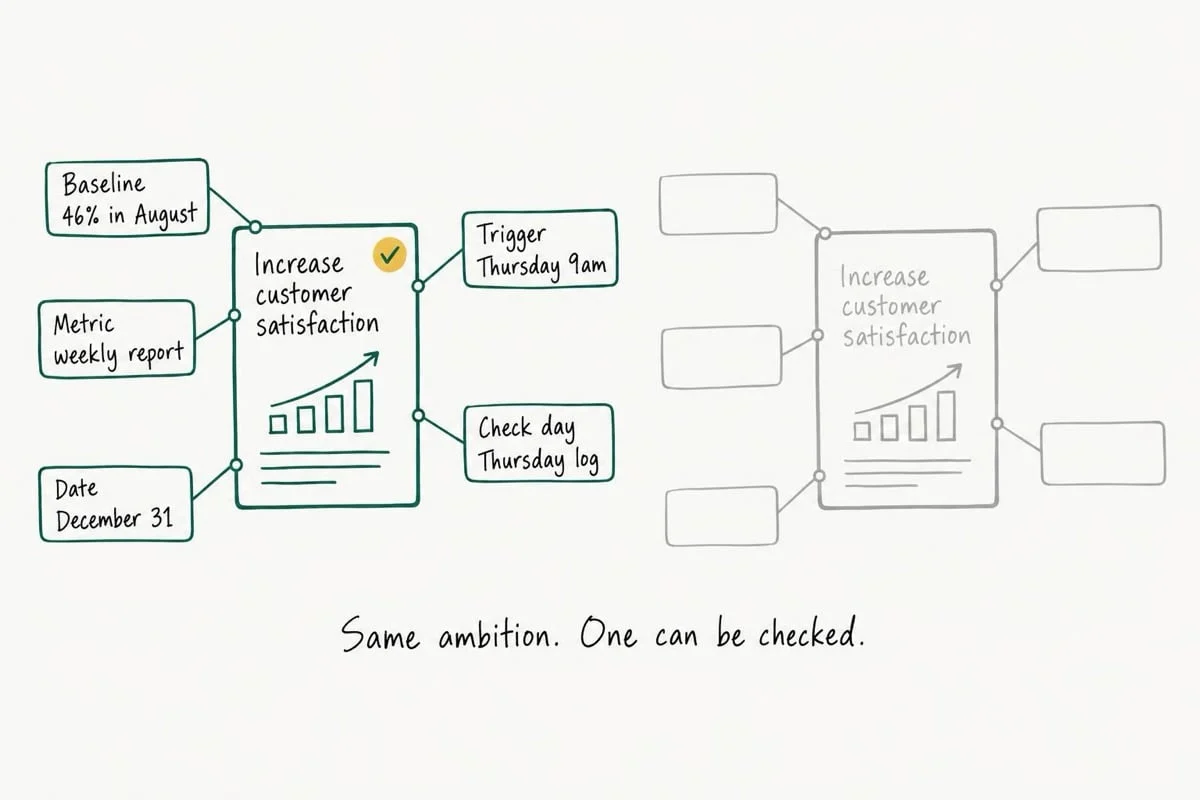
The disconnect between corporate goal-setting and daily reality is not a failure of ambition; it is a failure of architecture. Most "SMART" goals in the workplace are grammatically correct but operationally empty. They lack the structural integrity to survive the volatility of a real work week. If a goal does not include a starting number, a named owner, or a recurring check-in day, it isn’t a commitment—it is merely a wish.
The Anatomy of a Functional SMART Goal
At its core, a SMART goal is not a motivational slogan; it is an objective written with such clinical precision that any colleague could monitor your progress without needing to ask for clarification. It requires a measurable delta from a known baseline, a target that accounts for actual resource constraints, a clear business justification, and a concrete deadline.
The acronym SMART—Specific, Measurable, Assignable, Realistic, and Time-related—was introduced by George Doran in 1981. Originally, the "A" stood for "Assignable," acknowledging that management is about delegation. Over the decades, the acronym has "drifted" in common parlance, often shifting toward "Achievable" and "Relevant." While those adjectives are noble, they have stripped the framework of its primary utility: accountability. In a modern corporate environment where we often set our own goals, we must reclaim the "Assignable." If a goal says, "We will improve onboarding," it is a sentence four people can nod at and zero people will actually own.
Chronology of a Goal: From Planning to Execution
To transform a vague objective into a functional commitment, one must treat the goal as a project with a lifecycle.
The Planning Phase (The Baseline)
Before setting a target, you must establish a baseline. You cannot "improve quality" if you do not know the current error rate. A goal without a starting number cannot be missed—which is exactly why they are ignored. A target that is impossible to miss is, by definition, a sentence rather than a commitment.
The Execution Phase (The Trigger)
Research indicates that "if-then" planning is a superior strategy for goal attainment. By specifying when and where an action will occur, you reduce the cognitive load required to start. Instead of "prioritize outreach," try "Tuesday, 9:00 AM, before checking email, I will complete my outreach block."
The Monitoring Phase (The Check Day)
A meta-analysis of nearly 20,000 participants found that individuals who are prompted to monitor progress toward a goal see significantly higher attainment rates. This is why every effective goal needs a "check day"—a standing appointment on your calendar where you input the current metric.

Ten Examples of Operational SMART Goals
These examples are designed to be copied, adjusted with your own metrics, and paired with a trigger and a check day.
- Individual Performance (Reporting Quality)
- Vague: Improve report quality.
- SMART: Cut client report revisions from an average of four rounds to two or fewer by December 31, as tracked in the shared file.
- Check Day: Friday, 4:00 PM.
- Leadership (Managerial Availability)
- Vague: Be a more available manager.
- SMART: Hold a 30-minute 1:1 with each of my six reports every two weeks from October 1 to December 19, with no more than two sessions missed, verified by calendar logs.
- Check Day: Monday morning.
- Team Delivery (Backlog Management)
- Vague: Get on top of the backlog.
- SMART: Reduce open handoff tickets from 18 to fewer than 8 by November 30, with four engineers closing two each per week. Owner: Me.
- Check Day: Monday standup.
- Customer Service (Response Efficiency)
- Vague: Respond faster.
- SMART: Raise first-reply resolution on tier-one tickets from 46% (August baseline) to 60% by December 31.
- Check Day: Thursday.
- Sales (Pipeline Growth)
- Vague: Build a stronger pipeline.
- SMART: Book eight qualified discovery calls per month in Q4, up from five in Q3, by blocking 90 minutes for outreach every Tuesday and Thursday morning.
- Check Day: Friday (CRM count).
- Professional Development (Data Analysis)
- Vague: Get better at SQL.
- SMART: Complete a four-module SQL course and ship one query that replaces a manual report by February 28, studying 45 minutes on Mon/Wed/Sat.
- Check Day: Saturday.
- Process Improvement (Month-End Close)
- Vague: Make month-end less painful.
- SMART: Cut the month-end close from nine working days to six by the March close, automating one of the three slowest reconciliations each month.
- Check Day: First Monday after the close.
- Evidence Tracking (Self-Evaluation)
- Vague: Keep better track of accomplishments.
- SMART: Write two sentences of evidence against each goal every Friday, ensuring the April self-evaluation is based on 26 dated entries rather than memory.
- Check Day: Friday, 4:30 PM.
- Executive Visibility
- Vague: Communicate more with leadership.
- SMART: Send a five-bullet Friday note (shipped, blocked, decisions needed) every week through Q4, missing no more than two.
- Check Day: Friday (The note is the check).
- Workload Management
- Vague: Fix my calendar.
- SMART: Reduce recurring meetings from 22 hours/week to under 15 by December 1 by delegating or declining meetings where I hold no decision-making power.
- Check Day: Monday.
Supporting Data: The Science of Goal Monitoring
The effectiveness of these frameworks is supported by several longitudinal studies. Research by Locke and Latham (2002) confirms that specific, difficult goals consistently outperform "do your best" objectives. However, the caveat is "task complexity." When work is highly complex, the goal itself is less important than the feedback loops established to navigate that complexity.
Furthermore, a study in the field of behavioral psychology suggests that simply tracking a goal is a form of intervention. When individuals report their progress publicly or in a fixed, recorded format, the likelihood of goal attainment increases significantly. The "check day" acts as a recurring prompt that prevents the "goal drift" that usually sets in by the end of the first month.
Managing the "Blow Up": When Plans Fail
What happens when the quarter goes sideways? When a team member leaves or a market shift makes your target obsolete, most employees fall into one of two traps: they either abandon the goal entirely or heroically defend it until they burn out.
A better approach is to define a "floor version" of every goal before the quarter begins. If your support resolution goal is 60%, your floor might be "maintain 46% and do not let it slide." By naming the floor, you remove the need for stressful self-negotiation during a crisis. If the quarter breaks, you drop to the floor, keep the check-in alive, and wait for a window to pivot. The goal is to keep the metric in your field of vision; if you stop opening the report in October, you will be rewriting from scratch in February.
Implications for the Modern Workplace
We must differentiate between the "Review Version" and the "Running Version" of our goals. The review version—the one on your company form—is for the manager who has ninety seconds to scan your performance. It should be clean, assignable, and tied to existing business metrics. The running version is for you. It lives in your calendar, includes your trigger, your check day, and your weekly log.
Collapsing these two into a single, sterile document is why "goal season" feels like corporate theater. By keeping the running version separate and actionable, you fulfill the administrative requirement while retaining the ability to actually move the needle on your performance.
Ultimately, the SMART acronym is not a scientific theory; it is a formatting checklist. The behavior change you seek does not come from the letters; it comes from the baseline, the trigger, and the weekly habit of checking your progress. If you spend ten minutes this week auditing your goals for a starting number and a check day, you will be ahead of 90% of your peers. The rest is just noise.