You arrive at your desk with fourteen items on your agenda. Eleven are marked as "High Priority." Two of these demands arrived via a frantic email from your manager this morning, three were born from a customer escalation, and the remaining one is that elusive strategy memo you have dutifully pushed from one Monday to the next for a month.
Every single one of these items is defensible. That is precisely the problem.
In the modern workplace, priority levels are intended to function as a triage system. Instead, they have devolved into a hollow nomenclature. Teams append P1, P2, and P3 fields to their project management software, yet within weeks, every request that holds any weight with any stakeholder appears pre-stamped as a P1. The labels are aesthetically tidy, but the outcome remains unchanged: you find yourself at 7:00 PM on a Thursday, staring at a screen, agonizing over which professional promise you are forced to break.
The current crisis of productivity is not a lack of effort; it is a failure of mechanism. A priority level only functions when it extracts a tangible cost—a time slot, a day, or a place in the queue. A label that costs nothing to assign will be spent with reckless abandon. When everything is a "Priority 1," you are not managing a workload; you are simply maintaining a list with extra steps.
The Anatomy of True Priority: Fact-Based Management
Priority levels are, by definition, a fixed set of markers designed to rank tasks based on the potential damage their delay causes and the velocity required for resolution. In the realm of IT Service Management (ITSM), this process is governed by a rigorous matrix: impact—the objective scale of business loss—is balanced against urgency—the expected speed of restoration. The highest intersection of these two variables dictates the P1 (Critical) status.
This heritage is essential for personal productivity. Incident response teams define their top-tier priorities with agonizing specificity. A major network vendor, for instance, defines a "Priority 1" incident as a total business outage affecting critical applications across multiple sites. Notably, this definition ignores who made the request, how loudly they pleaded, or how recently the ticket arrived in the queue.
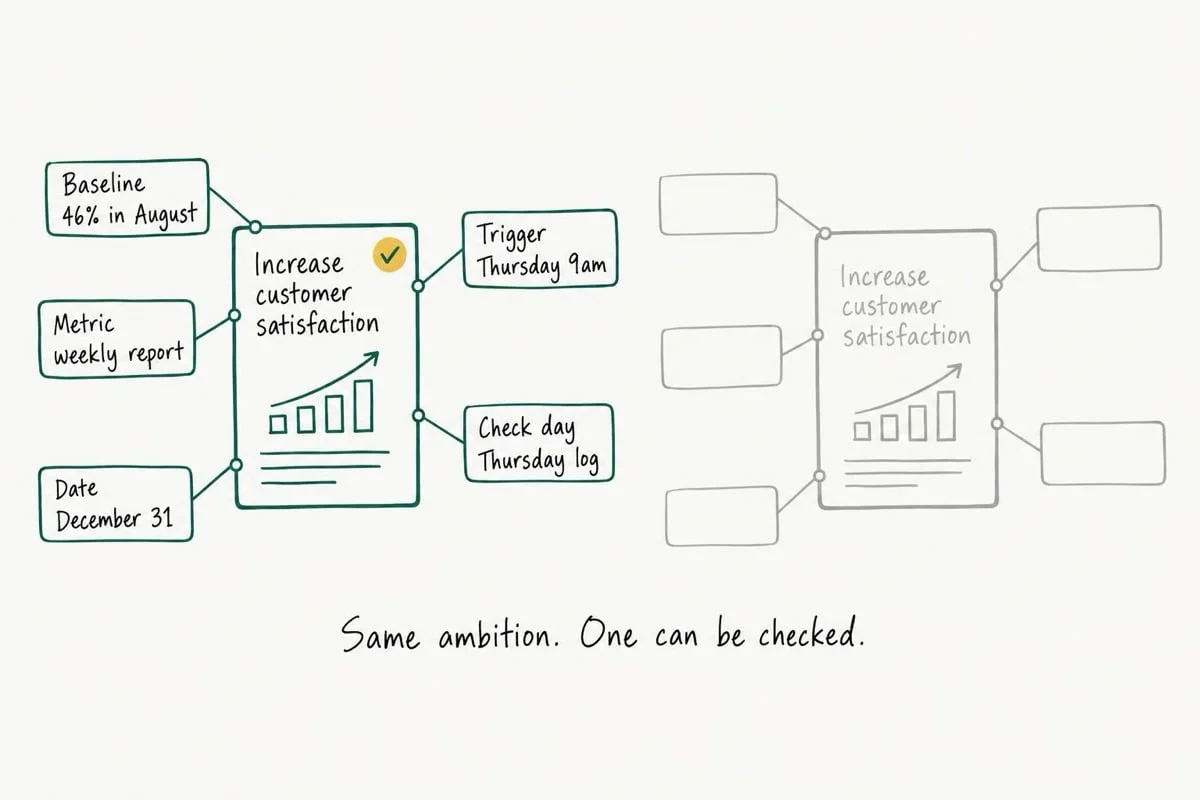
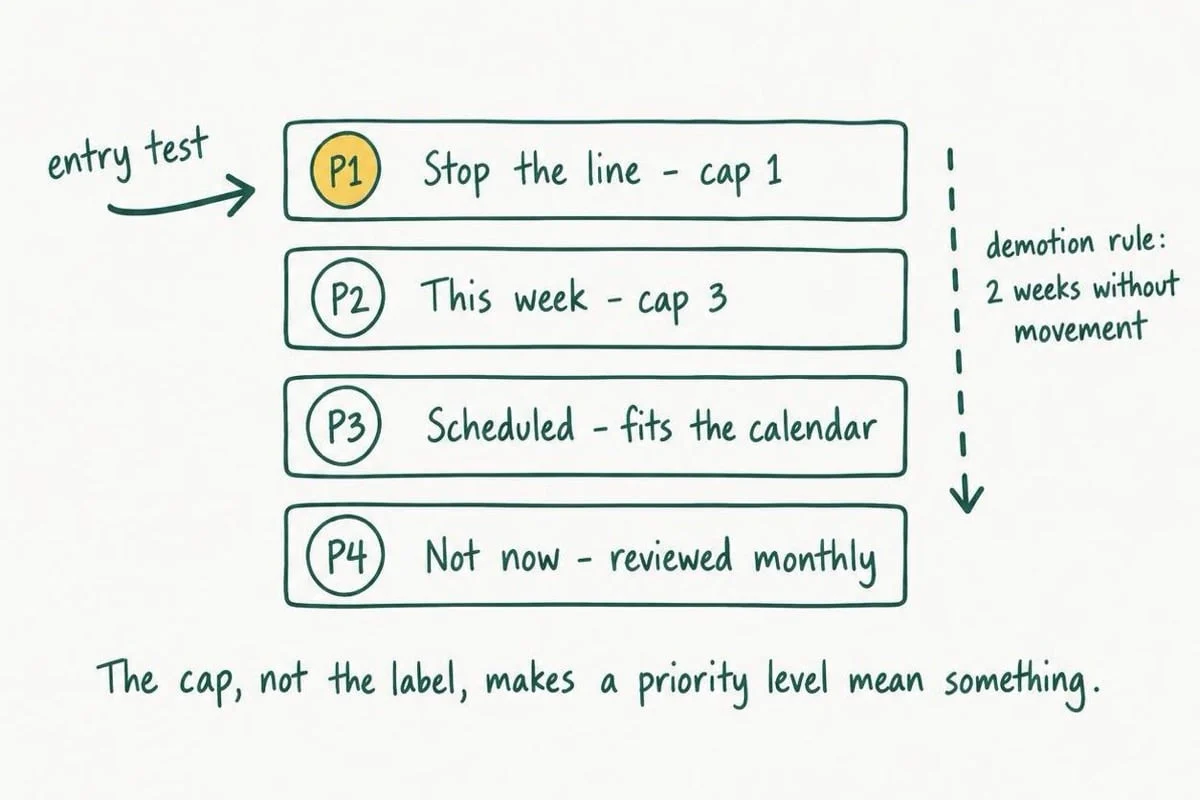
Most individual workers fail because they lack this objective "entry test." Without a predefined, immutable standard, the labels become subjective. Whether a system utilizes three, four, or five levels is irrelevant; the effectiveness of the system rests entirely on the written test required to enter each tier. If the entry test isn’t written down, the system isn’t a strategy—it’s an opinion.
The Erosion of Meaning: Why Labels Inflate
Priority labels suffer from a predictable, structural degradation. Because assigning a label is "free," it inevitably inflates until it loses its signaling value. By the third week of a project, a "P1" designation no longer denotes criticality; it denotes the most recent request or the one from the most senior person in the room.
This is compounded by the "mere urgency effect." Behavioral research across multiple experiments has demonstrated that individuals consistently favor lower-payoff tasks when those tasks are framed with an urgent or expiring cue. We are biologically predisposed to treat the "urgent" as synonymous with the "important," a cognitive bias that President Dwight D. Eisenhower famously addressed in 1954: "I have two kinds of problems, the urgent and the important. The urgent are not important, and the important are never urgent."
While the Eisenhower Matrix provides a helpful framework for categorization, it remains incomplete. It sorts tasks into four quadrants, but it does not solve the underlying scarcity of time. If you have eleven "important" tasks and only one Tuesday, the grid does not help you choose. Furthermore, the act of constant re-sorting induces "decision fatigue." Laboratory studies on task switching indicate that the cognitive tax of constantly re-evaluating priorities is significant, often leading to the mid-afternoon burnout where lists remain untouched because the brain has simply run out of decision-making fuel.

A Four-Level Architecture for Choice
To reclaim control, one must shift from an "assignment" mindset to a "capacity" mindset. The following structure, designed by LifeHack, integrates the incident-management logic of impact and urgency while introducing the two missing components of personal productivity: a hard cap on capacity and a transparent cost for entry.
The Priority Ladder
| Level | Definition | Entry Test | Cap | The Cost of Entry |
|---|---|---|---|---|
| P1: Stop the Line | Prevents immediate damage | External block or dated failure | 1 | Everything else slides by one day |
| P2: Weekly Promise | Dated commitments to a person | Due date within this week | 3 Open | No new P2 enters until one closes |
| P3: Scheduled | Future-dated work | Calendar block/defensible date | Unlimited | Reviewed weekly; move up or move out |
| P4: Not Now | Everything else | Does it beat a P2 slot? | None | Reviewed monthly; deleted at 90 days |
The inclusion of a "Cap" column is the most critical innovation here, rooted in Little’s Law. In systems engineering, Little’s Law posits that the number of items in a system is equal to the arrival rate multiplied by the time spent in the system. Practically, this means that holding more items "open" simultaneously stretches the duration of each individual task. By capping your "P2" items at three, you ensure that your focus is concentrated, thereby reducing the total time spent in the system.
Case Study: The "Ordinary Tuesday" Protocol
To understand how this operates in practice, consider a professional, "Curt," who manages operations for a mid-sized logistics firm.
Chronology of a Tuesday:
- 9:12 AM: A warehouse integration failure occurs. This is an objective P1—customers are currently blocked. Curt marks it P1.
- 11:40 AM: The CFO requests a pricing analysis. Curt does not treat this as a personal rejection or a lack of productivity. He applies the system: "I can start this at 2:00 PM if the integration is closed, or I can take it now and the integration waits. Which do you prioritize?"
By framing the request as a capacity choice rather than a "Yes/No" plea, Curt moves the conversation from the subjective to the objective. He is not saying "I am too busy"; he is saying "Here are the consequences of your choice." This is a powerful, professional, and entirely neutral negotiation.
Implications for Organizational Culture
When an organization encourages or mandates a label-heavy culture where everything is urgent, it creates a toxic environment of constant fire-fighting. Implementing a hard-cap system forces senior leadership to confront the reality of resourcing. If a CEO demands that a new project be added to the P1 list, the employee is empowered to respond: "I am happy to make this our P1, but the current P1 project will be delayed by 48 hours. Please confirm if that is the desired outcome."
Most senior leaders, when presented with the actual trade-off, will provide a clear, rational answer. Those who refuse to acknowledge the trade-off are providing a critical data point about the organizational culture—namely, that the priority is not the work itself, but the illusion of infinite capacity.
Implementing the Change
To move from a bloated to-do list to a high-functioning system, follow these three steps:
- Define Your Test: On a quiet Sunday, write down the specific, objective criteria for what constitutes a "P1" in your world. If you cannot check a box to prove it is a P1, it is not a P1.
- Enforce the Cap: The cap is the promise. If you hold more than three items as "High Priority," you have effectively labeled nothing as high priority. When the cap is reached, the next item must wait or be traded.
- Audit the System: After two weeks, count the number of P1 declarations. If you are consistently hitting more than two per week, your "Entry Test" is too loose. Tighten the definition until the label carries the weight of a serious business decision.
Ultimately, your priority list should be a reflection of your strategic goals, not a ledger of your exhaustion. By establishing clear, defensible boundaries, you transition from being a passive recipient of tasks to an active architect of your time. When the system is rigid, the person becomes flexible; when the system is loose, the person becomes trapped. Choose the structure that allows you to finish your day with the work that actually matters.