The calendar on your wall says it is nearly time. The goal-setting form is due Friday, and like clockwork, you are preparing to perform the familiar ritual: typing out four or five bullet points that sound vaguely responsible, hitting “submit,” and watching as your manager gives them a cursory glance before the quarter buries them under the weight of daily operations.
By week three, these goals are effectively dead. They aren’t failing because of a lack of ambition or a lack of talent. They are failing because they were never built to survive the reality of an ordinary Tuesday. They crumble when a customer escalates a crisis, when a key team member resigns, or when that project you promised in January suddenly requires a budget that no one approved.
Most SMART goals for work fail in the exact same way: they are grammatically correct, yet operationally empty. They lack a starting number, a named owner, or a recurring check-in. They are not commitments; they are aspirations disguised as corporate policy.
The Evolution of a Management Concept
The acronym SMART (Specific, Measurable, Assignable, Realistic, and Time-related) was introduced by George Doran in the November 1981 issue of Management Review. Originally, it was a tactical tool for managers to assign objectives to subordinates.
Over the past four decades, however, the acronym has drifted. In most modern corporate HR forms, "Assignable" has been quietly replaced by "Achievable," and "Realistic" has often morphed into "Relevant." This shift represents a fundamental change in how we view goal-setting. While Doran’s original framework was about command and control, the modern version is a form of self-management. Yet, in our attempt to make goals more personal, we have stripped them of their accountability.
When a goal is written as "We will improve onboarding," it is a sentence that four people can nod at, but no one actually owns. To reclaim the efficacy of the SMART framework, we must move beyond the letters and return to the mechanics of execution.
Anatomy of a Functional Work Goal
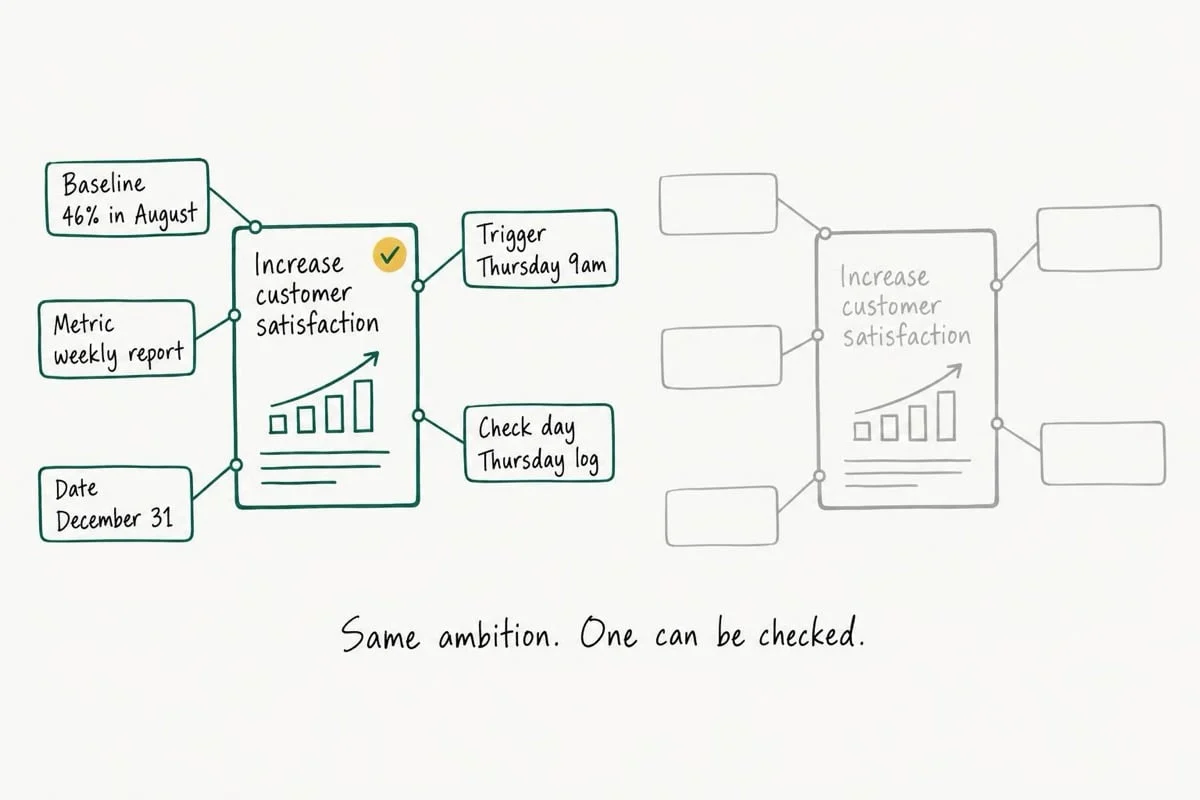
A truly effective work goal is an objective written with such precision that a colleague could track your progress without ever needing to ask for clarification. It requires four non-negotiable elements:
- A Baseline: A starting number you can point to.
- A Verifiable Metric: Data that someone else can check.
- A Concrete Date: A target date that isn’t just the end of the quarter.
- A Standing Check-in: A specific day and time when you review the progress.
10 Examples of Actionable Work Goals
Below are ten examples that transform vague corporate speak into operational commitments.
- Individual Contributor (Report Quality): Cut the client report from an average of four revision rounds in Q3 to two or fewer by December 31, as tracked in the shared file. Check: Friday, 4pm.
- Managing People: Hold a 30-minute one-on-one with each of my six reports every two weeks from October 1 to December 19, missing no more than two sessions. Check: Monday morning.
- Team Delivery: Reduce open handoff tickets from 18 to 8 by November 30, with each of the four engineers closing two per week. Check: Monday standup.
- Customer Service: Raise first-reply resolution on tier-one tickets from 46 percent in August to 60 percent by December 31. Check: Thursday.
- Sales: Book eight qualified discovery calls a month through Q4 (up from five in Q3) by holding 90 minutes for outreach on Tuesday and Thursday mornings. Check: Friday.
- Professional Development: Complete the four-module SQL course and ship one query that replaces a manual report by February 28, studying 45 minutes on Monday, Wednesday, and Saturday. Check: Saturday.
- Process Improvement: Cut the month-end close from nine working days to six by the March close, automating one of the three slowest reconciliations each month. Check: First Monday after close.
- Review Evidence: Write two sentences of evidence against each goal every Friday, so the April self-evaluation draws on 26 dated entries rather than memory. Check: Friday, 4:30pm.
- Visibility: Send a five-bullet Friday note covering shipped, blocked, and decisions-needed, every week through Q4. Check: The note is the check.
- Workload: Reduce recurring meetings from 22 hours a week in September to under 15 by December 1, by delegating every meeting where I hold no decision-making power. Check: Monday.
The Five Pillars of Goal Execution
Why do these examples succeed where others fail? The answer lies in the "trigger" and the "check day."
Research into goal attainment—notably the work of Locke and Latham—suggests that specific and difficult goals consistently outperform "do your best" objectives. However, complexity remains a hurdle. A 2006 meta-analysis published in the British Journal of Health Psychology found that individuals who formed "if-then" plans (triggers) were significantly more likely to reach their targets.
The Trigger (The "When and Where")
Most people fail to reach goals because they forget to start. By creating a trigger—"When it is Tuesday at 9:00 am, I will open the CRM to book calls"—you remove the cognitive load of decision-making. You are no longer deciding if you will do the work; you are simply executing a pre-programmed action.

The Check Day (The Feedback Loop)
A meta-analysis of 138 studies involving nearly 20,000 participants confirmed that monitoring progress is the strongest predictor of success. A goal that is only reviewed when you happen to remember it is a goal destined to be reviewed only when it is going well. By establishing a fixed "Check Day," you ensure that the goal remains visible, even during the weeks when the results are poor.
Implications: The Two-Version Strategy
To thrive in a modern corporate environment, you must master the art of the "Double Document."
The Review Version: This is the version that lives on your HR form. It is concise, professional, and written for a manager who will likely spend less than two minutes reviewing it. It focuses on the "what" and the "when."
The Running Version: This is your personal dashboard. It contains the granular details, the triggers, the check-in logs, and the raw data. It is not for your manager; it is for you. Keeping these separate prevents your goal-setting process from feeling like theater. You satisfy the corporate requirement while maintaining the operational rigor necessary to actually move the needle.
When the Quarter Blows Up
Even the best-laid plans are subject to entropy. When a crisis occurs, a goal typically dies one of three ways: it is abandoned, it is heroically (and destructively) defended, or it is quietly renegotiated when it is already too late.
The solution is to define a "Floor Version" of your goal before the quarter begins. If you are aiming for 60% resolution but a team member resigns, your "floor" might be to simply maintain the current 46% and keep the reporting rhythm active.
By defining the floor, you avoid the shame-spiral that leads to total abandonment. When the quarter breaks, you don’t stop the process; you simply shift to the floor. You keep the check-in alive. A metric you are still looking at in November is one you can repair; a metric you stopped looking at in October is one you have already lost.
Conclusion: Stop Counting, Start Operating
Before you finalize your goals this Friday, perform a simple audit. Count how many of your goals have a starting baseline and how many have a standing check-in. If the answer to either is zero, you are not setting goals; you are writing a wish list.
The difference between a high performer and everyone else is rarely intelligence or raw talent. It is the ability to turn a vague ambition into a series of actionable, trackable events. The "SMART" acronym may have been born as a management theory in 1981, but it survives today as a survival skill for the modern worker.
Fix your baseline. Set your trigger. Name your check-in. Stop viewing your goals as a performance to be judged at the end of the quarter, and start viewing them as the operating system that runs your daily work. When you stop writing for the form and start writing for the work, the results will follow.