The scene is familiar to millions: you have just finished a grueling workday, but your mental transition to "home mode" is nonexistent. You are answering a teacher’s message regarding your teenager, scheduling a pharmacy pickup for your aging father, and navigating a complex insurance claim—all from the driver’s seat of your car in a grocery store parking lot. It is 9:40 p.m., and somewhere, a well-meaning voice suggests you "make time for self-care."
While the advice is not inherently wrong, it is profoundly inadequate for the scale of the burden. Caregiving often expands like a gas, filling every available crevice of your life—work, sleep, finances, marriage, and your own physical health. Eventually, no single task feels impossible, but the entire week does. You may still be checking every box, paying every bill, and attending every appointment, but you are also snapping at those you love, forgetting vital details, or feeling a hollow numbness when another request arrives.
This pattern is not a failure of character or a lack of love; it is a clinical and practical reality known as caregiver burnout.
What Is Caregiver Burnout?
Caregiver burnout is defined as a state of cumulative physical, emotional, and mental depletion linked to sustained caregiving demands, compounded by a lack of support, control, or recovery. It manifests through exhaustion, detachment, irritability, dread, and a reduced capacity to manage the basic functions of daily life.
It is crucial to note that "caregiver burnout" is not a standalone medical diagnosis in the DSM-5 or ICD-11. As a 2023 review in The BMJ highlighted, after decades of academic study, no universally accepted clinical diagnosis for burnout exists. However, this does not mean the distress is imaginary. Instead, it signifies that a label should never replace a thorough professional evaluation when symptoms persist, worsen, or interfere with personal safety and daily functioning. Similar symptoms—such as fatigue, irritability, or low mood—can also be indicative of clinical depression, sleep disorders, medication side effects, or other physiological health issues that require medical intervention.
The Scale of the Hidden Workforce
The scale of this issue is immense. According to 2025 estimates from AARP and the National Alliance for Caregiving, approximately 63 million U.S. adults—nearly one in four—provide ongoing care for an adult or child with a medical condition or disability. This staggering statistic does not represent a "burnout rate," but rather the sheer volume of households carrying work that remains largely invisible to the public eye and the economy.
Distinguishing Between Stress, Burnout, and Compassion Fatigue
To address the problem, one must first name it correctly. While the terms are often used interchangeably, they represent distinct phenomena:
- Caregiver Stress: The immediate, acute strain of caregiving demands. It is the friction of the day-to-day.
- Caregiver Burnout: The result of long-term, cumulative depletion where demands consistently exceed available resources and recovery time.
- Compassion Fatigue/Secondary Traumatic Stress: A state focused on the emotional impact of repeated exposure to another person’s suffering.
Research on physicians has shown that these conditions often overlap, yet they remain conceptually distinct. For the family caregiver, the distinction is a tool for direction rather than diagnosis. If you are experiencing suicidal thoughts, persistent low mood, or an inability to function, these are signals that require immediate medical attention—not just a vacation or a spa day.
The Problem is Capacity, Not Commitment
Society frequently treats caregiver burnout as a "coping failure." The prevailing narrative suggests that if you just meditated more, exercised, or maintained a "positive mindset," you would be fine. When capacity is the bottleneck, however, these suggestions become merely another task on an already overflowing to-do list.

This pressure is particularly acute for the "sandwich generation"—those balancing the care of aging parents while simultaneously raising children and managing career trajectories. A national study on sandwich-generation caregivers identified significant financial strain resulting from the compounding costs of elder care, child-rearing, and the "opportunity cost" of lost career advancement. This confirms that burnout is not a private attitude problem; it is a structural failure of support systems.
Care Load Triage: A Strategic Framework
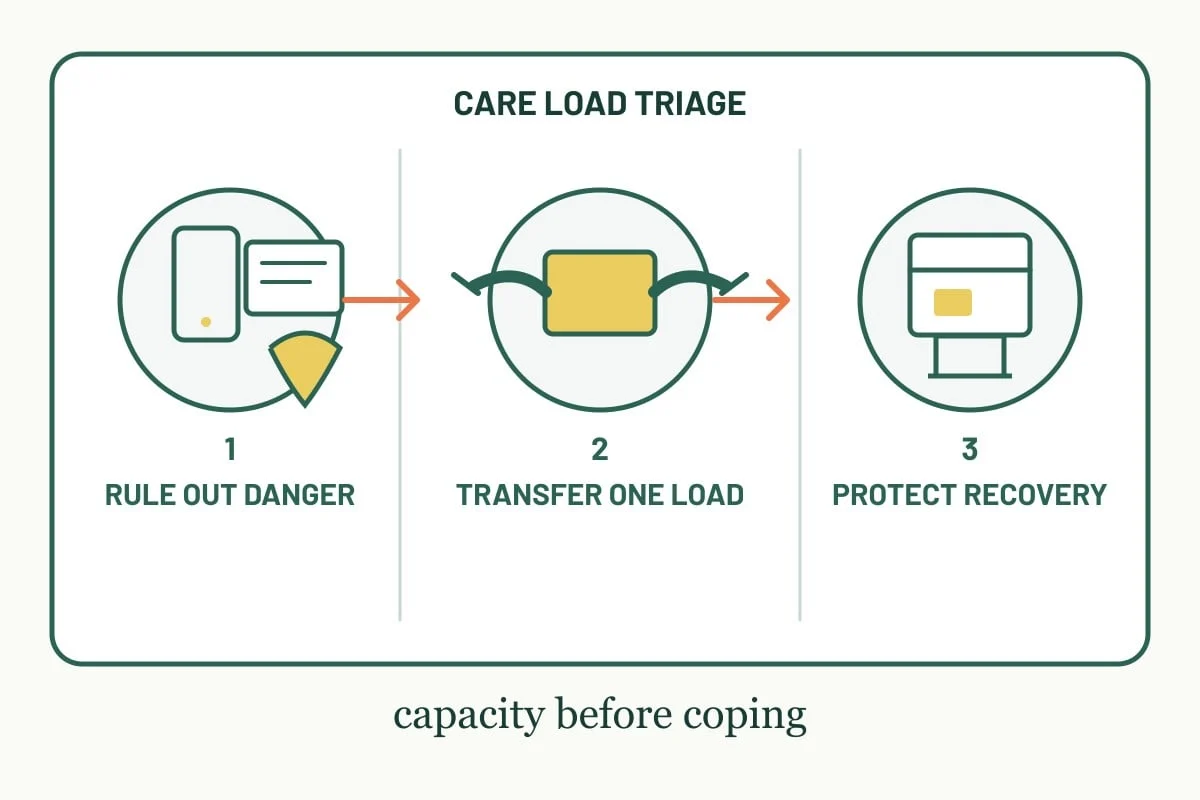
When you are overwhelmed, you do not need more advice; you need an editorial tool to cut through the noise. "Care Load Triage" is a three-part process designed to stop the bleeding and prioritize survival over perfection.
1. Rule Out Danger and Health Concerns
Safety is the priority. Can you and the person in your care navigate the next 24 hours? Are medications, nutrition, mobility, and supervision accounted for? If exhaustion is causing you to make dangerous mistakes—such as medication errors or unsafe driving—it is time to bypass the "self-care" phase and seek professional assistance immediately. If you are in crisis, reach out to local emergency services or the 988 Suicide & Crisis Lifeline in the U.S.
2. Transfer One Load-Bearing Task
The phrase "let me know if you need anything" is often well-intentioned but functionally useless. To move toward stability, you must convert the vague offer of help into an "owned" task.
- Example: Instead of asking for help, ask a family member: "Can you own the Thursday transport to the clinic for the next month, including the wheelchair transfer and note-taking?"
- The Goal: You are not looking for general support; you are looking for a transfer of ownership of a specific, high-stress responsibility.
3. Protect One Recovery Block
A recovery block is not "whatever time is left over." It is a scheduled, protected duration where you are off-duty. Whether it is 20 minutes behind a locked door or a two-hour walk, it must have an owner, a start time, an end time, and—crucially—coverage. If you are the only one who can handle a crisis, you have no recovery block. Creating this space is not a luxury; it is the floor upon which your long-term stability is built.
Implications for the Future
The current reliance on unpaid family caregivers is a systemic issue that will likely intensify as the population ages. For the individual, the path forward requires a blunt reframe: Stop asking how to tolerate the load more gracefully. Start asking which parts of the load can be made safer, smaller, or shared.
A "life audit" can identify where caregiving is eroding your financial, physical, and professional foundations. If you find yourself in a position where no one else will help, do not assume this is a sign that you must become "limitless." Instead, treat it as a logistical problem. Document the gaps, contact local aging and disability resource centers (such as the Eldercare Locator in the U.S.), and reach out to social workers or patient advocates who can help you navigate the system.
Conclusion: Redefining Strength
Caregiver burnout is a symptom of a system that relies on the "invisible" labor of families without providing the necessary infrastructure for sustainability. If you find yourself searching for the signs of burnout, it is a signal that your current operating model is no longer viable.
You do not need to prove your love or your devotion by making your own capacity invisible. True strength, in the context of long-term caregiving, is not about how much you can endure—it is about how effectively you can manage the load so that you can continue to care for your loved one without sacrificing your own humanity in the process. Start today by choosing one task to transfer, one recovery block to protect, and one conversation to have with a professional. Your capacity is not infinite, and acknowledging that is the first step toward genuine recovery.