
Main Facts
The American freight and logistics sector stands at a historic and perilous crossroads. A confluence of crippling fuel costs, compounding regional supply shocks, and the looming transition toward automation has pushed independent owner-operators and union drivers to the brink. Across the nation, whispers of coordinated nationwide protests and rolling shutdowns are giving way to serious mobilization efforts. While unionized labor accounts for roughly 10 percent of the American trucking workforce, the grievances fueling this potential unrest are universal, uniting independent contractors and corporate drivers alike.
At the center of this turbulence is an unprecedented escalation in diesel fuel prices. National averages have climbed past $6.29 per gallon—representing a roughly 60 percent year-over-year increase—with localized markets, most notably in California, surpassing the $8 to $10 thresholds. For independent operators whose rigs can cost upwards of $1,200 to fill, these price hikes represent an existential threat. This fuel inflation functions as a regressive tax, rippling through the entire supply chain to inflate the cost of groceries, clothing, and manufactured goods.
Compounding the pricing crisis is a wave of structural refinery closures and infrastructure failures that threaten severe regional fuel shortages. Major facilities in California and the Midwest have gone offline due to regulatory pressures, shifting market dynamics, and catastrophic equipment failures. Simultaneously, the horizon presents a permanent structural threat: the rapid advancement and deployment of autonomous long-haul trucking. Together, these three crises—soaring fuel prices, regional scarcity, and technological displacement—threaten to dismantle the traditional framework of American freight transportation.
Chronology of the Crisis
The unfolding pressure on the trucking industry is the culmination of regulatory shifts, geopolitical disruptions, and corporate investments that have accelerated dramatically over the past two years:
- October 17, 2025: The Phillips 66 refinery in Wilmington, California, officially ceases operations, removing approximately 139,000 barrels per day of refined product from the West Coast market.
- January 31, 2026: Valero announces a staggering $1.1 billion loss to shutter its Benicia refinery, further contracting California’s domestic refining capacity amid stringent environmental mandates like Assembly Bill X2-1.
- Early 2026: National diesel prices surge by nearly $3.00 per gallon compared to previous baselines, pushing pump prices past $6.29 nationwide and sparking the first wave of widespread trucker anxiety.
- September 11, 2026: Saudi Arabia temporarily shuts down its critical East-West Pipeline following regional drone attacks, subsequently canceling crude shipments to European buyers and tightening global petroleum markets.
- Mid-September 2026: Persistent drone strikes target Russian oil infrastructure, compounding international supply constraints as Russia maintains its total ban on diesel exports.
- Sunday, October 2026 (Recent Weeks): A major electrical grid failure knocks out ExxonMobil’s Joliet refinery in Channahon, Illinois, triggering emergency flaring and wiping roughly 11 million gallons per day of gasoline and diesel off the Midwest market.
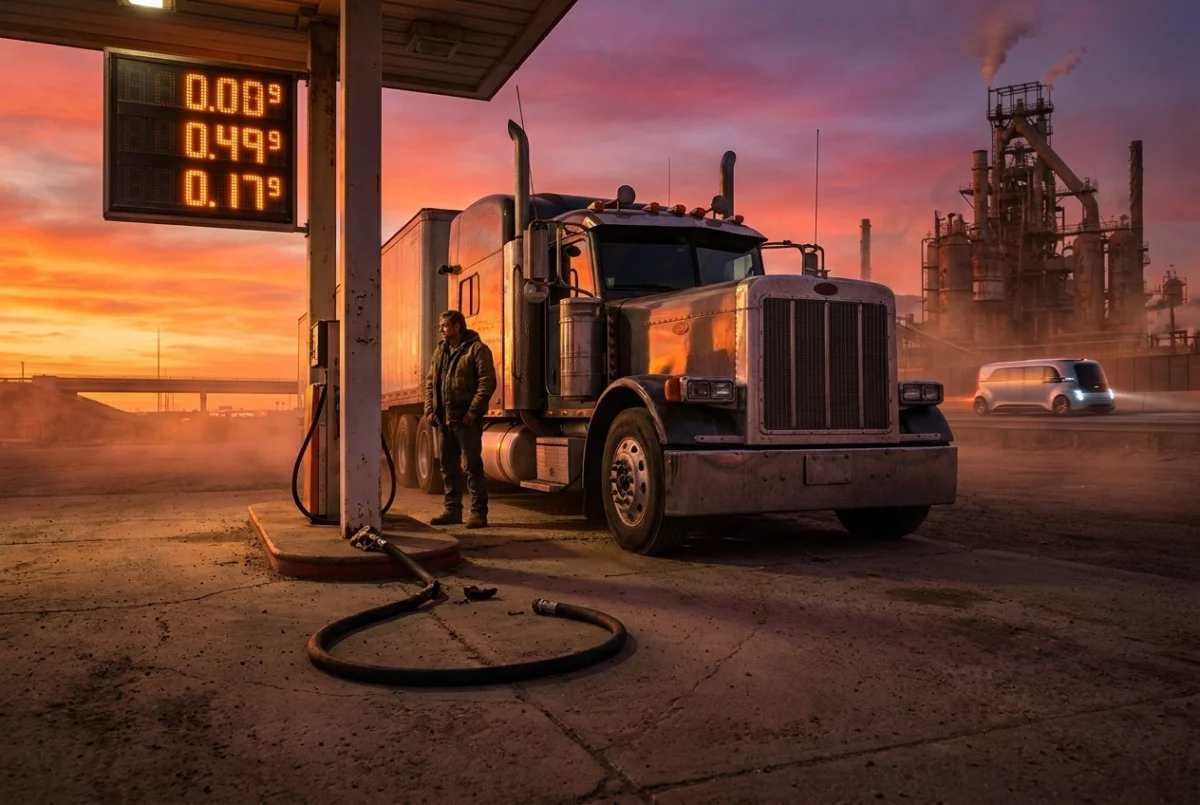
- Current Outlook (Late 2026–2027): Industry stakeholders report that fuel station pumps in high-cost regions are maxing out mechanical pricing displays at $9.99 per gallon, signaling acute localized shortages and setting the stage for potential industry-wide job actions.
Supporting Data and Economic Indicators
The quantitative markers of the current trucking crisis underscore the systemic vulnerability of America’s supply chain:
- Fuel Consumption: The heavy-duty commercial truck fleet in the United States consumes upwards of 2.9 million barrels of diesel fuel per day to support an estimated 7 billion ton-miles of daily freight movement.
- Price Escalation: The national average for diesel has escalated from approximately $3.55 per gallon a year prior to over $6.29 per gallon, with spikes reaching historic highs above $8.00 in San Francisco and threatening the $10.00 ceiling.
- Refinery Capacity Losses: The closure of the Phillips 66 Wilmington facility eliminated 139,000 barrels per day of regional output, while the Channahon, Illinois grid failure stripped 11 million gallons per day of refined product from the Midwest supply.
- Workforce Demographics: Approximately 90 percent of the American trucking workforce operates outside of traditional union structures, comprising a highly decentralized network of independent owner-operators and small business fleets.
Official Responses and Industry Stakeholder Perspectives
The reaction to the unfolding energy and labor crunch highlights a profound divide between corporate boardrooms, regulatory bodies, and frontline transportation workers.
Energy sector executives have increasingly acknowledged the fragility of global supply chains. Even leadership within major international firms like Shell has publicly warned that refined product shortages are becoming an acute structural risk, driven by years of deferred maintenance and underinvestment in traditional refining infrastructure. Industry analysts note that running legacy facilities without adequate capital expenditure increases the frequency of unplanned outages, leaving regional markets exposed to single points of failure, such as the recent electrical grid collapse in Illinois.
Conversely, state and federal regulators defend environmental and safety mandates—such as California’s stringent minimum fuel storage and low-carbon fuel standards—as necessary steps toward a green energy transition. However, critics within the logistics sector argue these policies ignore basic economic realities, asserting that legislative overreach directly accelerated the closure of vital domestic refineries.
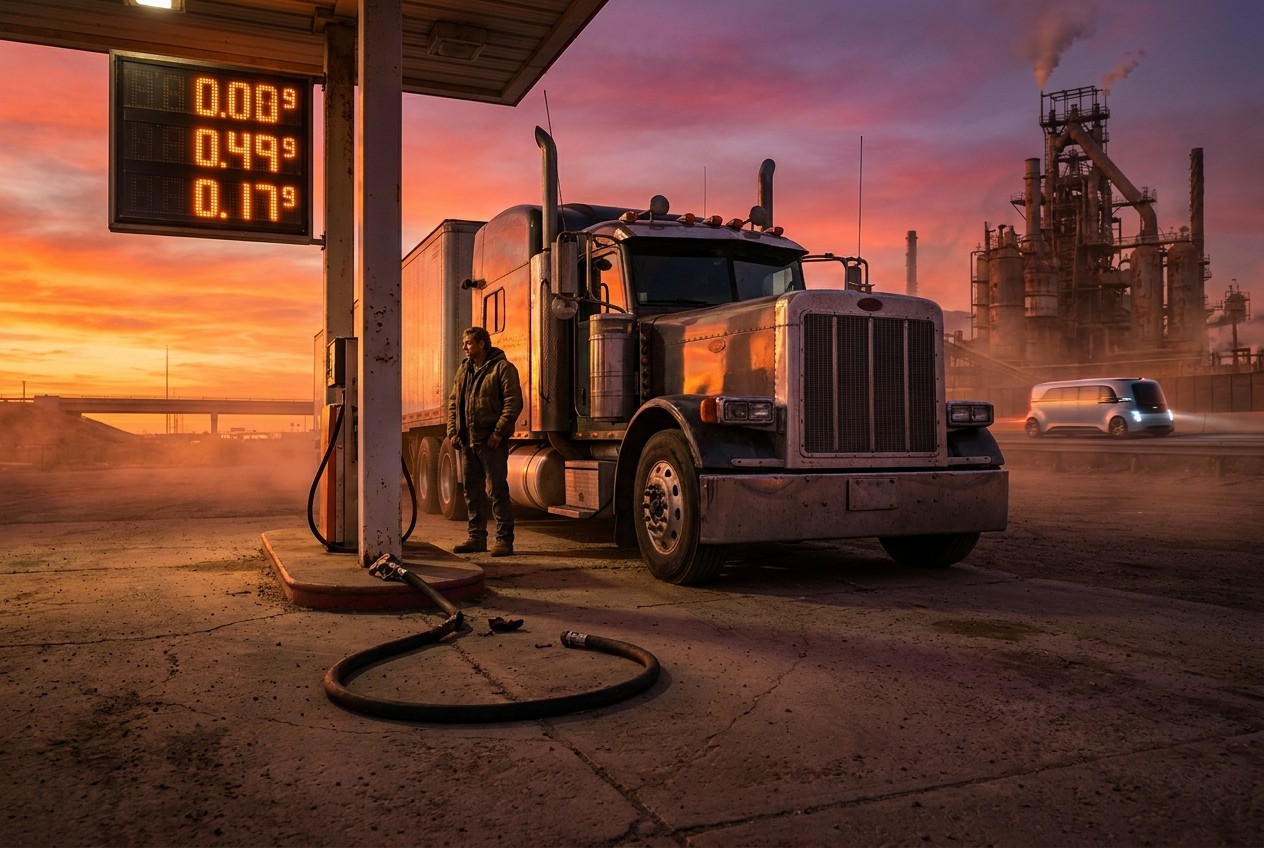
Among drivers, official channels of communication have broken down. Because the vast majority of owner-operators function as independent micro-businesses, they lack collective bargaining representation, leaving grassroots coordination—such as discussions regarding coordinated work stoppages and parking protests—as their primary vehicle for registering discontent against surging operational costs.
Implications for Consumers and the Supply Chain
The convergence of diesel inflation, regional scarcity, and technological disruption carries profound implications for the broader American economy:
1. Persistent Inflation
Because freight movement underpins every tier of commerce, elevated diesel costs act as a hidden consumption tax. Transporting goods from agricultural hubs and ports to distribution centers and retail shelves requires massive volumes of fuel. As logistics companies pass these expenses downstream, consumers face sticky, persistent inflation across staple categories, including groceries, building materials, clothing, and home heating oil.
2. Regional Supply Vulnerabilities
The loss of key refining nodes—such as the shutdowns in California and the Midwest—demonstrates that national energy averages mask severe regional volatility. When a major refinery experiences an unexpected outage, surrounding states face immediate localized scarcity. This dynamic creates rolling shortages where fuel stations run dry, forcing commercial fleets to idle and threatening fresh food and medical supply chains.
3. Structural Consolidation and Automation
Perhaps the most transformative implication involves the accelerated shift toward autonomous and electric commercial fleets. While human-driven independent operators are squeezed out by high diesel prices and capital constraints, well-capitalized technology firms are scaling autonomous trucking pilots. Unlike human drivers subject to hours-of-service regulations and fuel price volatility, autonomous, grid-dependent fleets offer corporations 24/7 operational continuity.
This technological leap threatens to eliminate the independent owner-operator as a viable economic class, centralizing American freight control into the hands of a few mega-corporations. Such centralization risks reducing logistical redundancy, potentially leaving rural and less profitable municipal routes underserved.
Ultimately, the triple crisis facing trucking is forcing a fundamental reevaluation of modern supply chain resilience. As traditional centralized systems strain under regulatory, geopolitical, and economic pressures, policymakers, businesses, and consumers alike must confront the reality of an evolving transportation landscape.