The phenomenon is universal, yet deeply isolating: you sit before your laptop at 9:15 a.m., acutely aware of the day’s requirements. By 9:50 a.m., the screen remains unchanged. You have opened a spreadsheet, closed it, navigated through a handful of redundant emails, and scanned the news—all while accomplishing nothing. The work itself is not technically difficult; you could easily explain its requirements to a colleague. Yet, you remain physically and mentally frozen.
This state, often colloquially referred to as "task paralysis" or an "overwhelm freeze," is frequently misdiagnosed as a failure of discipline or a lack of motivation. However, a growing body of research suggests the problem is not a character flaw, but a structural one. It is a "definition problem"—an overload of the cognitive architecture that governs decision-making.
The Cognitive Anatomy of the Freeze
To understand why we freeze, we must look at the limits of human cognition. Nelson Cowan’s seminal work on working memory suggests that the human brain can only actively hold about three to five "chunks" of information at once. When we are faced with a to-do list that contains dozens of open loops, we are not merely dealing with a long list; we are dealing with a cognitive load that far exceeds our processing capacity.
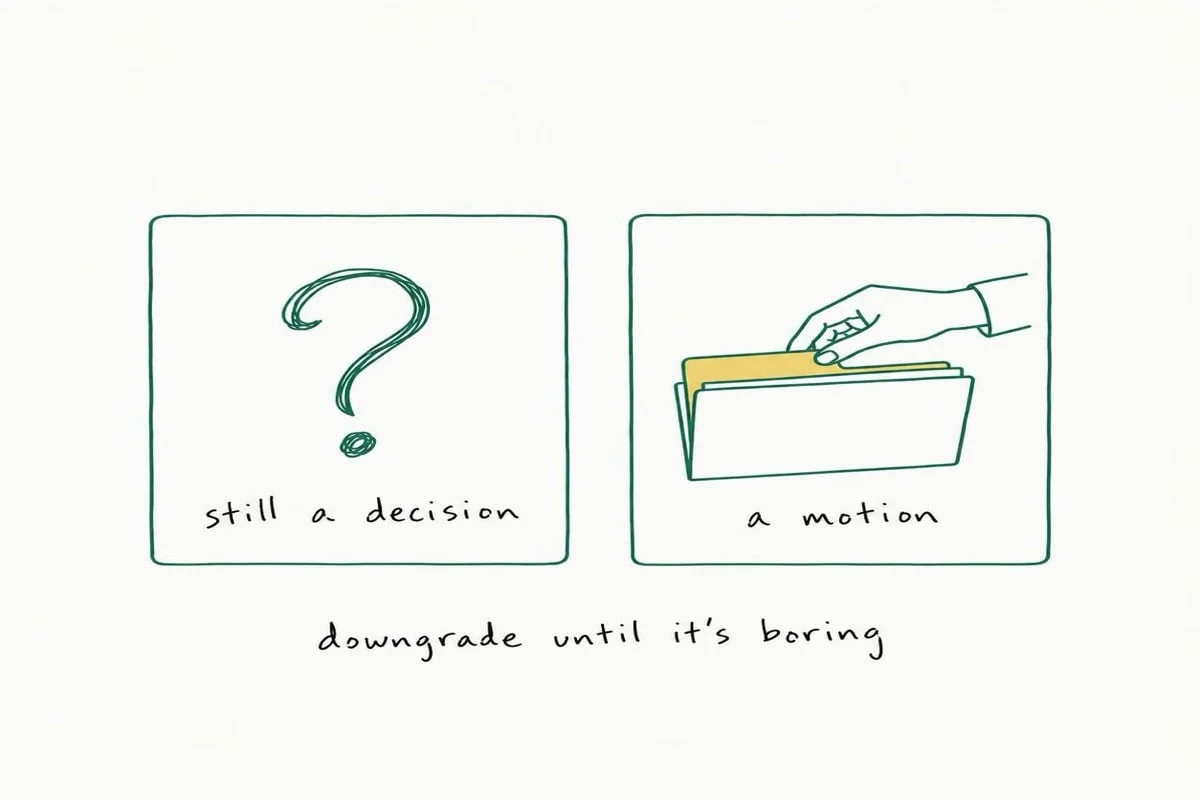
The "freeze" occurs when the brain looks at a task and cannot identify a clear, singular first move. We often write tasks like "Prepare Quarterly Report" or "Handle Vendor Contract" on our lists. These are not tasks; they are questions wearing the costume of tasks. To "prepare a report," one must first decide which template to use, which data sets are relevant, and how to structure the opening paragraph. Because every single item requires a prior decision, the brain—already burdened by decision fatigue—simply chooses the path of least resistance: doing nothing.
The Failure of Traditional Productivity Hacks
Many professionals attempt to solve this through conventional productivity systems: time-blocking, sophisticated task-management applications, or "5 a.m. club" routines. These interventions often fail because they assume the bottleneck is when you work. In reality, the bottleneck is the ambiguity of the work. If you block out two hours for a task that remains a vague, unresolved question, you will spend those two hours staring at the screen, feeling the weight of your perceived lack of discipline, while the task remains untouched.
The Strategy of Extreme Downgrading
If the problem is an overabundance of unresolved decisions, the solution is not more planning, but "extreme downgrading." The goal is to strip a task of its complexity until it becomes inherently boring.
A task is properly downgraded when a total stranger could execute the next step without asking you a single clarifying question. For example, "Finish the tax filing" is a catastrophic, high-level task. "Open the 2024 folder and drag the PDF labeled ‘Expense_Report’ into the ‘Tax_Upload’ folder" is a boring, executable motion. By focusing on the "boring" rather than the "important," you bypass the brain’s tendency to stall when faced with complex choices.
The Four-Step Implementation Protocol
To break the cycle of paralysis, practitioners suggest a four-move, low-maintenance framework:
- Externalize the Load: Empty your brain by writing every pending item onto a single sheet of paper.
- Identify the Hiding Decision: For the item causing the most dread, ask yourself: "What have I not decided yet?"
- Define the Motion: Write three lines on a sticky note: when it starts, the exact physical motion, and when it stops.
- Execute and Halt: Perform only that motion, then stop. Do not attempt to leverage that momentum into a two-hour work block. The goal is to prove to your brain that the task is manageable, not to trick yourself into an all-day marathon.
Supporting Data: Why "If-Then" Planning Works
The effectiveness of this method is backed by behavioral psychology. Research on "implementation intentions"—often called "if-then" plans—shows that they significantly increase the likelihood of goal attainment. A meta-analysis of 94 independent studies involving over 8,000 participants found that individuals who created specific, actionable plans were significantly more likely to complete their tasks than those who merely set a general goal.

When you write, "When I finish my coffee, I will open the vendor contract to page four," you are offloading the mental energy required to initiate the task. A 2011 study published in Current Directions in Psychological Science found that making these specific plans actually reduces the intrusive, circular thoughts associated with unfinished work. By setting a "stopping point," you lower the psychological barrier to starting, as the brain no longer views the task as an open-ended, potentially endless commitment.
Official Guidance and Clinical Perspectives
While "task paralysis" is a popular term, it is not a clinical diagnosis. However, the symptoms associated with it—such as difficulty concentrating, an inability to make simple decisions, and severe procrastination—are often addressed in therapeutic contexts.
The National Institute of Mental Health (NIMH) suggests that if an individual experiences these symptoms persistently for two weeks or longer, it may be an indication of an underlying issue, such as anxiety, depression, or undiagnosed ADHD. In these cases, behavioral activation—a therapeutic technique that involves scheduling small, concrete activities to counteract the lethargy of depression—has shown significant success in clinical trials. A 2023 meta-analysis of behavioral activation found a strong, positive effect in treating these symptoms, suggesting that the clinical community and the productivity community are, in fact, aligned: action, when broken down into microscopic units, is a potent antidote to stagnation.
Implications for the Modern Workplace
The implications for professional life are profound. Managers and team leads often push for "productivity," but they rarely provide the environment that makes it possible. When a team is overwhelmed, they are not failing because they lack "hustle"; they are failing because they are drowning in ambiguity.
Moving Toward "Action-Oriented" Communication
Organizations that adopt an "action-first" culture tend to see higher output. Instead of assigning a project, a leader should assist in defining the first "boring" step. If an employee is stalled, the manager’s role is not to demand more hours, but to help identify the "hiding decision." Is the employee stalled because they don’t know how to do the work, or because they haven’t decided which vendor to contact?
The Cost of Avoidance
Avoidance is a classic coping mechanism. In the short term, it provides relief from the anxiety of a difficult decision. In the long term, it compounds the cost. By the time evening arrives, the guilt of a wasted day adds "emotional interest" to the original task, making it feel significantly more daunting the following morning. Breaking this loop requires a shift in perspective: the objective is not to be productive, but to stop the day from being "lost."
Conclusion: The Power of One Small Motion
The next time you find yourself staring at your screen, trapped in the cycle of "I get so overwhelmed that I do nothing," remember that you are not broken. You are simply over-taxed.
Do not try to fix your week. Do not download a new app. Simply take a physical piece of paper and write down the one thing you have been avoiding. Identify the tiny, boring, non-decisional motion that starts the process—like opening a file or sending a single question. Commit to that one action, and nothing more. Once the motion is made, the wall of the "impossible task" begins to crumble. The goal is not to finish everything; it is to prove to yourself that the work is no longer a source of paralysis, but a series of manageable, boring errands.