You have likely seen them before: a small, precarious stack of Moleskines or spiral-bound pads collecting dust on a shelf. The fourth—the one currently open on your desk—is a chaotic sprawl of grocery lists, half-formed business strategies, and scribbled phone numbers from meetings that took place weeks ago. Somewhere in that mess is the precise figure your client quoted on a Tuesday in March, or the name of a reliable plumber recommended by a neighbor.
You know the information is there. But you cannot find it.
For most of us, the physical notebook has become a "write-only" device—an excellent tool for the immediate capture of ideas, yet utterly useless when it comes time to retrieve them. We often attempt to fix this by purchasing more expensive stationery or starting a fresh book, hoping for a clean slate. These are merely aesthetic changes that fail to address the core issue: the lack of a structural retrieval system.
The Structural Failure of Modern Note-Taking
To understand why our current systems fail, we must look at the structural disconnect between how we write and how we need to access information. Notebooks are, by design, chronological. We write in the order events occur. However, our brains rarely search for information chronologically; we search by topic, relevance, or project.
When a notebook relies solely on a linear timeline, the only search mechanism available is the manual flip. Once a notebook crosses the fifty-page threshold, "flipping" ceases to be an effective retrieval method and becomes a form of tedious archaeology.
Most popular productivity hacks fail because they ask us to perform "sorting" during the capture phase—the worst possible time. Whether it’s using color-coded pens, maintaining multiple notebooks for different projects, or using tabs, these methods require cognitive load at the exact moment you should be listening or thinking. If a system requires you to make a decision while someone is speaking, you will eventually abandon it. True organization must be frictionless at the moment of capture, with the structural heavy lifting occurring after the fact.
The Philosophy of Japanese Notebook Systems
When researchers and enthusiasts discuss "Japanese notebook systems," they are often referring to two distinct worlds: commercial products and, more abstractly, a methodology of maintenance.
On the product side, companies like Hobonichi and MIDORI have mastered the "fixed-format" philosophy. The Hobonichi Techo, for instance, is a world-renowned planner built around a strict daily-page format. Similarly, the MIDORI TRAVELER’S notebook utilizes a sophisticated leather cover system where the internal paper refills can be swapped out while the cover remains a permanent, tactile fixture. These products share a core belief that Western planners often avoid: the format is fixed, and the user commits to it.
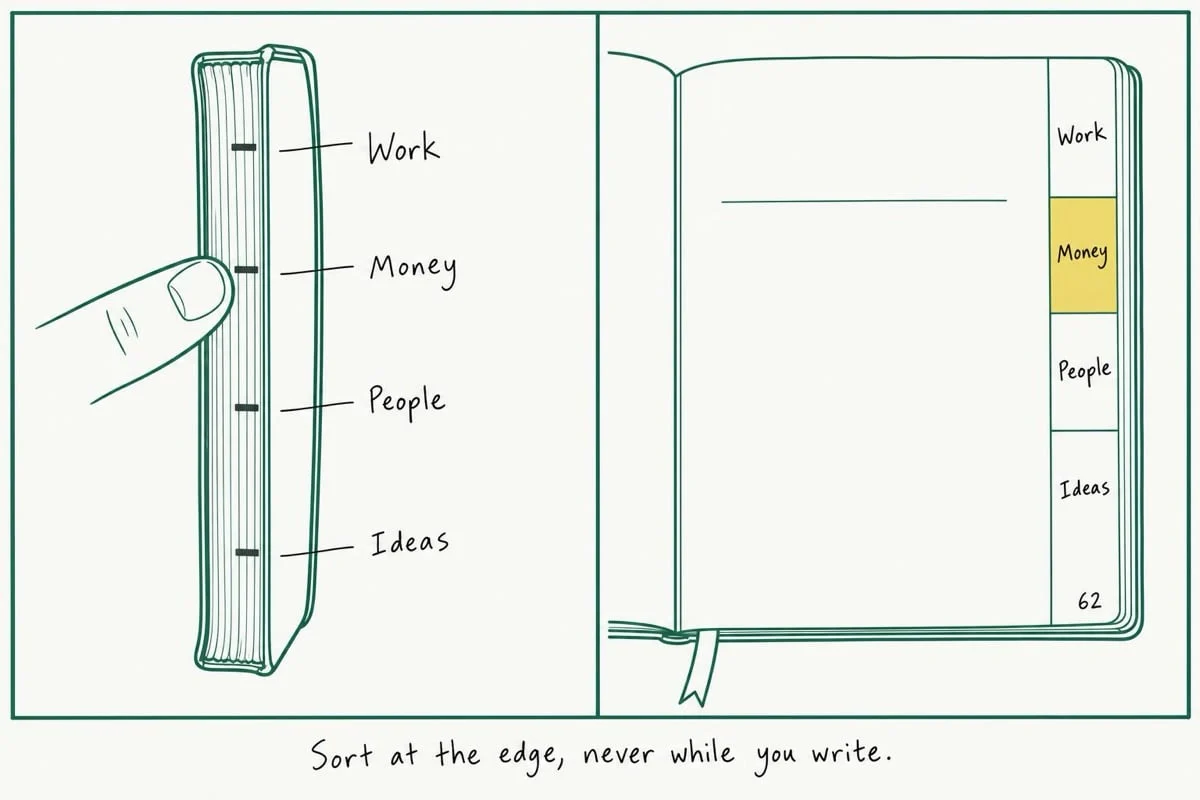
However, the "system" itself—the secret to never losing a note again—is not found in the binding or the paper quality. It is a page-edge indexing technique that, while often attributed to folklore, is a highly effective, low-cost workflow. This system treats the notebook as a single, unstoppable chronological stream while moving all the "sorting" to the page edges and the back pages.
Implementing the System: A Twenty-Minute Build
The following system requires no expensive software or complex training. It is designed to be low-maintenance enough to survive a busy work week.
1. Page Numbering (The Foundational Step)
Begin by numbering every page of your current notebook in the bottom outer corner. It is a mundane task that takes roughly twenty minutes, but it is the prerequisite for any functional index. If you do not have page numbers, you cannot index.
2. Define Your Four Categories
Select four—and only four—categories that encompass your life. Examples might include: Work, Personal Finance, People/Networking, and Creative Ideas. Limiting your categories to four is crucial; if you have more, you will begin to hesitate during the capture phase. If a fifth category feels necessary, that subject likely warrants its own dedicated notebook.
3. The Edge Column
On every page, designate a narrow vertical strip (roughly half an inch wide) along the outer margin. Divide this strip into four equal horizontal bands corresponding to your four categories. When a page is dedicated to a specific topic, simply fill in the corresponding band with a highlighter or marker, running the ink right off the edge of the paper. When the book is closed, you will see a colored stripe along the edge. To find your "Work" notes, you no longer flip through every page; you simply scan the edge for the "Work" stripe.

4. The Back-Page Index
Reserve the final two pages of your notebook for a formal index. For every page of notes, write one line: the date, a brief summary (three to six words), and the page number. This takes roughly four seconds at the end of each session.
5. The Friday Maintenance Ritual
The final piece of the puzzle is a five-minute weekly review. Open your index, ensure all pages are logged, and circle any outstanding tasks. If a task remains incomplete, copy it onto a fresh, current page. This keeps your notebook "live" rather than letting it become a graveyard of old to-do lists.
Chronology of a Productive Week
Consider "Dana," a project manager. On Monday, she takes notes for a client meeting. She records action items in small square boxes. She fills the "Work" band on the edge of the page and logs the meeting in the back-page index.
On Wednesday, she captures a creative spark for a side project while on the train, marking it in the "Ideas" band. On Thursday, a plumber calls with a quote; she scribbles it on the next available page and marks the "Money" band.
Three weeks later, when the plumber disputes the bill, Dana does not need to search through hundreds of pages. She simply looks at the edge of her notebook, spots the "Money" stripe, and flips directly to the relevant entry. The system succeeds because the notebook remained chronological—the only way to maintain a record while living a chaotic life—while the edge-indexing provided the structure for rapid retrieval.
Supporting Data: Why Paper Outperforms Digital for Capture
The debate between paper and digital is often framed as a binary choice, but the most productive individuals use them for different stages of the cognitive process.
Digital tools (like Notion, Obsidian, or Evernote) possess an undeniable advantage in full-text search and long-term storage. However, they suffer from "capture friction." The act of unlocking a device, navigating to an app, and potentially being distracted by notifications can kill a thought before it is fully formed.
Paper, conversely, has zero latency. It is the superior tool for thinking and capturing. The optimal workflow is a hybrid: use paper to think, iterate, and capture. Move that information to a digital database only when the information meets a specific threshold—such as when it requires collaboration with a team, has a firm deadline, or needs to be referenced repeatedly over years.
Official Responses and Expert Consensus
While "The Japanese Notebook System" is not a singular, copyrighted methodology, it aligns with the consensus of modern cognitive productivity experts. Organizations such as the LifeHack collective emphasize that the failure of most note-taking systems is not a "discipline failure" by the user, but a design failure of the system itself.
By separating the act of capture from the act of organization, you remove the barrier to entry. The goal is to make the system so simple that it feels like an extension of the writing process rather than a chore. Expert observers note that even the most high-tech professionals often return to paper for the "thinking phase" of work, provided they have a retrieval mechanism that prevents the information from becoming lost in the stack.
Implications for Your Workflow
The implications of adopting this system are significant. First, it restores trust in your own note-taking. When you know you can reliably retrieve a piece of information, you spend less mental energy trying to "keep everything in your head."
Second, it eliminates the "archive anxiety" that leads people to hoard half-empty notebooks. By photographing your index pages when a notebook is finished and archiving those files, you create a searchable digital map of your analog life.
Ultimately, the gear you use—the brand of notebook, the type of pen—is irrelevant. The constraint is not the quality of your paper, but the consistency of your index. Start today. Number your pages, define your four categories, and log your next ten pages. If, in a month, you find yourself successfully retrieving information that would have otherwise been lost, you have successfully built a "second brain" that is as robust as it is simple. The era of the "write-only" notebook is over; the era of structured retrieval has begun.