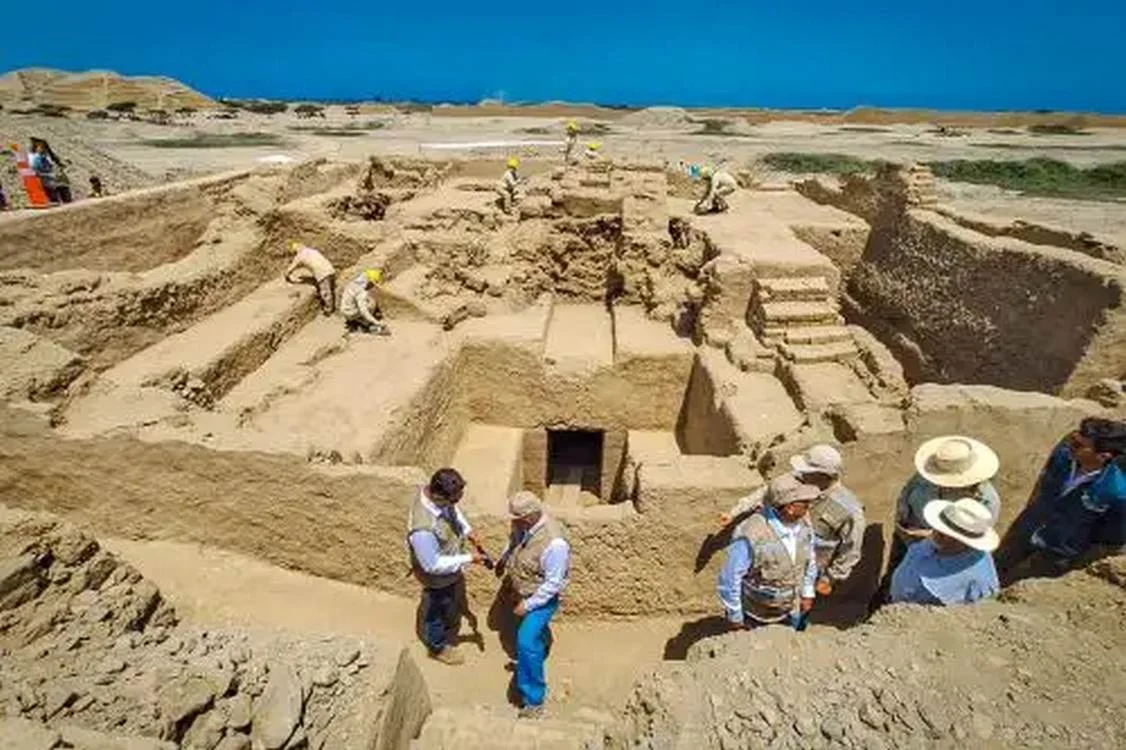
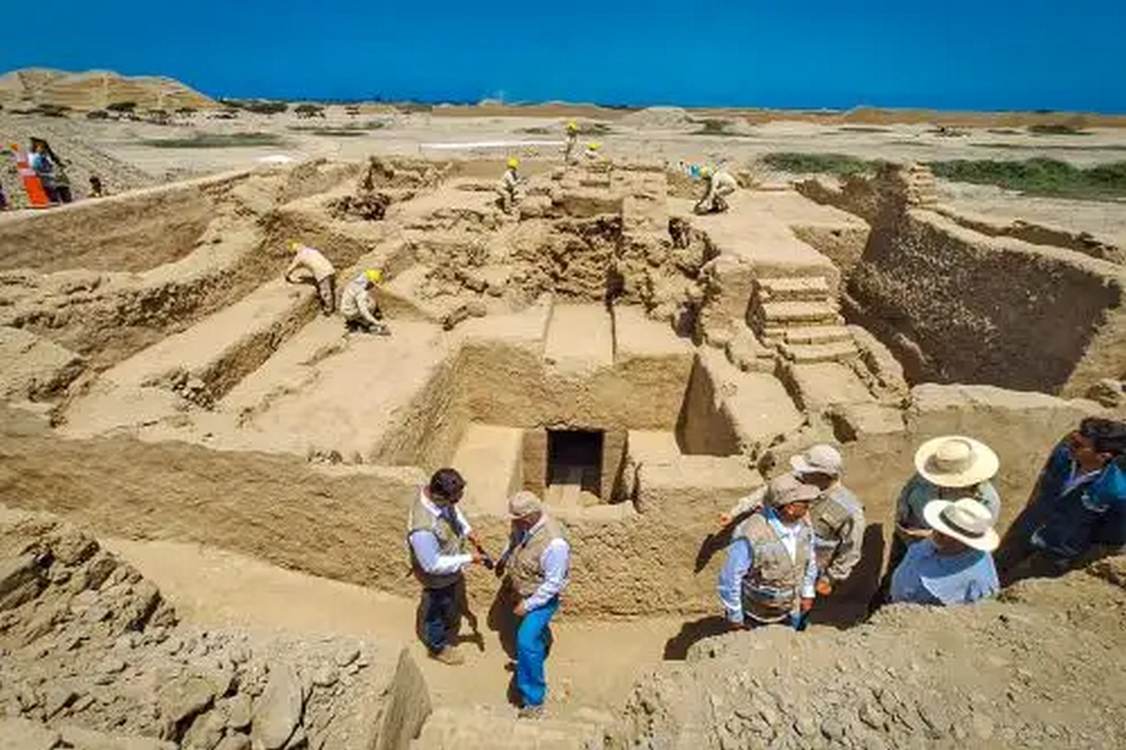
TRUJILLO, PERU — In what leading archaeologists are calling the most significant find of the century for Andean studies, an entirely intact, untouched elite tomb has been discovered within the ancient adobe city of Chan Chan on the northern coast of Peru. Preserved away from the hands of looters for approximately six centuries, the subterranean mausoleum contains 38 skeletons and a breathtaking cache of precious grave goods, offering an unprecedented window into the sophisticated social hierarchy, religious rituals, and funerary practices of the pre-Inca Chimú civilization.
The discovery was made within the UNESCO World Heritage-listed archaeological site of Chan Chan, specifically inside the expansive Utzh An palatial complex. Led by archaeologist Jorge Meneses, the excavation team has slowly revealed a complex subterranean architectural feat consisting of a central shaft, side chambers, and a surrounding platform containing high-status individuals adorned in gold, copper, and textiles.
Hailed by external experts as the "discovery of the decade," this monumental unearthing remedies a decades-long deficit in Andean archaeology: the total lack of scientifically documented, unlooted elite Chimú burials.
Main Facts: Inside the Intact Mausoleum
The newly excavated tomb platform is part of a series of monumental funerary structures built by the Chimú elite at the height of their civilization. At the bottom of a steep staircase, archaeologists uncovered a mausoleum measuring roughly 4 feet wide and 16 feet deep.
Inside this primary chamber rested a single principal individual, whose skull distinctly bore traces of a red pigment. Unlike traditional Chimú burials, which typically featured the deceased in a flexed or seated position, this primary figure was laid out with his body fully extended. Furthermore, osteological examination revealed that the individual was missing several bones—an intriguing detail suggesting that the body may have undergone secondary burial, a ceremonial practice wherein remains were relocated from an initial resting place to a permanent, hallowed ancestral tomb.
Branching off from the central shaft were two secondary chambers. One of these side vaults contained the remains of 20 additional people, alongside a dazzling array of elite artifacts:
- Precious Metals: Ornate copper and gold artifacts, signifying immense wealth and status.
- Armament: Intricately crafted metal weapons suited for nobility.
- Adornments: Fine, elaborate jewelry.
- Textiles: Vibrantly colored fabrics preserved remarkably well by the arid coastal climate.
In addition to the occupants of the primary and secondary chambers, 17 other skeletons were discovered interred within the surrounding tomb platform directly above the mausoleum, bringing the total number of individuals in the complex to 38.
Chronology: The Rise, Fall, and Silence of the Chimú Empire
To fully appreciate the gravity of the Chan Chan discovery, historians must look back at the trajectory of the Chimú civilization, which dominated the Peruvian coastline for centuries before the rise of the Inca Empire.
The Zenith of the Chimú (10th–15th Centuries)
Emerging from the ruins of the earlier Moche culture, the Chimú kingdom (or Chimor) established its capital at Chan Chan around the 10th century. By the 15th century, the civilization had reached its cultural, economic, and political zenith. Stretching along the arid northern coast of Peru, the Chimú were masters of desert survival and statecraft.
They constructed massive monumental architecture, extensive urban settlements, and an ingenious network of irrigation canals that transformed the desert into fertile agricultural land. At the center of this empire was Chan Chan, which, at its peak, was the largest adobe city in the pre-Columbian Americas, housing tens of thousands of residents within its imposing, labyrinthine perimeter walls.
The Inca Conquest (1460s)
The empire’s vast administrative infrastructure, highly stratified society, and sophisticated political organization did not go unnoticed by their southern rivals. In the 1460s, the burgeoning Inca Empire, under the leadership of expansionist rulers, launched a campaign that ultimately conquered the Chimú civilization.
Crucially, rather than destroying the culture, the Incas absorbed many aspects of Chimú administrative techniques, agricultural systems, and architectural styles into their own burgeoning empire. Following the conquest, however, Chan Chan gradually fell into a period of decline and abandonment.
Centuries of Silence and Looting
Over the centuries, as Spanish colonization swept through South America, the immense wealth buried within the grand platforms and huacas (sacred mounds) of Chan Chan made them prime targets for treasure hunters. For generations, the vast majority of what academics and museums knew about the Chimú elite came entirely from looted tombs, illicit private collections, and scattered museum acquisitions. Scientific contexts were systematically destroyed, leaving a frustrating void in the archaeological record regarding the exact rituals, social associations, and biological profiles of the Chimú aristocracy.
That silence was finally broken with the unearthing of the Utzh An palatial complex tomb—a site that somehow managed to escape the notice of both colonial treasure hunters and modern-day looters for 600 years.
Supporting Data and Archaeological Significance
The discovery at Chan Chan is more than just a collection of glittering gold and ancient bones; it provides hard, quantifiable data that revolutionizes modern understanding of pre-Columbian South America.
According to project director Jorge Meneses, previous analyses of Chimú elite burials relied heavily on guesswork and circumstantial evidence gathered from disturbed sites. "What was known about elite burials in Chimú society came from looted platforms, private collections, and museum holdings," Meneses noted in an interview with El Pais. "There was no scientific data on the individuals and their corresponding artifacts and associations."
The discovery of 38 bodies in a single, pristine context allows bioarchaeologists and geneticists to conduct extensive studies on:
- Social Stratification: Analyzing the diet, health, and familial relations of the primary noble alongside the secondary occupants and platform burials to understand whether sacrifices or retainers accompanied rulers in death.
- Metallurgical and Textile Technologies: Examining the pristine metal artifacts and colorful textiles using advanced non-destructive spectrometry, yielding insights into Chimú supply chains, workshop organization, and aesthetic values.
- Mortuary Rituals: Documenting the deliberate application of red pigment to the skull and the anatomical selection of a relocated skeleton, shedding light on ancestor worship and elite ideology in the pre-Hispanic Andes.
Furthermore, statistics regarding the site itself emphasize the vast potential for future discoveries. Archaeologists note that only 7% of the total area of Chan Chan has been excavated to date. This has led many in the academic community to describe the site as a "Peruvian Pompeii," hinting that decades—if not centuries—of groundbreaking discoveries still lie buried beneath the Peruvian sands.
Official Responses and Expert Commentary
The international archaeological community has reacted to the unearthing with an extraordinary degree of excitement, praising both the preservation of the site and the meticulous work of the excavation team.
Dr. Gabriel Prieto, a prominent anthropologist at the University of Florida who was not directly involved in the excavation, voiced the collective awe of his peers when he spoke to the press. Interviewed by The New York Times, Prieto did not hesitate to label the find "the discovery of the decade," emphasizing that it provides the very first scientifically controlled, undisturbed glimpse into the inner workings of an elite Chimú burial.
State officials in Peru have also celebrated the discovery as a massive win for national heritage and cultural tourism. Representatives from the Peruvian Ministry of Culture and the state-run Andina news agency highlighted the collaborative efforts required to protect, excavate, and analyze the delicate artifacts—particularly the fragile textiles and oxidized metalwork—without exposing them to damaging environmental elements.
Jorge Meneses and his team have spent recent weeks traveling through media circuits, explaining the painstaking processes being used to lift the artifacts from the earth and stressing the importance of protecting the remaining 93% of the unexcavated city from modern urban sprawl and illicit excavation.
Implications for Future Andean Research
The unblemished tomb at Chan Chan opens unprecedented avenues for historical and anthropological research, with implications that stretch far beyond the borders of Peru.
Rewriting Pre-Inca History
By establishing a baseline of scientific data regarding elite Chimú burials, researchers can now re-evaluate artifacts currently sitting in museum collections worldwide. Items that were once stripped of their historical context can now be cross-referenced against the stratigraphy and biological data recovered from the Utzh An complex. This allows historians to draw more accurate conclusions regarding trade networks, inter-regional diplomacy, and the economic power wielded by the Chimú kings.
Shedding Light on Inca Statecraft
Because the Inca Empire adopted so many structural, agricultural, and administrative paradigms from the Chimú after their conquest in the 1460s, understanding the Chimú elite directly informs our understanding of the Inca themselves. The ideological structures that allowed Chimú lords to command absolute loyalty, organize massive labor forces, and construct monumental urban centers clearly laid the structural groundwork for the sprawling Inca Tawantinsuyu that followed.
Conservation and the Future of Chan Chan
As climate change, weathering, and human encroachment continue to threaten fragile archaeological sites across South America, the successful, high-tech excavation of the Utzh An tomb serves as a gold standard for modern preservation.
With 93% of Chan Chan still resting beneath the desert surface, the discovery of the 38-skeleton mausoleum serves as a powerful reminder of how much of human history remains hidden in plain sight. As archaeologists secure funding and apply non-invasive scanning technologies to map the rest of the ancient adobe metropolis, the world watches eagerly to see what other secrets the sands of Peru are waiting to yield.