NEW YORK — For nearly a century, Manhattan’s legendary Park Avenue has been synonymous with the concrete-and-steel grandeur of corporate America. Dominated by towering skyscrapers, yellow cabs, and endless streams of bumper-to-bumper vehicular traffic, the world-famous thoroughfare has long prioritized motorized transit over human life.
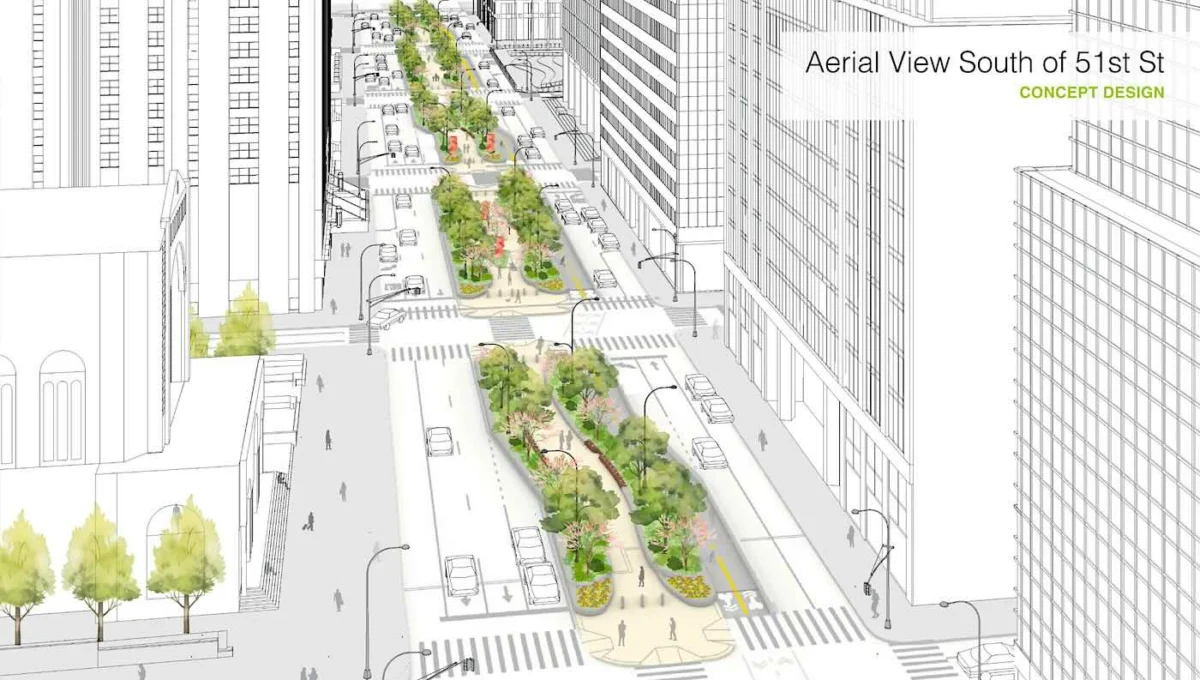
However, a sweeping new initiative spearheaded by Mayor Mamdani and the New York City Department of Transportation (NYC DOT) is set to rewrite that narrative. In a project designed to harken back to the avenue’s early 20th-century origins, the city has officially unveiled an ambitious blueprint to transform a crucial 11-block stretch of Park Avenue into a lush, people-centric public park, complete with sprawling green medians, pedestrian seating, public art installations, and a heavily requested protected two-way bike lane.
By reclaiming underutilized asphalt and converting it into vibrant green infrastructure, city leaders hope to heal a historic wound in the urban landscape—returning Park Avenue to the natural, park-like character it proudly boasted prior to the 1920s.
Main Facts of the Reimaginement
The newly unveiled design focuses on a critical, high-density stretch of Midtown Manhattan, running from 46th Street to 57th Street. Crafted in close collaboration with landscape architecture firm Starr Whitehouse Landscape Architects and Planners, the redesign aims to fundamentally shift how commuters, residents, and visitors experience the corridor.
At the core of the project is the expansion of the avenue’s central medians. Once narrow strips that served primarily as dividers for vehicular traffic, these zones will be significantly widened to accommodate lush plantings, native trees, inviting public benches, and designated spaces for rotating public art installations. Enhanced pedestrian crosswalks will tie the corridor together, allowing walkers to traverse the grand avenue safely and comfortably.
To accommodate these massive public upgrades, vehicular capacity along the corridor will be scaled back. The project removes one travel lane in each direction and converts an existing southbound vehicular lane into a dedicated, two-way protected bike lane. This physical barrier separating cyclists from heavy traffic is designed to dramatically improve safety while laying the crucial groundwork for future cycling network expansions throughout East Midtown.
A Century in the Making: The Chronology of Park Avenue
To understand the revolutionary nature of the current redesign, one must look back at the fascinating history of Manhattan’s most prestigious address.
The Early Days: An Actual Park
Before the rapid commercialization and vertical explosion of Midtown Manhattan in the 1920s, Park Avenue lived up to its literal name. Originally known as Fourth Avenue, the route featured an actual park running directly down its center. This green corridor served as a recreational haven for residents, framing the burgeoning residential district with natural beauty rather than asphalt.
The Concrete Era
As New York City grew into a global economic powerhouse through the mid-20th century, the demands of the automobile age transformed the urban landscape. The historic parkland running down the center of the avenue was systematically paved over, narrowed, and converted into medians designed to speed vehicular traffic through the city’s central business district. The corridor became an intimidating, car-choked canyon of steel and stone, symbolizing the twentieth-century urban planning philosophy that favored cars over communities.
The Catalyst: Grand Central Train Shed Rehabilitation
The current push to reimagine Park Avenue is not merely an aesthetic whim; it is tied to a massive, once-in-a-generation subterranean infrastructure project. The 11-block project area sits directly above the sprawling Grand Central Terminal train shed, a century-old engineering marvel currently undergoing a multi-million-dollar capital rehabilitation by Metro-North Railroad.
As the Metropolitan Transportation Authority (MTA) works below ground to replace aging structural components and completely waterproof the massive rail yard, city planners recognized a golden opportunity. Rather than simply repaving the street above once structural repairs concluded, the City and the MTA opted to coordinate their timelines. This rare synchronization allows NYC to fundamentally alter the streetscape above, aligning necessary underground utility and transit investments with a forward-thinking vision for urban public space.
Supporting Data and Community-Driven Design
The transformation of Park Avenue is far from a top-down administrative decree; it is the direct result of intense public demand and shifting urban demographics. Over the past decade, New York City has seen exponential growth in cycling and walking, driven by a growing desire for sustainable, health-conscious, and emissions-free modes of transportation.
According to municipal transit data, thousands of commuters navigate the East Midtown business district daily. Yet, despite high pedestrian foot traffic, the area has historically suffered from a deficit of public seating, green space, and safe cross-town or up-town cycling infrastructure.
When the NYC DOT launched its public outreach campaign regarding the future of Midtown corridors, the message from everyday New Yorkers was loud and clear: they wanted more room to walk, safer routes to bike, and more green spaces to combat the urban heat island effect.
The resulting design directly addresses these metrics:
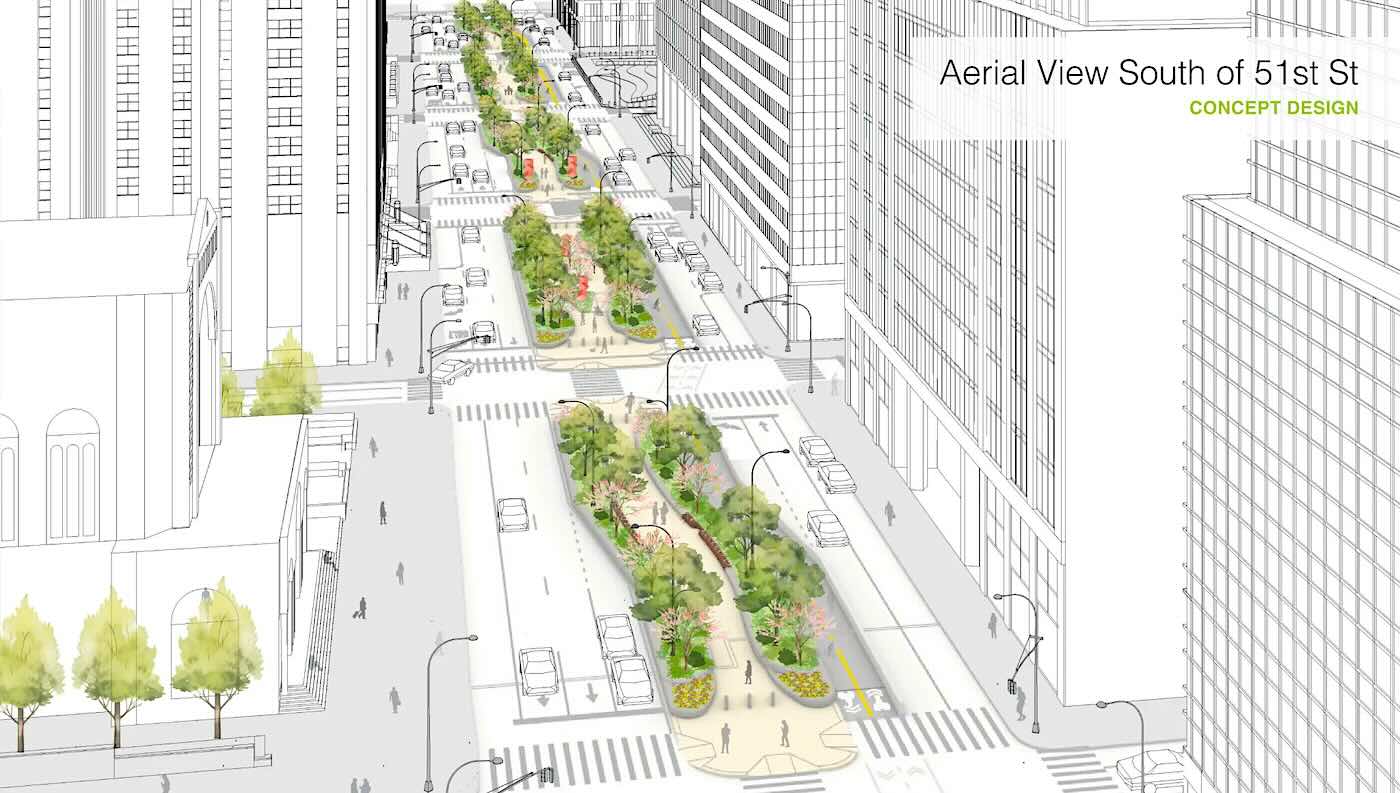
- 11 Blocks of completely reimagined streetscape between 46th and 57th Streets.
- Conversion of 2 car lanes to prioritize active transportation and public green space.
- 1 Dedicated, Two-Way Protected Bike Lane establishing a vital north-south cycling artery in a historically underserved area for bike infrastructure.
- Significantly expanded medians equipped with permeable surfaces, extensive landscaping, and social infrastructure like benches and art.
Official Responses and Stakeholder Perspectives
The ambitious project has garnered widespread praise from federal, municipal, and transit officials, highlighting a rare alignment of vision across different levels of government.
NYC Mayor Mamdani emphasized that the project is a direct response to the desires of the city’s residents.
“New Yorkers asked us to make more room for people to walk, bike, and enjoy their city, and we listened,” said Mayor Mamdani. “This final design converts underused median space into vibrant public space while incorporating a dedicated, world-class bike connection that lays the foundation for future bike network upgrades in East Midtown.”
NYC DOT Commissioner Mike Flynn echoed these sentiments, pointing out the long-term logistical benefits of the design.
“As more people turn to biking and walking as cleaner, more effective modes of transportation, we must continue updating our infrastructure to keep our riders and pedestrians safe,” noted Commissioner Flynn. “We are grateful to our partners across city and state government for helping us bring this vision to life.”
Federal lawmakers representing the region have also championed the initiative. U.S. Congressman Jerrold Nadler praised the collaborative effort to modernize Manhattan’s iconic thoroughfares.
“I’m grateful to Mayor Mamdani and Commissioner Flynn for advancing this ambitious reimagining of one of Manhattan’s most iconic thoroughfares,” said Congressman Nadler. “As our city continues to evolve, our streets must evolve with it to prioritize safety, environmental health, and community well-being. I look forward to seeing work get underway.”
Meanwhile, transit authorities managing the subterranean aspects of the project emphasized the historical significance of the partnership. MTA Construction and Development President Jamie Torres-Springer highlighted the synergy between the railroad restoration and the street-level greening.
“The reconstruction of the Grand Central Train Shed is part of the MTA’s commitment to modernize the infrastructure that keeps New Yorkers moving,” stated Torres-Springer. “This century-old structure made it possible for Midtown to grow into one of the world’s most important business districts—and now, as we rebuild it, we’re thrilled to partner with the city to deliver a greener, more vibrant public space that honors that history while looking toward the future.”
Implications for the Future of New York City
The reimagining of Park Avenue is much more than a localized beautification project for 11 blocks of Midtown; it represents a philosophical shift in how New York City approaches urban planning, climate resilience, and public health.
1. Environmental and Climate Resilience
By replacing thousands of square feet of heat-absorbing asphalt with permeable, planted green medians, the project contributes directly to the city’s climate goals. The new trees and plantings will help mitigate the urban heat island effect, absorb stormwater runoff during heavy downpours, and improve local air quality in one of the densest commercial zones on the planet.
2. Economic and Social Vitality
Urban design studies consistently show that pedestrian-friendly, green streetscapes boost foot traffic for local businesses, restaurants, and retailers. By offering a welcoming environment with places to sit, linger, and enjoy public art, the redesigned Park Avenue transforms a transient thoroughfare into a destination. Office workers, tourists, and residents will have a dedicated urban oasis in the heart of the corporate capital.
3. A Blueprint for Future Transformations
Perhaps most importantly, the project serves as a testing ground for how New York City can leverage major capital infrastructure repairs—such as the MTA’s train shed overhaul—to redesign the public realm above. By coordinating subterranean structural work with surface-level street transformations, the city can avoid the inefficiency of tearing up newly paved streets later and instead execute holistic, future-proof upgrades.
As construction timelines move forward, all eyes will be on Midtown to see how this dramatic blend of historic restoration and modern urbanism takes shape. If successful, the return of the "park" to Park Avenue may well serve as a gleaming model for how other great global cities can reclaim their streets for the people who walk them.