Retirement marketing is a multi-billion-dollar industry built on a specific, glossy aesthetic. Flip through any financial brochure or insurance advertisement, and you will inevitably find the same stock photos: a serene lake, a designer suitcase sitting by a front door, or two bicycles leaning against a sun-drenched beach house. These images sell the "Golden Years" as a permanent Saturday—a lifetime of vacations, leisure, and the absence of responsibility.
However, the reality of retirement, as reported by those living it, is far more grounded. The most resonant advice from veteran retirees consistently points away from the bucket list and toward the calendar’s most unassuming day: Tuesday.
The Reality Gap: When the Clock Stops Ticking
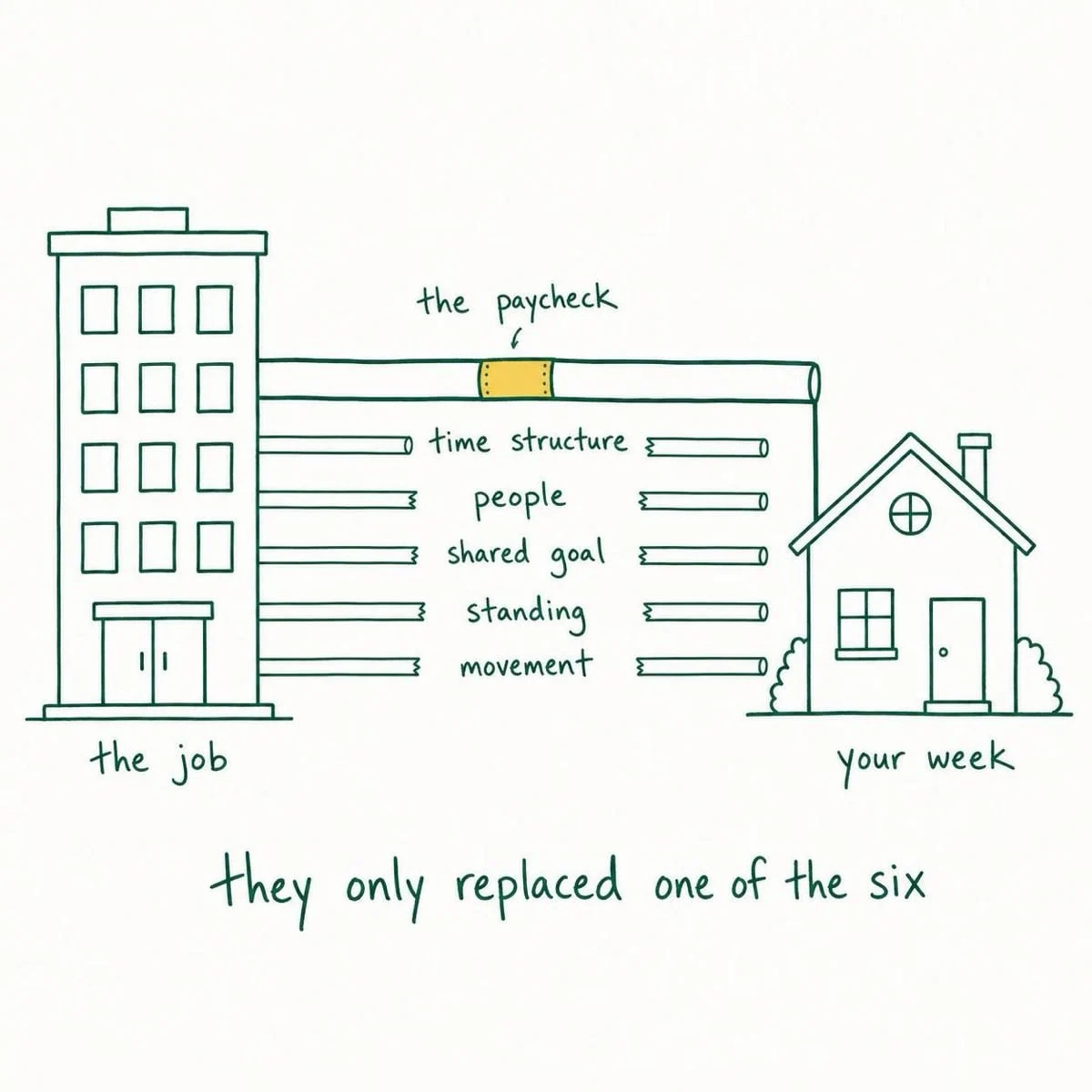
The transition into retirement is often framed as a finish line. Yet, for many, the moment the paycheck stops, a deeper, structural void emerges. For decades, the workplace provided more than just a salary; it provided a temporal skeleton. It offered a clock, a community of peers, a steady stream of "useful" problems to solve, and the social permission to prioritize one’s future.
When you retire, those hidden supplies vanish overnight. A bucket list—no matter how exotic—can only sustain you for a few weeks of "vacation." But a life cannot be lived in a permanent state of vacation. To thrive, a retirement must be designed to function on a rainy Tuesday at 10:40 a.m., when there is no office to report to and the weight of "together time" with a partner begins to feel less like a luxury and more like an existential question.
The Tuesday Test: Five Anchors for a Sustainable Life
To navigate the shift from career-driven existence to self-directed time, experts and retirees alike suggest the "Tuesday Test." This is not a rigid schedule, but rather a diagnostic tool to ensure your weekly rhythm contains five essential anchors:
- Body: A commitment to physical maintenance.
- People: Intentional social contact beyond your immediate household.
- Purpose: A role that requires your presence or input.
- Money: A clear, written boundary for safe spending.
- Partnership: An explicit agreement regarding shared and independent time.
You do not need all five to be in play every single day, but a healthy week requires each of these elements to have a designated "home."
Chronology of the Transition
The psychological shift of retirement happens in distinct phases, and the Tuesday Test serves a different purpose at each juncture.
Phase 1: Pre-Retirement (The Simulation)
Before you officially exit the workforce, try a "dry run." Take a Tuesday off—not for a vacation, but for an ordinary day. Notice how you feel when the morning alarm is optional. Do you feel adrift? Does your spouse wonder why you are hovering in the kitchen? This trial run often reveals that your retirement plan lacks the specific "appointments" that keep a human life stable.
Phase 2: The First 90 Days (The Adjustment)
In the first three months, there is a natural urge to over-schedule. Avoid the trap of filling every hour with busyness to mask the loss of your professional identity. Instead, focus on establishing two fixed anchors. Maybe it is a standing Tuesday morning walk and a recurring Thursday volunteer shift. Let the rest of the week remain flexible as you learn your new energy levels.
Phase 3: Year One and Beyond (The Drift)
By the end of the first year, the initial novelty has worn off. This is the period where "retirement drift" sets in. You may find that travel has overtaken your physical health, or that your social circle has shrunk as your office ties faded. Running the Tuesday Test at the one-year mark allows you to re-calibrate and ensure that no single element—such as volunteer work or household chores—has become a surrogate for the work-life balance you originally sought.

Supporting Data: Why "Ordinary" Matters
The emphasis on routine is backed by both sociological and health research. A study involving 1,635 sedentary adults (the LIFE trial) highlighted that mobility is not a fixed asset but a variable maintained through consistent use. The participants who engaged in structured activity were significantly less likely to suffer major mobility disability than those who treated physical movement as an "event" rather than a routine.
Similarly, research from Finland tracking 2,319 employees through the retirement transition found that while close relationships remained stable, "peripheral" ties—the receptionist, the client, the colleague—often vanished. This social thinning is a major, yet often overlooked, contributor to feelings of isolation.
Furthermore, a 2024 survey by the Employee Benefit Research Institute (EBRI) revealed a paradox: while 38% of retirees identified as having a "savings mindset," 31% admitted to spending more than they could afford. This suggests that without a clear, written, and "authorized" spending plan, the anxiety of potential poverty can coexist with the danger of overspending.
Official Responses and Expert Perspectives
Financial planners increasingly argue that retirement is as much a psychological challenge as a fiscal one. John Tak, a 68-year-old retiree, echoes a sentiment shared by many: "We have been programmed to save, not spend." He notes that the transition requires learning the "opposite move"—giving your money a specific job rather than treating it as a hoard.
Kathryn Brookfield, who transitioned from a career in public service, offers a blunt assessment: "If you’re healthy enough and have the finances, go travelling as soon as possible." Her advice isn’t just about fun; it’s about acknowledging the time-sensitive nature of our physical capacity. Use your health while it aligns with your budget.
The Implications of "Role-Based" Purpose
A common pitfall in retirement planning is the pursuit of a "grand purpose." Many believe they must find a new, life-defining passion. However, the data suggests that purpose is better viewed as a role.
When you tutor a student, repair a neighbor’s furniture, or commit to a weekly nonprofit shift, you are providing a service that someone else is counting on. This external expectation is a powerful motivator. It doesn’t need to be profound; it just needs to be necessary. Studies on retirees in England have shown that frequent, recurring volunteering is associated with higher life satisfaction and lower rates of social isolation. The key is the "recurrence"—the knowledge that you are expected somewhere, on a specific day, to perform a specific task.
Practical Steps: Building Your Tuesday
If you feel your current retirement is drifting, do not attempt a total reinvention. Instead, diagnose which of the five anchors is missing.
- If you feel lonely: Do not simply "be more social." Schedule a standing coffee date on Wednesday morning.
- If you feel purposeless: Identify one task that someone else needs you to complete next week.
- If there is friction at home: Sit down with your partner and sketch out your "ideal" Tuesday separately. Compare the two sketches. You will likely find that one person wants to paint in the garage while the other wants to go for a hike. The friction isn’t incompatibility; it’s a lack of a shared map.
Conclusion: Build the Day, Not the Decade
The allure of the "golden years" is a fantasy that often ignores the granular reality of our daily lives. By focusing on the Tuesday—the most ordinary day of the week—you shift your focus from an abstract, future-tense destination to a present-tense reality.
Retirement is not a one-time event; it is a long-term project of self-construction. By ensuring you have a role that matters, people to see, a body to move, money to use, and a partner to coordinate with, you create a foundation that can weather the passage of time. Do not try to build the next twenty years today. Start by building a Tuesday you would be willing to repeat. That, ultimately, is the secret to a retirement that holds.