Greg lasted exactly four months. The initial phase of his retirement followed the familiar, idyllic script: he meticulously cleared out the garage, embarked on a road trip to visit his daughter in Charlotte, and enjoyed the novel luxury of sleeping past 6:00 a.m. for the first time since 1987. Then came a Tuesday in his third month. He found himself standing in his kitchen at 10:40 a.m., staring at a cup of cold coffee, suddenly struck by the realization that nothing in the world required his attention that day.
His finances were stable; his health was excellent. Yet, he felt a profound sense of vacancy that no bank statement could rectify. Greg’s experience is not an anomaly—it is a hallmark of the modern retirement transition. The prevailing narrative suggests that purpose is a singular, internal "thing" one must discover. The reality, however, is that purpose is a supply-chain issue.
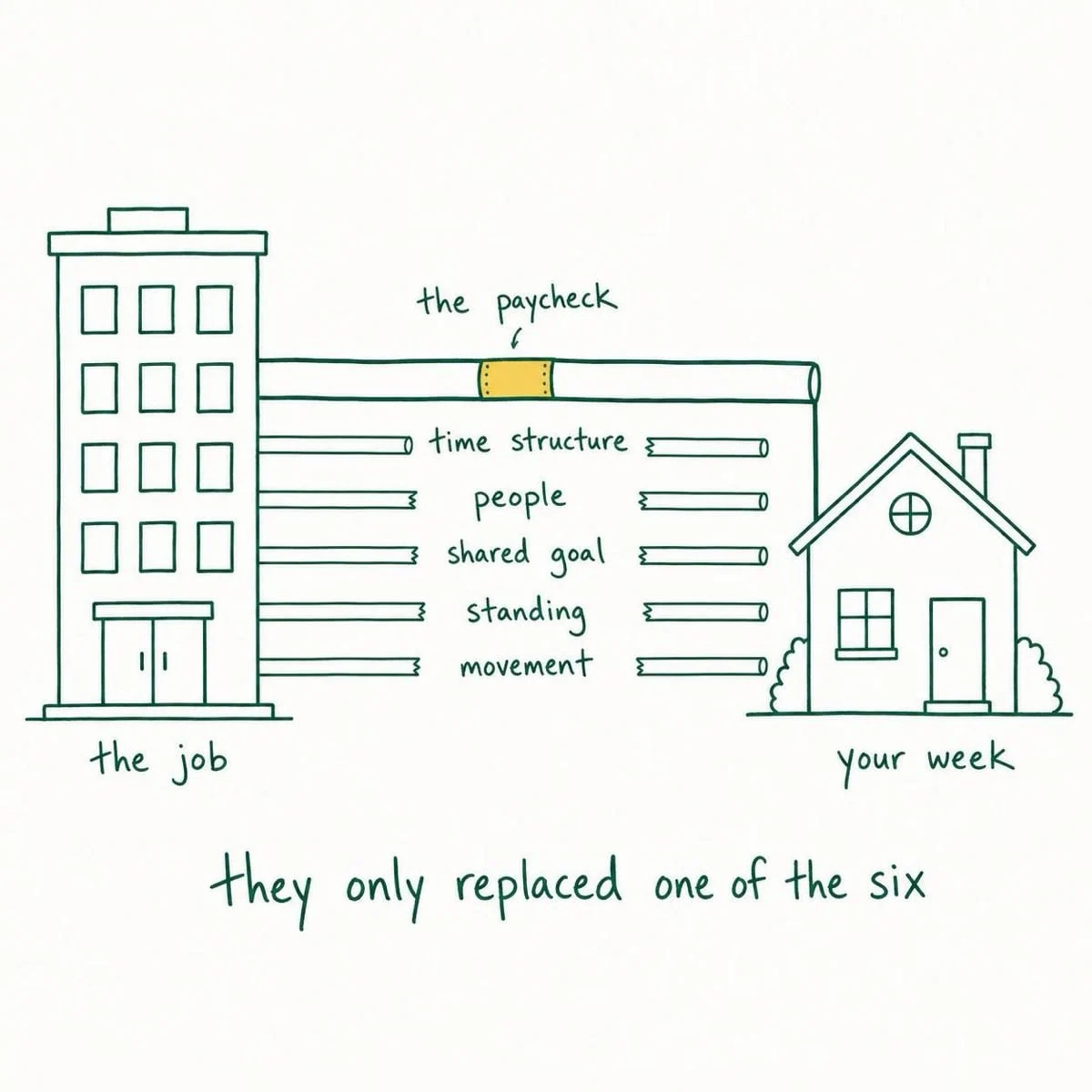
When we work, our jobs provide us with a hidden infrastructure—what social psychologist Marie Jahoda famously termed "latent functions." We receive a paycheck (the manifest function), but we are also provided with a rigid structure for our time, a built-in social network, a collective goal, a defined status, and a reason to physically move our bodies. When retirement begins, the paycheck remains, but the other five pillars often collapse simultaneously.
The Mechanics of the Retirement Transition: A Chronology
To understand the sudden onset of malaise in retirees, one must view retirement not as a singular event, but as a multi-stage process.
The Honeymoon (Months 1–2)
In the immediate wake of leaving the workforce, the relief of escaping the "grind" dominates the psychological landscape. This is the period of freedom—no alarm clocks, no commutes, and the ability to reclaim one’s personal agency. For many, this is a time of high life satisfaction.
The Disenchantment (Months 3–6)
This is where the "Greg scenario" takes hold. As the novelty of leisure wanes, the vacuum created by the loss of the five latent functions begins to manifest. The absence of routine becomes an existential weight. Retirees often interpret this as a loss of identity, when in reality, it is a loss of external scaffolding.
The Reorientation and Stability (Months 6+)
The final phase involves the active construction of a new "machine." Those who successfully navigate this transition are not those who "found their passion" in a vacuum; they are the individuals who rebuilt their daily infrastructure through intentional, fixed commitments.
The Evidence: Why the "Purpose" Crisis is Structural
Recent data underscores the severity of this transition. A 2023 meta-analysis of decades of retirement studies revealed a striking disparity between the employed and the retired regarding the availability of latent functions. The gap between these two groups is statistically significant, with a Cohen’s d effect size of 0.70—comparable to the psychological distance between the employed and the unemployed.
The data further clarifies which pillars are the most fragile:
- Social Contact: Takes the hardest hit (d = 1.05). The loss of daily, non-elective social interaction is the most significant contributor to post-retirement isolation.
- Enforced Activity: (d = 0.97). The removal of external demands on physical presence leads to a rapid decline in daily movement.
- Collective Purpose: (d = 0.56). The loss of a team-oriented goal leaves many feeling adrift.
- Status: (d = 0.16). Surprisingly, one’s sense of professional standing often survives the transition better than the calendar does.
These figures suggest that we have been misdiagnosing the problem. When a retiree expresses that they have "lost their purpose," they are often mourning the loss of eleven daily conversations, the necessity of leaving the house by 8:30 a.m., and the requirement to contribute to a shared outcome.
The Fork in the Road: Does Retirement Cause Depression?
For years, the literature on retirement and mental health has been conflicting. A European think-tank study of 9,000 individuals suggested that retirement increases the risk of clinical depression by 40%. Conversely, a massive systematic review of 557,111 individuals concluded that retirement is associated with a 20% decrease in the risk of depression.
The resolution to this paradox lies in the "fork" of the retirement experience. If an individual spent 30 years in a career they found draining or unfulfilling, retirement acts as a release, boosting their sense of purpose and overall well-being. However, for those who found deep satisfaction in their work—the "high-performers"—retirement acts as a deconstruction of their primary source of external validation and structure.

Crucially, the research indicates that the "honeymoon" phase can be deceptive. A study across ten European countries found that while retirement may have no immediate negative impact on mental health, the long-term effects—often hitting at the six-month mark—can be severe.
The Stakes: Why "Purpose" is a Health Metric
We must move past the idea that "purpose" is merely a philosophical concept. The data on mortality is startling. In a study of 6,985 US adults over the age of 50, those in the lowest category of life purpose were 2.43 times more likely to die during the study period than those in the highest, even after controlling for baseline health and demographic variables.
A second, long-term study following 6,163 Americans over 14 years found that for every one standard deviation of increased purpose, there was a 15% reduction in the risk of death. These findings hold true for both working and retired individuals. Consequently, identifying a source of purpose should be treated with the same urgency as managing cholesterol or blood pressure.
The 20-Minute Audit: Diagnosing the "Cut Pipes"
If you are struggling with the transition, stop asking "What is my passion?" and start auditing your past week. Score yourself on these five categories:
- Time Structure: Did you have at least four obligations last week that occurred at a set time you didn’t choose?
- Social Contact: Did you have four or more conversations lasting longer than ten minutes with someone other than a spouse, child, or service worker?
- Collective Purpose: Was there a single task last week that would have gone differently if you had stayed in bed?
- Status: Did anyone seek your professional opinion or expertise in the last month?
- Enforced Activity: Did external demands force you to move your body on at least four days last week?
If you score 0 or 1 in any category, you have identified a "cut pipe." Most retirees find that their distress is not an existential failure, but a failure of one of these two specific supplies: time structure and social contact.
Rebuilding the Infrastructure: A 90-Day Plan
Do not attempt to overhaul your life in a week. Success in retirement is built on sequencing.
Days 1–30: Establish Three Fixed Points
Forget "goals." You need three appointments that are non-negotiable, involving another human being who would notice your absence. This might be a standing volunteer shift, a weekly exercise class, or a recurring commitment to mentor someone. The key is that these events must have a fixed time and place.
Days 31–60: Adopt a "Deadline" Commitment
Seek out an activity where you are accountable to others. Join a committee, accept a part-time contract, or take a course with mandatory assignments. The litmus test for this activity is simple: if you fail to show up, does it inconvenience someone else? If the answer is yes, you have successfully replaced "collective purpose."
Days 61–90: Direct Your Energy Outward
This is the phase of "generativity," as defined by psychologist Erik Erikson. The Baltimore Experience Corps trial, which randomized older adults into elementary school volunteering, showed that participants’ sense of purpose grew directly as a result of their service to the next generation. You do not find the feeling and then help; you provide the help, and the feeling follows.
Final Implications: Guarding Your Health
As you navigate this transition, keep two "doses" in mind. First, aim for 100 hours of volunteering per year—roughly two hours a week. The data suggests this is the threshold at which mortality risks decrease and physical functioning improves. Second, maintain at least two distinct social groups outside of your immediate family. Losing these connections carries a mortality risk comparable to physical inactivity.
Ultimately, retirement is not a fall into an abyss; it is a transition into a new, self-designed structure. If you find yourself in the "disenchantment" phase, remember: your lack of purpose is not a failure of character. It is simply an empty calendar. Start with Tuesday. Put one thing on it. Let the rest of the machine rebuild itself around that single, fixed point.