By Beth Skwarecki, Senior Health Editor
Apple’s recent marketing campaign for the Apple Watch Series 12 and Ultra 4 carries a bold, almost provocative claim: that these devices possess the “most accurate heart rate sensor in a wearable.” For those of us who have tracked the evolution of wrist-based biometrics for over a decade, this is a significant assertion. Historically, the Apple Watch has been a reliable lifestyle companion, but it has often played second fiddle to specialized sports watches—specifically those from Garmin—when it came to high-intensity athletic performance.
As a certified personal trainer and weightlifting coach, I have spent years putting these devices through the wringer, comparing their output against the gold standard of biometric tracking: the electrical chest strap. After an intensive week of side-by-side testing, it is time to dissect whether Apple’s latest hardware has finally bridged the gap between “good enough for the gym” and “truly elite.”
Main Facts: The Anatomy of a Claim
The core of Apple’s argument lies in a total redesign of their optical heart rate sensor. The Series 12 features larger, more densely packed LEDs arranged in a circular array, designed to capture more consistent light penetration even during vigorous movement.

The company supported this hardware overhaul with a published study testing seven competing devices across a variety of workout types. However, the study’s methodology—while broad—left many data scientists and sports physiologists wanting more. The results were presented as high-level summaries, lacking the granular, second-by-second data that allows users to see exactly how a sensor behaves when a heart rate spikes during a HIIT circuit or drops during a recovery period.
To peel back the curtain, I conducted my own informal, real-world study. My goal was simple: to see how the Apple Watch Series 12 holds up against the Garmin Forerunner 570—a device I consider the current benchmark for optical wrist-based accuracy—using an electrical chest strap as the arbiter of truth.
A Chronology of Accuracy: From “Mid” to Competitive
To understand why this launch is so critical, one must look at the trajectory of the Apple Watch over the last five years.
- 2019–2021: Early models like the Series 4 were revolutionary for their time, often outperforming the fitness-focused wearables of that era. However, as the market matured, competitors like Garmin and even the Pixel Watch began to innovate faster.
- 2023–2024: Testing the Series 10 and 11, I consistently found that while Apple excelled at passive, daily heart rate tracking, they struggled during dynamic exercise. I frequently encountered "glitching"—where the device would lose the signal during a transition—leading to a "mid-tier" classification in my personal rankings.
- 2026 (The Current Generation): Apple has explicitly addressed the hardware-software feedback loop. By increasing LED size and optimizing the sensor array, they are attempting to solve the “noise” problem that has plagued optical sensors for years.
Supporting Data: The Real-World Lab
My testing protocol was designed to expose weaknesses in optical sensing. I wore the Apple Watch Series 12 on one wrist and the Garmin Forerunner 570 on the other, both calibrated for a snug but comfortable fit. The reference data was pulled from an electrical chest strap, which measures the heart’s actual electrical activity rather than just blood flow volume (photoplethysmography).

The Treadmill and Trail Run
In steady-state cardiovascular exercise, both watches performed admirably. The Apple Watch Series 12 showed a marked improvement in tracking the onset of intensity, effectively eliminating the “lag” I’ve noted in previous versions. However, the Garmin remained slightly more consistent in maintaining a continuous data stream.
The Rowing and Strength Test
This is where the difference between consumer-grade and pro-grade sensors usually reveals itself. Rowing and weightlifting create "noise" for optical sensors because the wrist is constantly flexing and gripping.
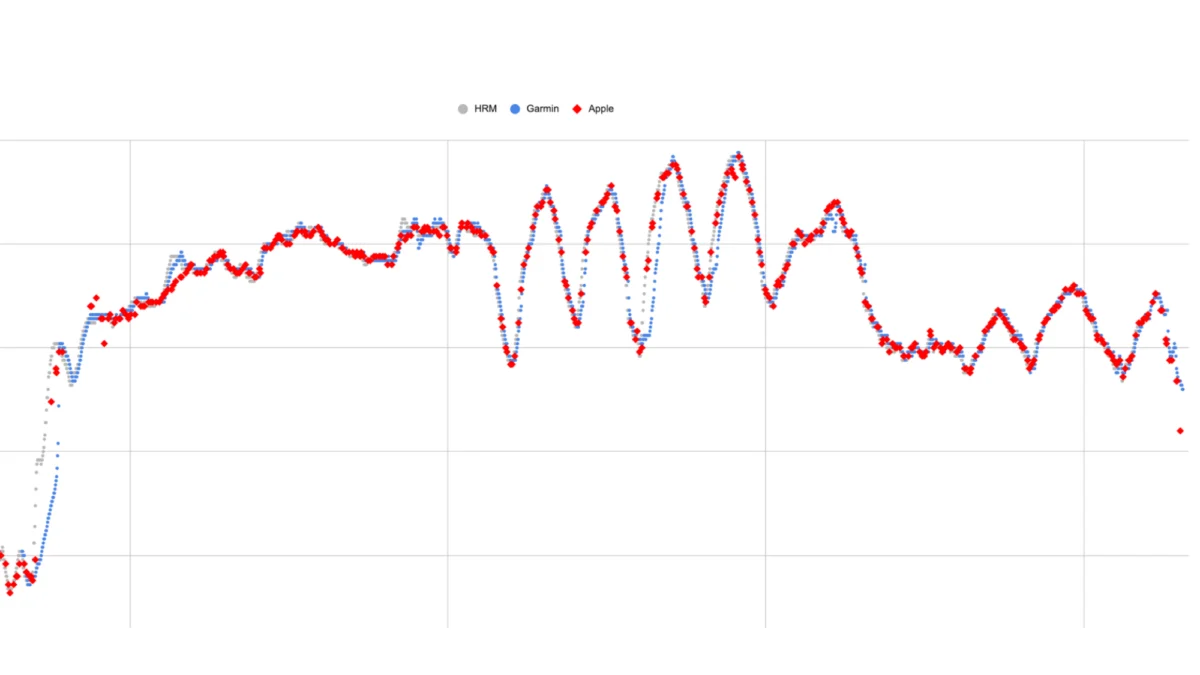
- The Rower: The Garmin struggled with the second interval, missing significant data points. The Apple Watch, conversely, overestimated intensity in some spots, showing a tendency to "smooth out" the data rather than capturing the sharp peaks and troughs of the effort.
- Strength Training: This was a mess for both. The nature of holding a barbell or dumbbell restricts blood flow and introduces motion artifacts that frustrate even the best sensors. While the Apple Watch was more accurate than its predecessors, it still exhibited a "sparse" data report, appearing to skip readings rather than guess incorrectly.
Official Responses and Industry Context
Apple’s official stance, as reflected in their documentation, suggests that their algorithm is now designed to prioritize data integrity. When the sensor is unsure of a reading, it would rather omit the data point than provide a potentially inaccurate "guess."
This is a defensive strategy. From a user experience perspective, it prevents the display of wildly incorrect heart rate spikes. However, from a data science perspective, it results in gaps in the workout graph. While this makes the Apple Watch look "cleaner" on a summary report, it raises a philosophical question: Is it better to have a data gap, or an estimated, potentially noisy data point? Apple is betting that accuracy-conscious users prefer the former.

Implications: What Does “Best” Mean?
After reviewing the charts and the performance logs, I have reached a nuanced conclusion. Apple is no longer “mid.” The Series 12 is a high-performance device that belongs in the same A-tier as the industry’s top sports watches.
Does it hold the crown?
If we are defining "most accurate in a wearable" strictly as a consumer-grade wrist-based device, the Apple Watch Series 12 makes a very strong case. It is arguably the most reliable heart rate monitor Apple has ever produced. It ties the Garmin in most scenarios and outperforms it in others, particularly in its ability to avoid false readings during transitions.
However, the "best" remains a moving target.
- The Chest Strap Gap: We must acknowledge that no optical wrist sensor—no matter the brand—can beat the precision of a chest strap. If you are training for a professional event or require clinical-grade monitoring, a watch should never be your sole source of truth.
- The Reliability Factor: While the Series 12 is impressive, it lacks the "perfect" graphs I have occasionally seen from Garmin’s top-tier sensors during their best performance days. Apple’s tendency to have gaps in data is a trade-off for accuracy, but it can still be frustrating for users who want a continuous, unbroken line of data.
Final Verdict
Apple has done something remarkable: they have effectively neutralized the competitive advantage Garmin held in heart rate sensing for years. The Series 12 is a massive leap forward. While I stop short of calling it the definitive "best" in the entire world of wearables—largely because the chest strap continues to sit on the throne of biometric accuracy—I am comfortable saying that for the vast majority of athletes, the Apple Watch Series 12 is no longer a compromise.

If you were waiting for Apple to get serious about fitness tracking, this is the hardware that finally makes that claim stick. The era of the "mid-tier" Apple Watch sensor is officially over. Now, the real competition begins—not for the title of "best," but for the consistency required to make every single beat count.