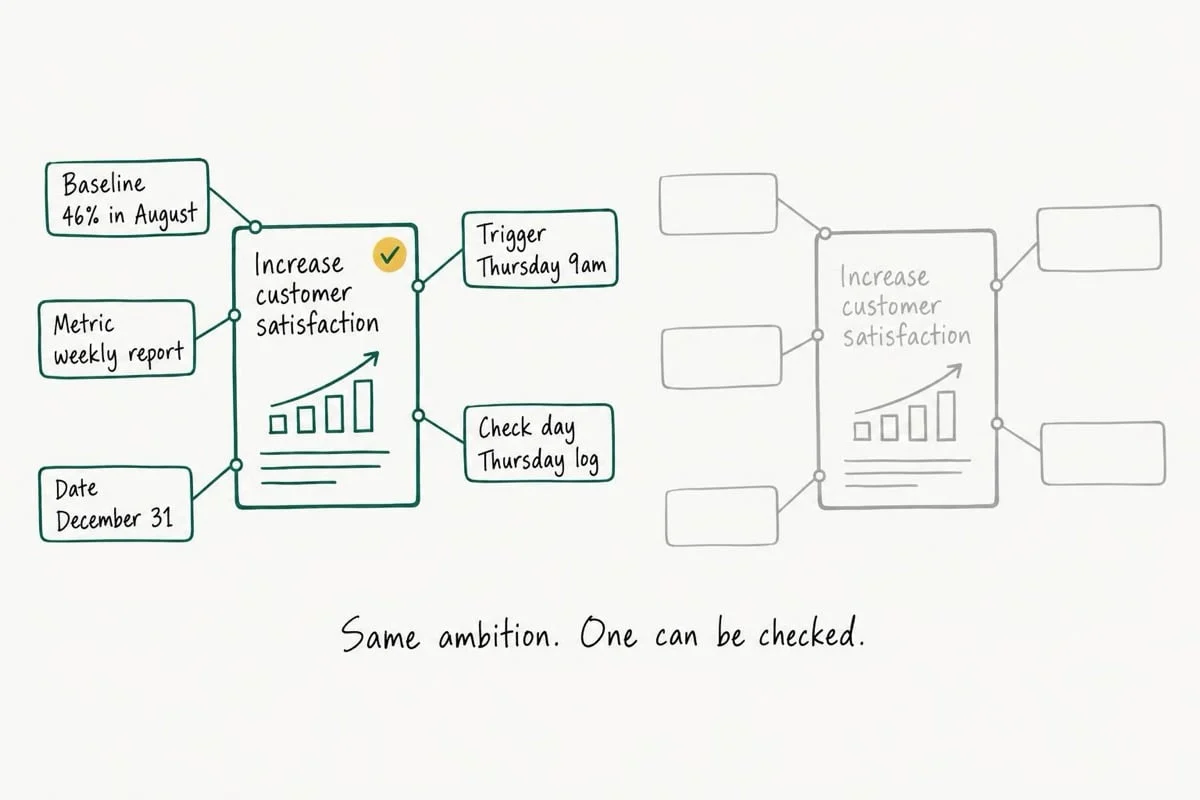
The deadline is Friday. You have been through this ritual before: four bullet points that sound responsible, a manager who skims them with a distracted nod, and a fiscal quarter that effectively buries your intentions by the end of week three. You write them to satisfy a digital form, only to watch them gather dust until the next performance review cycle, when you are forced to retrospectively justify why you didn’t hit targets that were never actually built to survive the reality of an ordinary Tuesday.
The problem is rarely a lack of ambition. Most "SMART" goals—the gold standard of corporate planning—fail because they are grammatically correct but operationally empty. They lack the connective tissue required to survive a day defined by client escalations, unexpected resignations, or budget cuts. They are sentences, not commitments. To turn these objectives into actual work, we must move beyond the buzzwords and back to the mechanics of high-performance execution.
The Evolution of the Acronym: Reclaiming the "A"
The SMART acronym has drifted significantly since George Doran introduced it in Management Review in November 1981. Originally, the framework was designed for managers assigning objectives to their subordinates: Specific, Measurable, Assignable, Realistic, and Time-related.
Over the decades, the corporate world transitioned the "A" from "Assignable" to "Achievable" and the "R" from "Realistic" to "Relevant." While this shift reflects a more democratic, bottom-up approach to goal setting, it also stripped the framework of its most critical component: accountability. When a goal is merely "achievable," it becomes a wish. When a goal is "assignable," it becomes an obligation. If your team’s goal is to "improve onboarding," you have created a sentence that four people can nod at while zero people take responsibility for the outcome. To reclaim the efficacy of the SMART model, we must re-introduce the necessity of ownership and replace vague intentions with verifiable data.
The Five Pillars of an Operable Goal
An effective work goal is not an aspirational statement; it is an objective written with such precision that a colleague could audit your progress without asking for clarification. To achieve this, every goal must contain five distinct components:
- A Baseline: A starting number you can point to. Without a "before" number, the "after" number is merely decoration, and performance reviews devolve into subjective arguments about whether progress was made.
- A Verifiable Metric: Something an outsider can confirm. Research by Locke and Latham suggests that specific, difficult goals consistently outperform "do your best" mandates. However, for complex tasks, the metric must be tied to a process you can control, not just a result you hope to see.
- A Strategic Date: Stop defaulting to the end of the quarter. When every goal is due on December 31, the date loses its urgency. Set milestones that align with the reality of your project lifecycle.
- A Trigger: This is the "when and where" of your goal. Behavioral psychology research—specifically the use of "if-then" planning—shows that specifying exactly when you will act on a goal significantly increases the probability of completion.
- A Check Day: A meta-analysis of nearly 20,000 participants found that monitoring progress is a primary driver of success. A goal that is only reviewed when you "remember" to check it is a goal that only succeeds when you are already having a good week.
10 SMART Goal Examples for the Modern Workplace
The following examples are designed to be copied and adapted. They prioritize a specific metric, a clear baseline, and a dedicated day for review.
Individual and Team Output
- Report Quality: Cut the client report from an average of four revision rounds in Q3 to two or fewer by December 31, as tracked in the shared file. Check: Friday, 4 p.m.
- Team Handoffs: Reduce open handoff tickets from 18 to fewer than 8 by November 30, with each of the four engineers closing two per week. Owner: Team Lead. Check: Monday standup.
- Customer Service: Raise first-reply resolution on tier-one tickets from 46 percent in August to 60 percent by December 31. Check: Thursday, helpdesk report.
Management and Strategy
- Manager Availability: Hold a 30-minute one-on-one with each of my six reports every two weeks from October 1 to December 19, missing no more than two sessions. Check: Monday morning.
- Sales Pipeline: Book eight qualified discovery calls a month through Q4, up from five in Q3, by holding 90 minutes for outreach every Tuesday and Thursday morning. Check: Friday, CRM count.
- Workload Management: Reduce recurring meetings from 22 hours per week in September to under 15 by December 1 by delegating or declining all meetings where I hold no decision-making power. Check: Monday, calendar review.
Professional Development and Process
- Data Analysis: Complete the four-module SQL course and ship one query that replaces a manual report by February 28, studying 45 minutes on Monday, Wednesday, and Saturday. Check: Saturday.
- Process Efficiency: Cut the month-end close from nine working days to six by March, automating one of the three slowest reconciliations each month. Check: First Monday after each close.
- Visibility: Send a five-bullet Friday note covering shipped items, blockers, and decisions needed, every week through Q4. Check: The note itself is the trigger.
- Evidence Tracking: Write two sentences of evidence against each goal every Friday, ensuring the April self-evaluation draws on 26 dated entries. Check: Friday, 4:30 p.m.
Implications: The Two-Version Reality
The secret to sustainable goal management is to maintain two versions of every objective.

The Review Version is what goes on the corporate form. It is concise, professional, and written for a manager who will spend exactly 90 seconds reviewing it. It serves as your record for promotions and organizational restructuring.
The Running Version is what you actually use. This version lives in your task manager or calendar. It contains the trigger, the weekly check-in, and the "floor version"—the minimum viable performance you will maintain when the quarter inevitably goes sideways.
When the Quarter Blows Up: The Importance of the "Floor"
Every goal should have a "floor"—the smallest result that still counts as progress. If your team loses two members mid-quarter, your original goal may become mathematically impossible. Without a pre-defined floor, you will likely abandon the goal entirely or burn out trying to achieve the impossible.
If your goal is to maintain a 60 percent resolution rate, your floor might be: "Maintain 46 percent, do not let it slide, and continue the Thursday check-in even when the numbers are flat." This "recovery loop" prevents the psychological collapse that occurs after a missed week. By continuing to monitor the metric, you remain in the game, ready to scale back up the moment conditions stabilize.
Conclusion: Stop Setting Goals, Start Building Habits
The common failure of the SMART framework is not the acronym itself, but the tendency to view it as a creative exercise rather than a maintenance schedule. If you have five goals to write, pick the one that matters most, apply the five-pillar test—baseline, metric, date, trigger, and check day—and leave the others for later.
As you audit your current goals before the end of the week, count how many have a starting number you can look up today and how many have a recurring day of the week attached to them. If the answer is zero, you haven’t set goals; you’ve set intentions. And intentions, unlike operable goals, are the first things to disappear when the pressure of the workday truly begins. Focus on the baseline, define the trigger, and make the check-in non-negotiable. That is the only way to ensure that your goals don’t just sit on a form—they actually move the needle.