It is 7:00 p.m. on a Thursday. You are staring at a list of fourteen tasks, eleven of which are marked "High Priority." Two of these demands arrived from your manager via a morning Slack message, three are the result of a customer escalation that consumed your entire afternoon, and one is a strategic memo that you have been dutifully moving from one Monday to the next for a month.
Every item on that list is defensible. That is the fundamental problem of the modern workplace. We have become experts at labeling, but we have lost the art of choosing.
When everything is a "Priority 1," nothing is. We treat priority labels as organizational tools, but in reality, they have become a way to avoid the agony of decision-making. A scale where every request is stamped with a red flag is not a system; it is a list with extra steps. To reclaim control, we must transition from a culture of "labeling" to a culture of "scarcity."
The Anatomy of a Priority Failure
Priority levels were originally designed to rank work based on the damage prevented and the speed required for resolution. In the high-stakes world of IT service management, these labels are derived from a rigid matrix: Impact (the scale of business loss) multiplied by Urgency (the time-to-resolution requirement).
However, in our personal and professional task management, we have stripped these labels of their teeth. We apply them to satisfy our own anxieties or to appease the loudest voice in the room. By week three, a "P1" label no longer signals a critical business outage; it simply signals that a request was recent, loud, or originated from a senior stakeholder. The scale fails not because people abuse it, but because the system lacks a mechanism for scarcity.
The Science of Misplaced Urgency
Why do we fall into this trap? Behavioral science points to the "mere urgency effect." Research consistently shows that humans are biologically predisposed to favor tasks with a perceived deadline—even when those tasks have objectively lower payoffs than the strategic work we push aside. When your inbox is flooded with eleven "high" items, your brain seeks the path of least resistance: the task with the loudest, most immediate deadline.
President Dwight D. Eisenhower famously distinguished between the urgent and the important, noting that "the urgent are not important, and the important are never urgent." While the Eisenhower Matrix is a staple of time-management seminars, it remains incomplete. It sorts tasks into quadrants but provides no mechanism for the "cost" of shifting focus. Every time you switch tasks to address a new "urgent" item, you pay a "switching tax"—a cognitive cost that leads to the inevitable decision fatigue that hits at 4:00 p.m., leaving you with a list you haven’t touched since lunch.
A Four-Level System of Hard Constraints
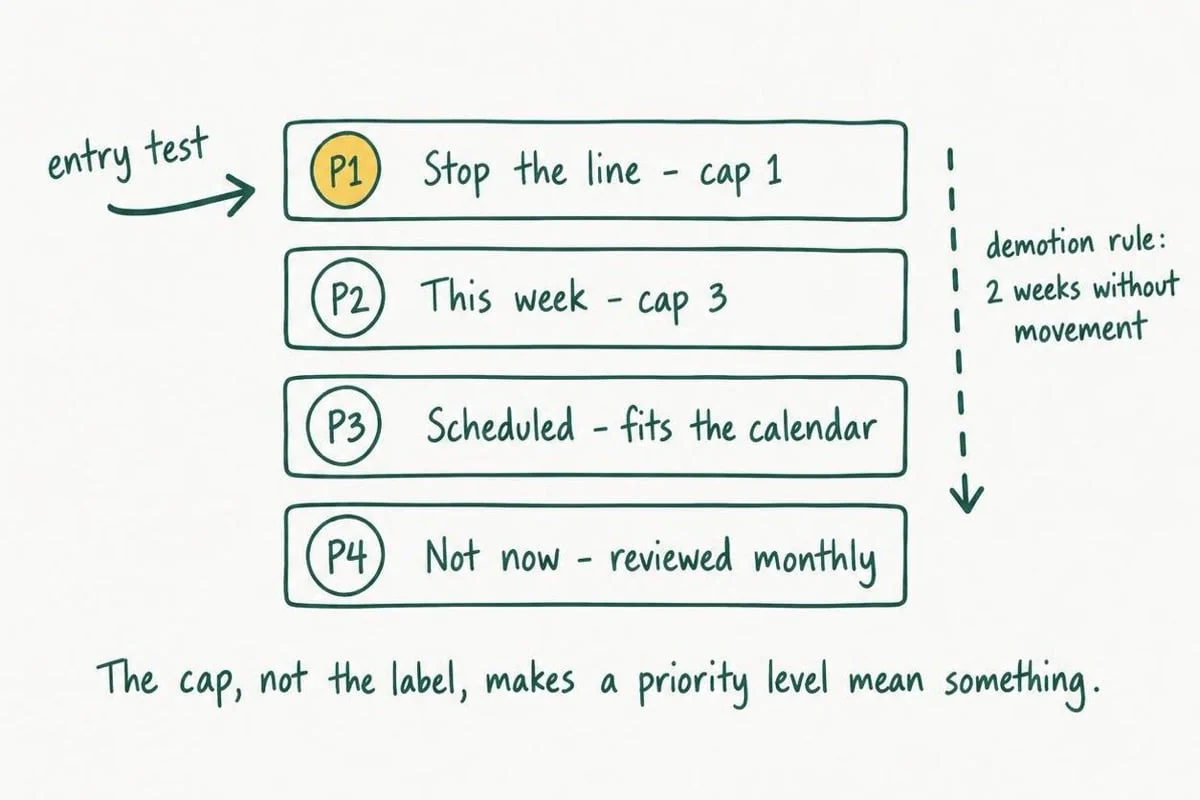
To move beyond the illusion of control, you must implement a system that treats your time as a finite commodity. The following scale, built on the logic of incident management, forces a choice by applying strict caps and defined "entry tests."
The Priority Ladder: A Strategic Framework
| Level | Definition | Entry Test (Objective) | Capacity Cap | The "Cost" |
|---|---|---|---|---|
| P1: Stop the Line | Prevents immediate damage | External blocker or failed deadline | 1 Item | Everything else slides 24 hours |
| P2: Commitment | Weekly promises to others | Has a named person waiting | 3 Open | No new P2 until one closes |
| P3: Scheduled | Future-dated work | Has a calendar block | Unlimited | Reviewed weekly |
| P4: Not Now | Everything else | Does it add value? | None | Deleted after 90 days |
The "Cap" column is the most critical component. It is derived from Little’s Law in queueing theory: if you maintain a steady throughput, increasing the number of open items in your system directly increases the time it takes for each item to be completed. By capping your P2 commitments at three, you ensure that you are not carrying the psychological weight of a dozen unfinished promises.
Chronology of a Productive Tuesday
To understand how this system operates, consider the day of "Curt," an operations manager at a logistics firm.

- 9:00 a.m. (The Baseline): Curt starts his day with a P2 board memo—a promise to his CFO, Ellen. His P1 slot is empty.
- 9:12 a.m. (The Interruption): A warehouse integration fails. Because this meets the P1 criteria (an external party is blocked), it takes the P1 slot. The board memo is moved to Wednesday, and—crucially—Curt informs Ellen. By communicating the shift, he removes the "silent cost" of a broken promise.
- 11:40 a.m. (The Negotiation): Ellen asks for a pricing analysis "ASAP." Curt’s P1 slot is occupied. He does not say "I’m slammed"; he says, "I can start this at 2:00 p.m. if the integration is fixed, or I can start it now and the integration waits. Which do you prefer?"
- 4:30 p.m. (The Close): Three new requests arrive. They fail the P2 test (the slot is full), so they are relegated to P3 with a date attached. Curt closes his laptop having finished the P1 and successfully managed expectations for the P2.
This is not magic; it is the result of a system that makes the trade-offs visible.
Supporting Data and Organizational Impact
Critics often argue that they do not control their inputs. They point to demanding CEOs or aggressive clients who ignore any internal system. However, the true value of a strict priority scale is not in how you categorize your own work, but in how it forces stakeholders to take responsibility for their requests.
When a supervisor demands that you prioritize a new task, you aren’t arguing about the label—you are asking about the trade-off. "I am happy to make this a P1," you might say. "However, that means the project for the sales team will be delayed by two days. Is that the trade you would like me to make?"
Research into "mechanical prediction" in clinical settings suggests that formal, rule-based systems are roughly 10% more accurate than intuitive, ad-hoc decision-making. By establishing your entry tests on a Sunday, you remove the emotional weight of having to say "no" while someone is standing at your desk on a Tuesday. You are not saying "no"; you are simply pointing to the rules that were agreed upon in advance.
Implications for Long-Term Strategy
The implications of adopting this system are two-fold: mental clarity and increased throughput.
1. Eliminating Cognitive Overload
When you keep a task in your head or on a list that isn’t managed, you experience "cognitive leakage"—the mental energy spent worrying about the work you aren’t doing. By forcing overflow tasks into a "P4: Not Now" list that is audited monthly, you clear your mental workspace.
2. Measuring System Performance
After two weeks of using this system, you should perform a "system audit."
- Count your P1s: If you are declaring more than two a week, your "Entry Test" is too loose. You are likely mislabeling "urgent" as "critical."
- Audit your P2s: If you are opening more P2s than you are closing, your cap is not binding. You are essentially lying to yourself about your capacity.
Conclusion: Start Small
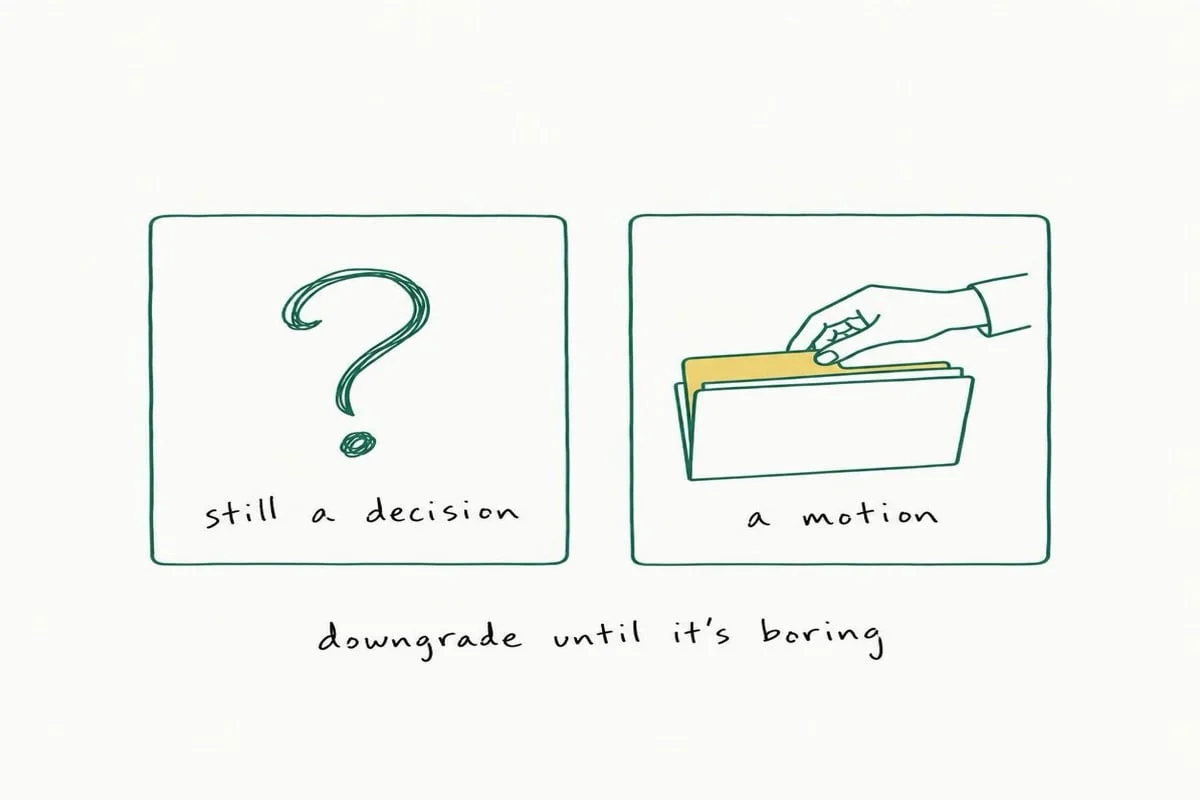
You do not need to overhaul your entire workflow overnight. Start by writing the entry test and the capacity cap for your top priority level on a single sticky note. Place it where you manage your tasks.
This single line is the smallest possible version of a professional system. It serves as your anchor when the chaos of the workweek begins. It is the boundary that protects your time, forces honest conversations with your superiors, and ensures that when you finally close your laptop at the end of the day, you know exactly what you achieved—and why it was worth doing.
In a world that demands everything at once, the most professional act you can perform is to decide what is worth waiting.