The cycle is agonizingly familiar: you resolve to tighten your belt, delete the shopping apps, and promise to exercise fiscal restraint. Yet, within days—or sometimes hours—you find yourself clicking "Buy Now" on an item you didn’t need, didn’t plan for, and might not even want once it arrives.
For many, this pattern is not a failure of character or a lack of willpower; it is a mismatch between a vague, general resolution and a highly engineered retail environment. While personal finance advice often focuses on the morality of saving, the reality of impulse buying is a tactical problem. To stop it, one must stop relying on broad "vows" and start understanding the specific environmental triggers that turn a moment of boredom into a transaction.
The Disconnect: General Resolutions vs. Specific Triggers
The primary reason most spending rules fail is that they are built in a calm environment (a Sunday morning at the kitchen table) but must be executed in a chaotic one (a Thursday night at 11:00 p.m. after a taxing day).
Your resolve is a general, abstract concept. The purchase, however, is a physical or digital event occurring in a specific context. Modern retail is not designed for the indecisive; it is designed for the friction-less. Saved credit card details, "one-tap" checkout buttons, and countdown timers are all engineered to reduce the "cognitive gap"—the time between identifying a want and fulfilling it. When a website provides a countdown timer signaling that a deal expires at midnight, it is weaponizing your psychology. A general resolution to "save more money" simply cannot compete with an expertly crafted urgency cue that requires only eleven seconds to complete.
Most advice on this subject—avoid the mall, make a list, wait 24 hours—is well-intentioned but fundamentally flawed because it is aimless. It treats all spending as the same, failing to acknowledge that a purchase made due to a "flash sale" email requires a different defense mechanism than a purchase made because you were feeling sad or bored on a Tuesday night.
Chronology of an Impulse: Anatomy of the 30-Day Audit
To break the pattern, you must first document it. The most effective diagnostic tool is a retrospective audit of your last 30 days of spending. This is not about budgeting or tracking every penny for the sake of austerity; it is about finding the "fingerprint" of your lapses.
Step 1: The Diagnostic Audit
Open your credit card statement and your order history from your primary shopping platforms. For every item you would not have written on a list that morning, record four variables:
- The Amount: Was it a small, "harmless" add-on, or a significant drain?
- The Timing: Note the date and the approximate hour.
- The Venue: Which specific app or store did the transaction take place in?
- The Preceding Context: What were you doing or feeling in the hour before the purchase?
Step 2: Categorizing the Triggers
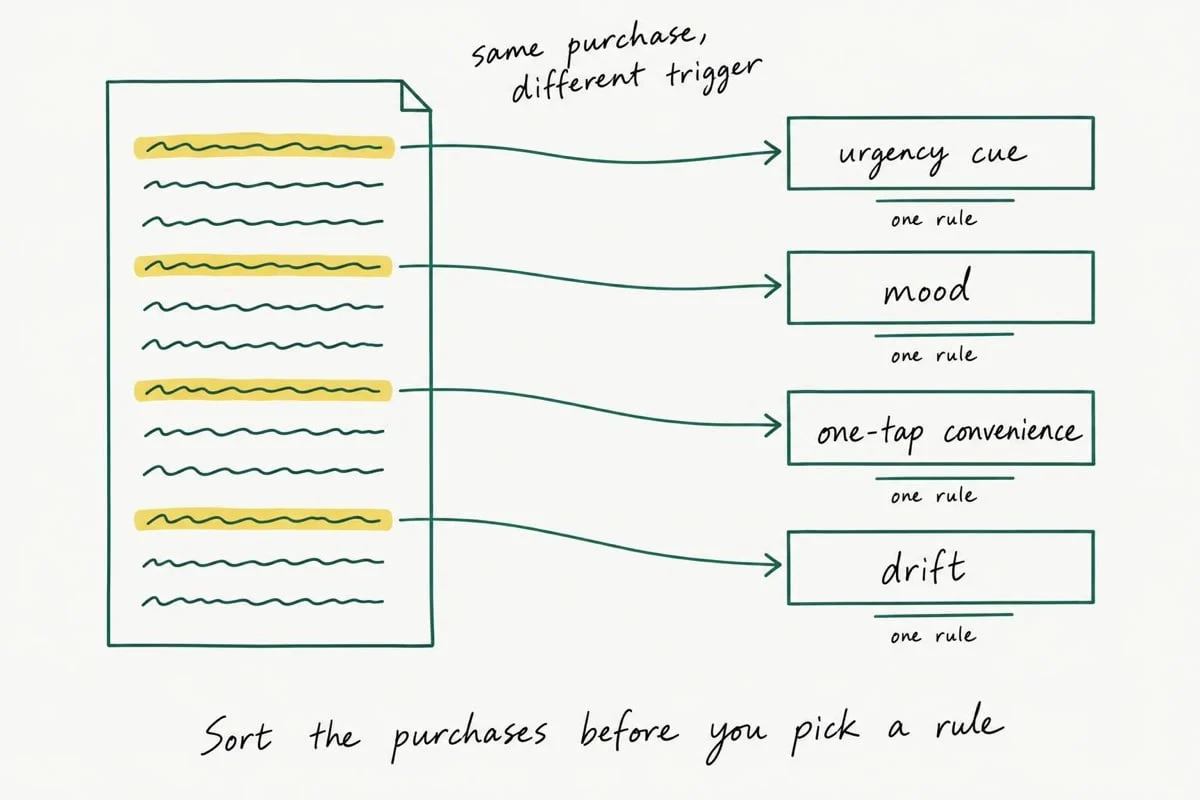
Once you have the data, look for "bunching." Do your purchases cluster late at night? Do they occur after opening a specific marketing email? This is where you move from abstract guilt to concrete strategy. We can categorize these into four specific triggers:

- Urgency Cues: Flash sales, countdown clocks, or "only 2 left in stock" warnings. These exploit the "fear of missing out" (FOMO) and the human tendency to anticipate future regret.
- Mood: Emotional regulation. Research, including findings published in PLOS ONE, indicates that feelings of sadness or stress can lead to higher price-setting and increased impulsive spending.
- One-Tap Convenience: When your card is saved and you are already logged in, the barrier to entry is effectively zero.
- Drift: The "window shopping" phenomenon. You open an app or walk into a store without a specific goal, and the environment creates one for you.
Supporting Data: What Research Actually Says
The world of behavioral finance is often cluttered with "rules of thumb" that lack empirical backing. For instance, the popular "48-hour waiting rule" is widely cited, yet there is a surprising lack of large-scale, peer-reviewed clinical trials proving its universal effectiveness. While waiting is a sensible strategy for many, it is not a cure-all.
Conversely, research into the "sadness effect" in spending is quite robust. Studies have shown that when individuals are in a negative emotional state, their valuation of objects changes, often leading to overpayment. Similarly, tracking spending has been linked to better financial outcomes in academic studies, such as the field experiment published in the Journal of Financial and Quantitative Analysis. While that specific study focused on student borrowing, the broader implication is clear: the act of auditing your own behavior acts as a cognitive "circuit breaker."
The Tactical Response: Rule-Setting by Trigger
Once you have identified your primary triggers, you must implement a rule that lives where the trigger lives. If your impulse buying happens in an app, the rule must be digital. If it happens in a store, the rule must be physical.
The Rules for Success
- For Urgency: If you see a countdown timer or a "low stock" warning, your rule is to close the tab immediately. If the item is truly necessary, you will still want it on Sunday. If you still want it then, buy it at full price.
- For One-Tap Convenience: Delete your saved credit card information from the specific apps identified in your audit. Adding 30 seconds of friction (the time it takes to find your wallet and type in the numbers) is often enough time for the impulsive urge to subside.
- For Mood: Create a "replacement action." If you find that you shop when bored or stressed, you need a pre-planned alternative. Whether it is a two-minute nervous system reset, a walk, or a specific task, having a non-monetary way to process that emotion is vital.
- For Drift: Establish a "zero-entry" policy. Never open a shopping app or walk into a store without a pre-written list of specific items. If it isn’t on the list, it doesn’t enter the cart.
Implications: Moving Beyond Guilt
It is essential to distinguish between a lapse and a pathology. A slip-up—where you delete your card but later type it in to buy something you genuinely decided you needed—is not a failure. It is the system working. You have moved the decision-making process from the "impulse" phase (the 11 seconds of scrolling) to the "deliberation" phase (the 30 seconds of typing).
However, if your spending is characterized by persistent distress, the hiding of purchases from partners, or significant debt that feels unmanageable, the problem may fall into the category of "compulsive buying disorder." Research suggests that for roughly 5% of the population, shopping is a source of clinical distress. In such cases, no amount of "tracking" will replace the need for professional, therapeutic intervention.
Final Thoughts: The Two-Week Check
The final step in this process is the two-week review. Set a calendar reminder to look at your spending after 14 days. If the number of impulse purchases has dropped, keep the rules exactly as they are. If they haven’t, do not "stack" more rules on top. Simply discard the ineffective rule and swap it for another.
The goal is to move away from the "all or nothing" mentality that leads to total failure. By treating your spending as a series of environmental triggers rather than a moral failing, you turn the tide from being a passive victim of retail engineering to being an active, intentional consumer. You are not a different person; you are simply a person with a better system.