
You used to stare out the train window. You used to stand in the checkout line with nothing to do but stand there, watching the world move at its own pace. You used to lie in bed for ten minutes before sleep with no input at all—no notifications, no blue light, just the internal hum of your own thoughts.
When did that stop?
It wasn’t a sudden, cataclysmic shift. It leaked out of your life one filled gap at a time. The red light. The elevator. The ninety seconds the kettle takes to boil. That first conscious minute of the morning, once reserved for the slow transition into wakefulness, is now spent on a screen six inches from your face. Every one of those moments used to be empty. Now, they are colonized by a relentless stream of digital information.
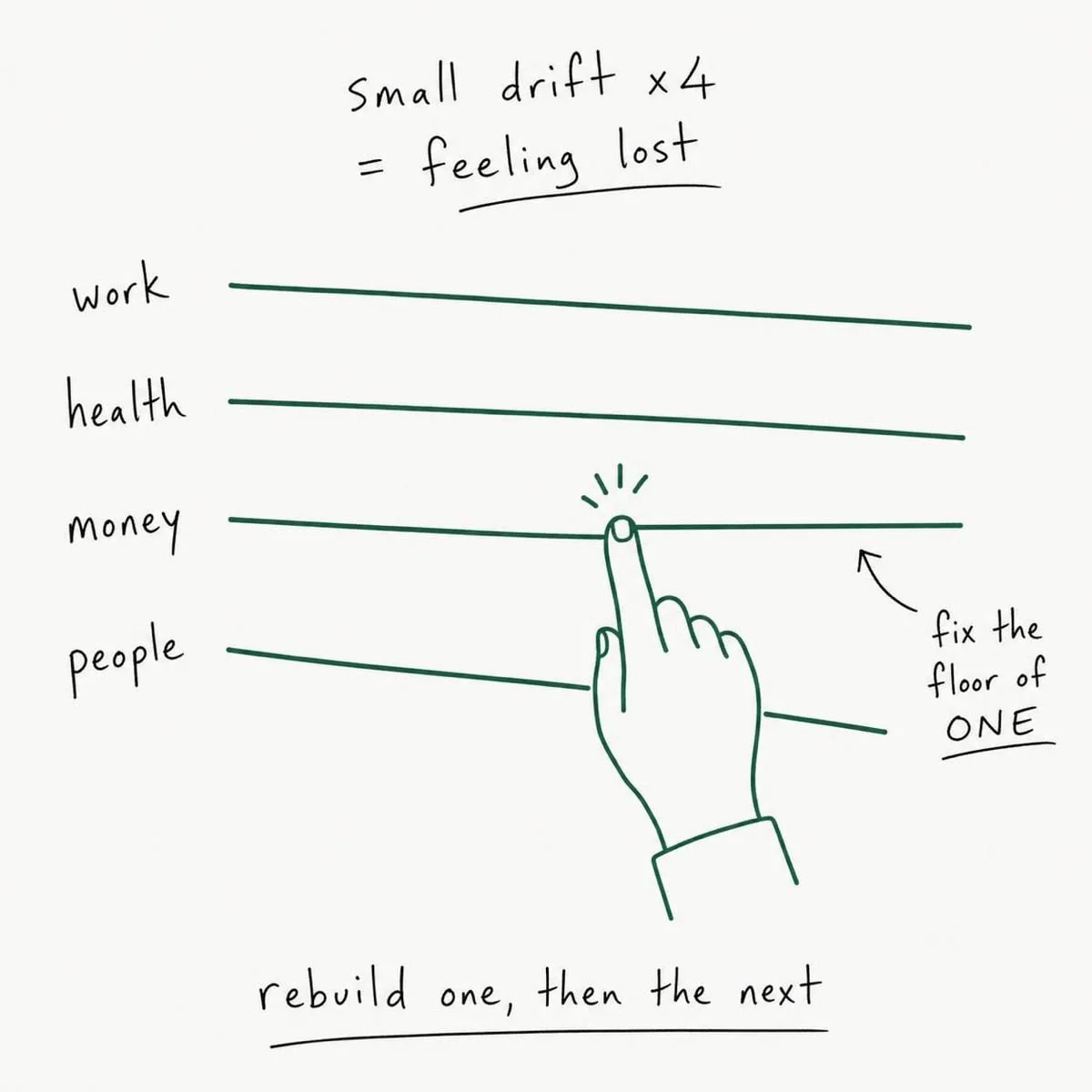
If you are in your forties or fifties, attempting to navigate the complex, often overwhelming task of recalibrating your health, your finances, and your career simultaneously, you may feel as though your discipline has evaporated. You blame your lack of focus, your waning willpower, or your inability to stick to the "plans" you’ve meticulously drafted. But the uncomfortable truth is that you haven’t lost your discipline—you have lost your boredom. And as emerging neuroscience suggests, boredom was doing some of your most important life-maintenance work.
The Neuroscience of the "Default Mode"
For almost all of human history, boredom was not a problem to be solved; it was the natural, dormant state of the human brain. It was the "standby" mode your mind dropped into the moment nothing else demanded its attention. In that state, it did not go to sleep; it began its heaviest lifting.
Neuroscientists, most notably Marcus Raichle and his colleagues at Washington University, identified the machinery responsible for this phenomenon: the "Default Mode Network" (DMN). When you focus intently on a task, the DMN goes quiet. The moment you stop focusing, it ignites.
The DMN is not a brain on vacation. It is a brain performing the high-level cognitive integration that is impossible while you are consuming content. Within the DMN, you process self-referential thoughts, weave together autobiographical memories, simulate the minds of others, and—crucially—construct a vision of your own future. If you are a forty-eight-year-old attempting to rewrite your life trajectory, this network is your primary tool. It is where you consolidate what you have learned and decide who you want to be.
When we ask why boredom is "good" for us, we are essentially acknowledging that boredom is the feeling of the brain finally being allowed to perform its own maintenance.
Chronology of the Digital Takeover: How the Gaps Vanished
To understand how we arrived at this state of constant stimulation, we must look at the evolution of the "seam."
- The Pre-Digital Era (Pre-2000s): The day was defined by "seams"—the transitional periods between distinct tasks. A commute was a block of time where an individual was tethered only to their own thoughts. Queuing, waiting for appointments, and household chores were characterized by low-stimulation, which allowed for involuntary mental "filing."
- The Proliferation Phase (2000–2010): The advent of mobile internet access began to erode these seams. While the technology was limited, it introduced the first habit of reaching for a device during "dead time."
- The Algorithm Era (2010–Present): With the rise of high-speed social media feeds and infinite-scroll architecture, the "seams" were effectively deleted. A 2026 industry survey suggests the average American checks their phone 186 times a day—roughly once every five waking minutes. This frequency ensures that the mind never has a window long enough to drift into the DMN.
The shift was not an accident; it was a consequence of an attention economy that views "empty time" as a bug to be patched with content. We have allowed our internal quiet to be cannibalized by an external feed that is fundamentally hostile to long-term reflection.
Supporting Data: The Mechanics of Quiet
The benefits of a "bored" brain are not merely anecdotal; they are backed by rigorous psychological research. Three key processes rely on the absence of external input:
1. Memory Consolidation
Our brains spend approximately half of their waking hours in "offline" states—daydreaming or mind-wandering. These states are critical for consolidating new memories. Studies show that a few minutes of quiet rest after learning a new skill or concept can cement that information as effectively as a full night of sleep. By constantly filling these gaps with content, we are effectively starving our brains of the time needed to retain what we learn.
2. The Creative Runway
Creativity requires a recombination of ideas, a process that happens in the subconscious. When researchers forced subjects to perform mundane, boring tasks (such as copying numbers from a phone book) and then tested their creativity, the "bored" group outperformed the active group by a significant margin. Boredom is not the enemy of creativity; it is the runway upon which creative solutions take flight.
3. Problem-Solving Efficacy
Perhaps most relevant to those in midlife, the ability to solve complex, stuck problems is heightened by mind-wandering. Research indicates that individuals who engaged in an undemanding, "boring" task were 41% more successful at solving creative problems they had previously been stuck on, compared to those who either rested completely or tried to "force" a solution through intense concentration. The answer often arrives in the shower or on a walk because those environments allow the brain to connect the dots in the background.
Official Perspectives: The Psychology of "The Rebuild"
Psychologists and productivity experts are increasingly noticing a trend: people in their late forties and fifties are suffering from a "vacancy problem."
The common refrain among this demographic is: "I know exactly what I need to do—I have the plans, the books, and the resources—but I cannot make it stick."
This is not a failure of character. It is an integration failure. Changing your life after 40 is not a matter of following a checklist; it is an act of architecture. You are trying to reconcile who you were at 30 with the reality of who you are now, while mapping out a future that feels authentic. This integration requires a high-level, "big picture" perspective that is only accessible through the DMN.
If you are constantly filling your bus ride with podcasts, your shower with news, and your post-dinner hour with a feed, you are denying your brain the "mental room" required to process these changes. You are trying to execute a complex, multi-year, multi-domain overhaul in a mind that is constantly occupied by someone else’s content.
Implications: The Quiet Cost of Constant Input
The long-term implications of our collective inability to be bored are profound.
- Emotional Suppression: When the gaps are removed, we stop noticing the "low-grade" signals our brain is trying to send us. The unresolved resentment, the early signs of burnout, the quiet dissatisfaction with a career path—these things usually surface during the gaps. By removing the gaps, we effectively numb ourselves to our own internal state.
- The "Motivation" Myth: Many people believe they have a motivation problem. In reality, they have a clarity problem. Without the quiet to ask "What am I actually doing with the back half of my life?", they remain in a cycle of aimless, high-effort activity that leads to burnout rather than progress.
- The Erosion of Self: The DMN is where our sense of self is constructed. If we never engage that network, we become increasingly reactive, living lives dictated by the inputs of others rather than the internal compass of our own goals.
Reclaiming the Seams: A Practical Path Forward
This is not a call for a dramatic digital detox or a return to the 1990s. Willpower-based "strikes" against technology almost always fail because they are too taxing to sustain. Instead, the solution lies in the strategic protection of your "seams."
How to Reintroduce Boredom
- The Morning Ten: Protect the first ten minutes of your day. No phone, no news, no email. Allow your brain to transition from sleep to wakefulness without external influence.
- The Unplugged Commute/Walk: Designate one period per day—a walk to the car, a train ride, or a stroll around the block—as a "content-free zone." If you feel the urge to pull out your phone, acknowledge the feeling and let it pass.
- The "Surface" Notebook: Keep a physical notebook to record the thoughts that surface during these quiet moments. Often, the problems you are "stuck" on will find their solutions here.
- The Bedtime Buffer: Cease all screen interaction at least 15 minutes before sleep. Let your mind wander through the day’s events, effectively "filing" your memories before you drift off.
Final Thoughts
You do not need more information. You have enough books, enough podcasts, and enough advice. What you lack is the space to turn that information into decision and that decision into action.
If you are in the midst of a life rebuild, stop viewing boredom as a waste of time. View it as a fundamental component of your strategy. By subtracting the constant input, you allow the most important part of your brain to come back online. You don’t need a new productivity hack; you need to give yourself a few minutes a day where you are finally bored enough to hear yourself think. That is where the change begins.