The 401(k) statement has been sitting in your inbox for three weeks, unopened. You know the ritual: you click it, glimpse a balance that feels significantly smaller than the life you’ve built, feel a cold knot of anxiety in your stomach, and promptly close the browser tab. You are a competent professional; you manage complex projects at work, you balance a household, and you navigate the intricate logistics of modern parenting. Yet, when it comes to your own net worth, you remain in a state of perpetual "financial fog."
This is not a failure of intelligence. It is a failure of systems. For millions of people entering their 40s, money has become the one area of life relegated to the "I’ll deal with it later" pile. This cycle—avoid, feel behind, repeat—is the silent tax on your peace of mind. However, as you enter your peak earning years, the strategy must shift from one of reactive willpower to one of proactive, automated architecture.
The Reality Check: Where You Stand at 40
Financial experts, including those at Fidelity, often cite a "on track" benchmark of having three times your annual salary saved for retirement by age 40. For many, this number serves not as a guide, but as a source of shame. According to recent data, the median American in their 40s holds roughly $37,700 in financial assets (excluding home equity), and nearly 40% of the demographic has zero retirement savings.
If these figures trigger a sense of inadequacy, it is time to recalibrate your perspective. These benchmarks are targets, not a final scoreboard. Your 40s are characterized by "peak earning power," and you still possess 20 to 25 years of compounding runway before traditional retirement age. This decade is the most critical window for catch-up contributions.
The Blunt Math of Compounding
The urgency of your 40s is defined by the mathematical cost of delay. If you begin a disciplined savings habit of $15,000 annually at age 40, you can reasonably expect to reach a $1 million target by age 65, assuming a 7% average annual return. If you wait until age 50 to initiate that same level of rigor, your required annual savings jump to nearly $37,500 to hit the same goal. The window is still wide open, but the cost of entry is increasing with every passing year.
Why "Getting Organized" Continues to Fail You
Most people approach financial planning as a monolithic, chaotic project. They attempt to solve for college tuition, credit card debt, retirement portfolios, and estate planning simultaneously. The human brain, when faced with such an overwhelming "tangle," defaults to the path of least resistance: avoidance.
Behavioral economists Shlomo Benartzi and Richard Thaler have long identified "inertia" as a primary obstacle to personal wealth. However, they also identified it as the ultimate solution. By defaulting to a state of inaction, you fail to build wealth. But by setting a "good default"—such as automatic retirement contributions—you turn inertia into a powerful, silent engine that builds your future while you focus on the fires of today.
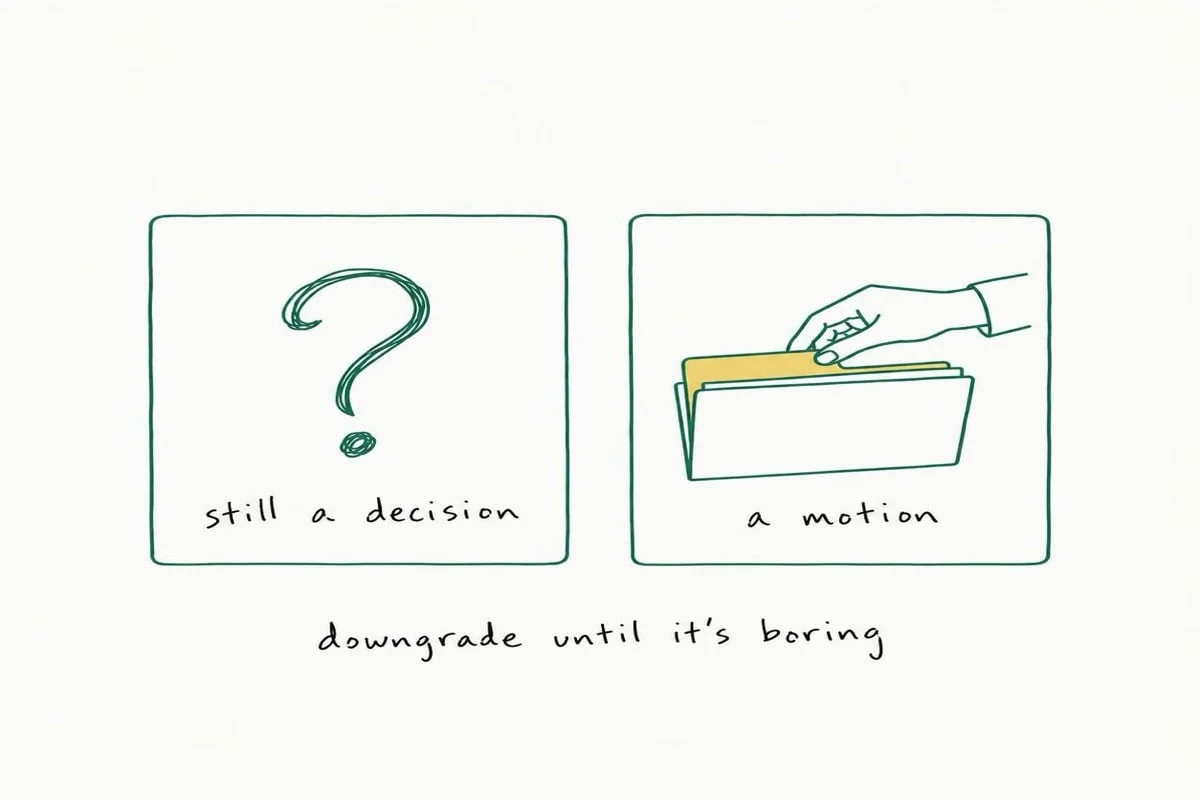
The fix is not a weekend of spreadsheet color-coding. The fix is a sequence of small, irreversible, automated decisions.
The Hierarchy of Financial Operations
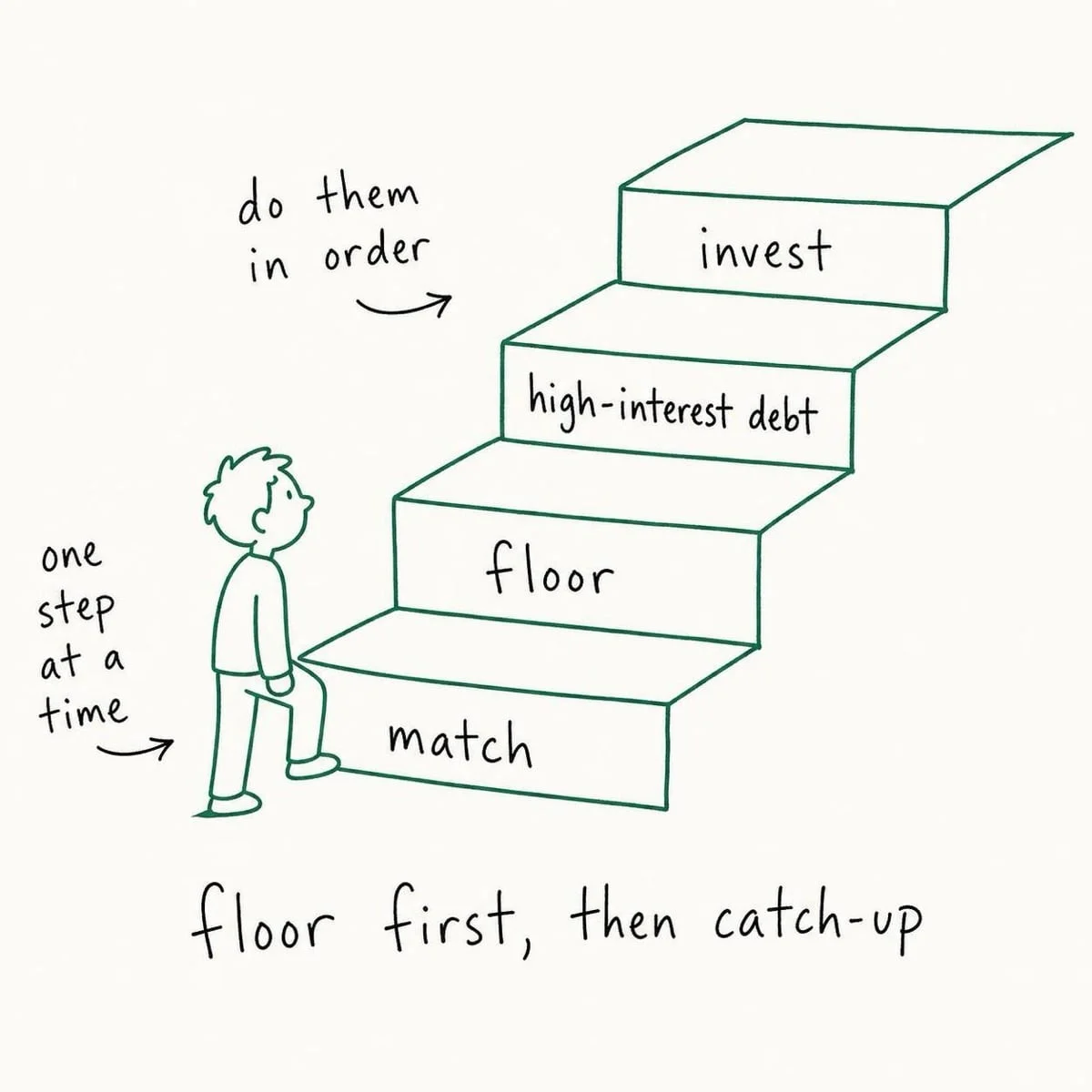
To regain control, you must stop trying to optimize everything at once. Instead, adopt a rigid "order of operations." Vanguard’s framework offers a clean, prioritized list that ensures your money is working as hard as you do.
1. The Guaranteed Return: Capture the Match
If your employer offers a 401(k) match and you are not contributing enough to claim it, you are effectively turning down a raise. Whether it is a 50% or 100% match, this is an immediate, guaranteed return that no stock market investment can replicate. This is your first priority. It requires ten minutes and one form.

2. The Floor: Establishing the Emergency Fund
A "floor" is a liquid safety net—a few thousand dollars in a high-yield savings account—designed to prevent a minor life crisis from becoming a debt-inducing disaster. Research suggests that simply holding $2,000 in liquid savings correlates to a 21% increase in reported financial well-being. Once you reach that initial threshold, you can gradually expand toward three to six months of expenses.
3. Attacking High-Interest Debt
Any debt with an APR above 20% (typically credit cards) acts as a reverse investment. Paying off a 22% credit card balance provides a guaranteed 22% return on your money. No index fund can offer this level of reliability. Attack these balances with intensity only after your company match is secured and your starter emergency fund is established.
4. Aggressive Retirement Feeding
Only after the "floor" is secure and high-interest debt is eliminated do you shift your focus to maximizing your tax-advantaged retirement accounts. In your 40s, you are eligible for IRS "catch-up" contributions, which allow you to exceed standard limits. This is your primary lever for late-stage growth.
Chronology of a Successful Financial Month: A Case Study
Consider "Marco," a 47-year-old operations manager. Like many, Marco felt the weight of his financial ambiguity. He didn’t start a marathon budgeting session. He utilized the sequence:
- The Weekend Reset: On a Saturday morning, Marco spent ten minutes adjusting his 401(k) contribution from 3% to 5% to capture his employer’s full match.
- The Automation: He opened a separate high-yield savings account and set an automatic $200 transfer to occur the day after his paycheck hits. He no longer has to "feel" motivated to save; the system does it for him.
- The Debt Strategy: He listed his credit card debt, set a fixed payment amount that he could afford, and committed to paying it down sequentially. He ignored his low-interest car loan for now, focusing his excess cash where it would provide the most mathematical relief.
- The Escalation: Borrowing from the "Save More Tomorrow" program, Marco opted into an automatic 1% annual contribution increase for his 401(k). He won’t feel the difference in his take-home pay, but in five years, his savings rate will be significantly higher.
Marco is not a more disciplined person; he is a person who has built a more disciplined system.
Supporting Data and Financial Rules
While "rules of thumb" are not substitutes for a rigorous strategy, they are effective for anchoring your goals.
- The $27.40 Rule: A psychological tool that breaks down a $10,000 annual savings goal into a manageable $27.40 per day.
- The 3-6-9 Rule: A staged approach to emergency savings, suggesting you reach for 3 months of expenses, then 6, then 9.
- The $1,000-a-month Rule: A rough projection indicating that you need approximately $240,000 saved for every $1,000 of monthly retirement income, assuming a 5% withdrawal rate.
These are not laws, but guideposts. The true strategy is the sequence. If you follow the order of operations, the math will eventually resolve itself.
Implications: The Psychological Shift
The most profound implication of this approach is the removal of guilt. By shifting the focus from "budgeting harder" to "automating a sequence," you stop treating every financial statement as a report card. You stop looking for willpower, which is a finite resource, and start relying on structure, which is infinite.
When you treat money as a domain that requires a "life plan"—much like your physical health or your career trajectory—you stop treating it as a crisis. You move from a state of reactive anxiety to one of quiet, compounding progress.
The next step is not to overhaul your life. It is to open your retirement account, verify your match, and set one automated transfer. Your 40s are not the end of your financial runway; they are the start of your most efficient climb. By the time you reach your 50s, you won’t need to be a different person—you will simply be a person who finally installed the right system.