
You are approaching or have already crossed the threshold of 50. The house is quiet, the career is stable, and the financial foundation is largely set. Yet, in the stillness of a Sunday afternoon, a persistent, gnawing question surfaces: Is this it?
For many, this feeling is not a sign of failure but a symptom of a transition. The roles that defined the last two decades—the climbing of the corporate ladder, the active rearing of young children, the primary provider script—have begun to loosen. In this vacuum, the instinct is often to seek a "blank slate." We dream of a clean break, a total erasure of the past, and the emergence of a brand-new persona.
However, the consensus among modern behavioral researchers and career strategists is clear: the blank slate is a fallacy. It is a myth that causes most midlife reinventions to stall before they even gain traction. You do not need to become someone new. You have three decades of hard-won pattern recognition, nuanced judgment, and refined skill sitting right at your fingertips. The task at 50 is not to discard these assets but to redeploy them.
The Myth of the Midlife Crisis: Why Being "Lost" Is Normal
The term "midlife crisis" has long been a cultural bogeyman, suggesting that at 50, one’s life is inevitably on the verge of detonation. But this framing is fundamentally flawed. When you feel "lost" in your 50s, you are not experiencing a breakdown; you are experiencing a structural shift.
Psychologically, this period marks a transition between two rooms. You have outgrown the identity that carried you through your 30s and 40s, but you have not yet fully inhabited the identity that will define your 60s and beyond. This state of disorientation is not a defect—it is the sound of your life preparing for a new iteration.
Research indicates that the "crisis" narrative is largely a social construct. In reality, life satisfaction often follows a U-shaped curve. It dips during the high-pressure years of early-to-mid career and parenting, only to see a documented, robust upswing after the age of 50. You aren’t arriving late to the party; you are arriving exactly when the curve begins to bend back toward peak satisfaction.
Supporting Data: Why 50 Is a Competitive Advantage
The prevailing belief that age is a disadvantage in the workforce or in personal development is often a story, not a fact. In the modern knowledge economy, "human capital"—the combination of experience, emotional intelligence, and social networks—is a premium asset.
The Emotional Dividend
As people transition past midlife, they become measurably more proficient at regulating their emotions and filtering out trivial stressors. This ability to focus on what truly matters is the secret weapon of the 50-plus reinvention. Where a 30-year-old might approach a career pivot with anxiety or a need for external validation, a 50-year-old approaches it with the calm, steady hand of experience.
The 40/60 Rule of Reinvention
Data on successful career pivots reveals a compelling pattern: the most durable reinventions involve a 40 to 50 percent overlap with previous experience. When individuals attempt to start from absolute zero, the failure rate is significantly higher because they lack a foundation to stand upon. By carrying over nearly half of their existing expertise, they ensure that their "new" venture is anchored in competence while providing enough space for the novelty they crave.
Strategic Redeployment: A Chronology of Change
If reinvention is not a reset, then what is it? It is a process of redeployment. To move from feeling stuck to feeling purposeful, one must follow a logical, sequenced trajectory.
Phase 1: Identifying the Four Domains
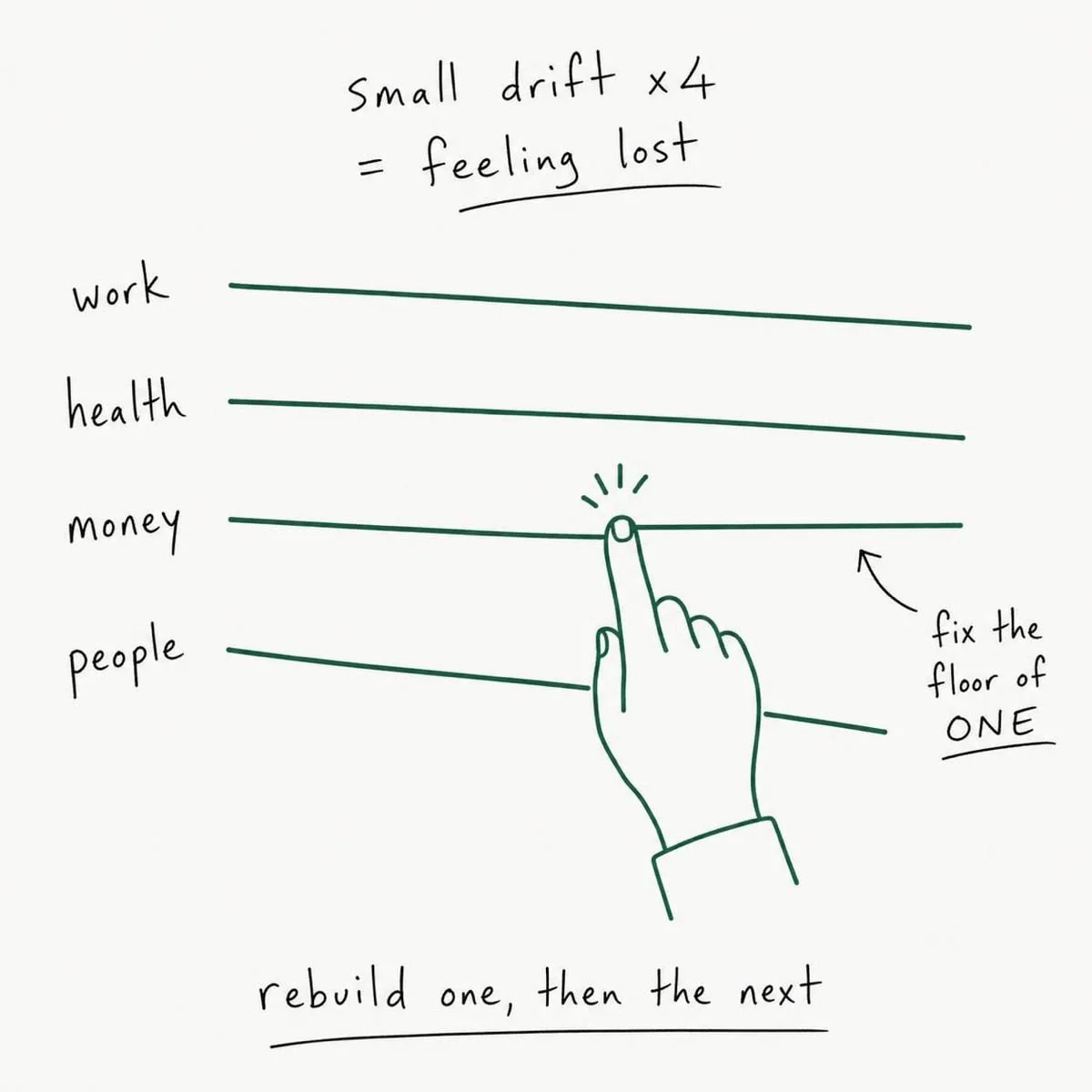
At 50, life is usually comprised of four distinct domains: Work, Health, Money, and Family. Most people feel overwhelmed because they attempt to "fix" all four simultaneously. The first step in a successful transition is to audit these domains and acknowledge that they do not need to be addressed in parallel.
Phase 2: The Pilot Experiment
Instead of making grand, irreversible decisions—such as quitting a job to launch a startup or moving to a different continent—the most successful individuals run "experiments." If you suspect you want to transition into consulting, coach one client. If you want to move into creative work, write one piece. By treating these moves as low-stakes tests, you gather data on what actually fits your life rather than relying on internal speculation.

Phase 3: Sequencing the Shift
Once one domain begins to stabilize, it serves as the fuel for the next. For example, once a new professional identity begins to generate momentum, that confidence and financial stability can then be applied to optimizing health or refining family dynamics. This sequential approach prevents the burnout that typically accompanies radical, overnight transformations.
Case Study: Anika’s Operations Shift
Consider the case of Anika, a 52-year-old hospital operations manager. After 25 years of ensuring the efficient flow of hospital systems, she felt a profound sense of stagnation. Her initial impulse was a total reset: quitting her job, two years of tuition-heavy graduate school, and entering a completely unrelated field.
Instead, Anika chose redeployment. She maintained her role while identifying a niche: advising small private clinics on operational efficiency. She tested this by helping one clinic reorganize its scheduling during her off-hours. The experiment required no new degree, utilized her existing network, and confirmed her desire to work with smaller, more agile teams. Within nine months, she had a client base. She had not "started over"; she had simply pointed her existing expertise at a different, more satisfying target.
Implications: The New Paradigm of Aging
The implications for individuals at this stage are profound. We must move away from the "all or nothing" mentality. The societal pressure to either "keep grinding" or "give up and retire" ignores the vast middle ground where the most meaningful work is done.
The "Same Person, Different Shape" Philosophy
When you view reinvention as redeployment, the terror of the "blank slate" vanishes. You are not erasing your history; you are curating it. You are taking the "building blocks" of your life—your skills, your network, your hard-won wisdom—and rearranging them into a structure that better suits your current values.
The Role of Mature Judgment
Employers and clients are increasingly recognizing the value of mature judgment. While younger workers may possess technical agility, those in their 50s possess the "meta-skills" of crisis management, conflict resolution, and long-term vision. These are not liabilities; they are the primary goods that you bring to the marketplace.
Expert Perspectives on Midlife Transitions
Dr. Elena Rossi, a career psychologist specializing in mid-career transitions, notes: "The individuals who thrive after 50 are those who treat their past as an asset rather than a sunk cost. The people who struggle are those who view their age as a barrier to entry. We are seeing a shift where ‘fractional’ work, consulting, and advisory roles are exploding precisely because they require the depth of experience that only a 50-year-old can provide."
Financial advisors also emphasize that redeployment is the most sustainable path for economic security. Rather than liquidating savings to fund a "leap of faith," individuals are finding success by creating hybrid income streams that build upon their existing professional reputations.
Conclusion: The Move to Make This Week
If you are currently feeling the stirrings of a desire for change, do not detonate your life. Do not resign from your job or move to a cabin in the woods just yet.
Start with a single page. Write down the four domains: Work, Health, Money, and Family. Identify the one area where a shift would provide the highest leverage for your personal happiness. Design a single, small, low-risk experiment that you can complete within seven days.
Reinvention at 50 is not a dramatic performance for an audience. It is a quiet, deliberate process of aligning your life with your authentic self. You are not behind, and you are not starting from nothing. You are simply stepping into the part of the curve that bends upward. The question is no longer "is this it?" but rather, "which version of me gets to come forward next?"
The foundation is already laid. Now, it is time to build a different shape.