Introduction: The Quiet Unsettling of Midlife
The feeling of being lost in one’s 40s rarely manifests as a dramatic, life-altering crisis. Instead, it’s a more insidious, quiet unease that can creep into everyday life. On the surface, everything might appear stable: a satisfactory job, a solid marriage, bills paid on time. Yet, somewhere between the ages of 44 and 46, a persistent, disquieting question begins to echo: "Is this it?" This isn’t necessarily a sign of clinical depression or an existential breakdown, but rather a subtle disconnection from a life that, while seemingly well-constructed, no longer feels entirely one’s own.
This pervasive feeling has a distinct texture, characteristic of this particular decade. The career that demanded two decades of effort may now operate on autopilot, feeling slightly out of sync, akin to a suit that no longer fits quite right. The body’s resilience diminishes, making recovery from a poor night’s sleep or a challenging week a more protracted affair. Relationships, whether with a partner or long-standing friends, might have quietly transitioned into a state of passive maintenance, leaving one uncertain as to when the active engagement faded. Individually, these elements may not constitute an emergency, but collectively, they can fuel sleepless nights and a pervasive sense of unease.
Crucially, it is vital to understand that feeling lost in your mid-40s is not an indictment of a life wasted. More often than not, it represents a period of gradual drift rather than catastrophic damage. And importantly, drift is something that can be addressed and rectified.
Understanding the "Midlife Drift": A Multifaceted Disorientation
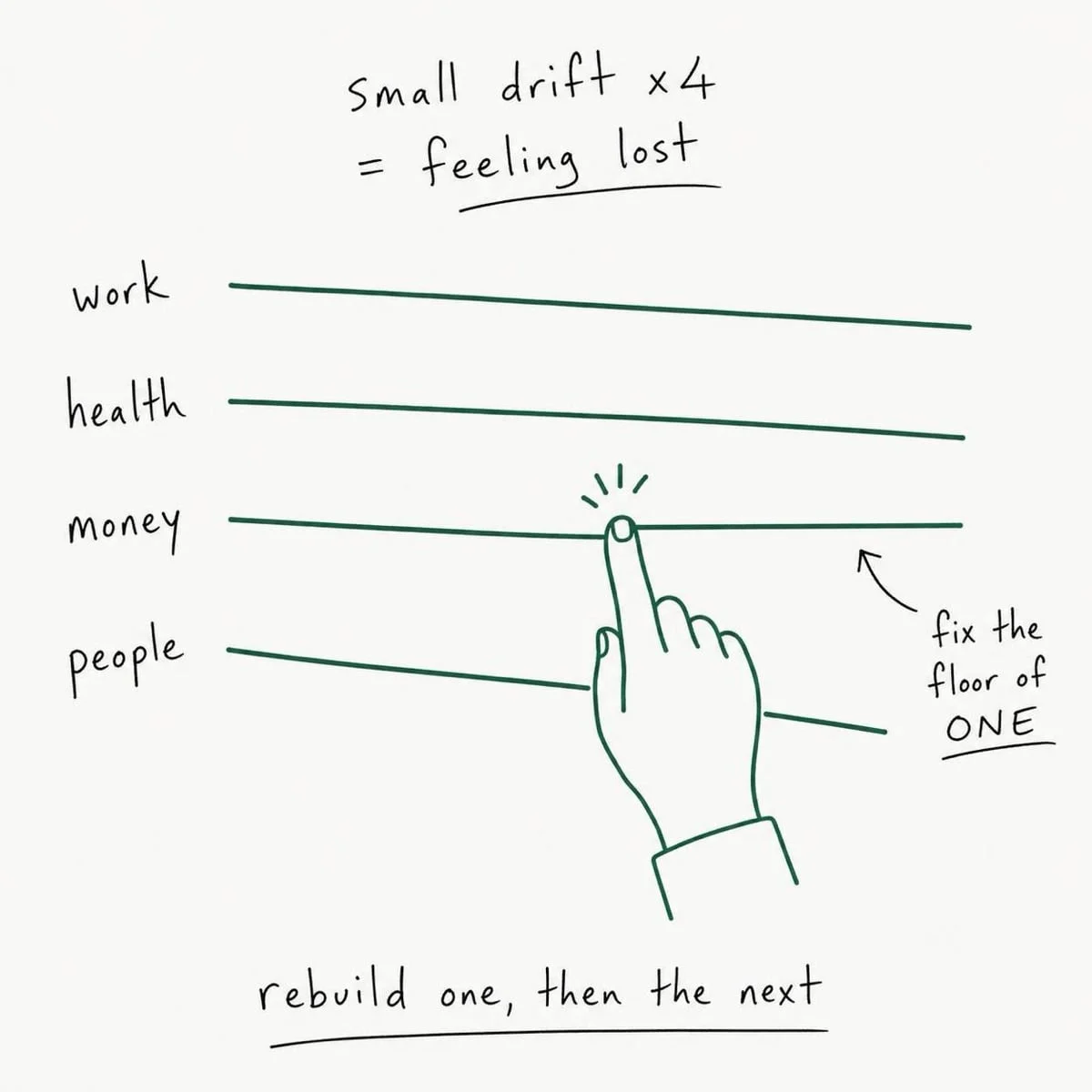
The sensation of being lost in one’s 40s typically arises from a simultaneous slipping of several life domains out of sync, rather than a singular failure in any one area. Work, health, financial stability, and close relationships may each have experienced a subtle deviation over time while one was diligently focused on maintaining the overall structure. No alarms were triggered because no single element completely broke down. The disorientation stems from the cumulative effect of these minor shifts.
This phenomenon is not merely anecdotal. Extensive research on global wellbeing, spanning 145 countries, consistently reveals a U-shaped curve in life satisfaction, with a discernible dip occurring around the late 40s and early 50s, followed by a subsequent rise. This dip, a robust finding in social science, often occurs precisely at the juncture where established life structures begin to wear thin, and new ones have yet to be fully constructed. It mirrors the feeling of being "stuck in a rut," but within the context of the 40s, this sensation tends to impact multiple facets of life concurrently. The frequent online searches for phrases like "life at 40 for a woman" and "45 and feeling lost" underscore the widespread nature of this experience; it is not a niche problem but a defining characteristic of the decade for many.
You Are Not Failing: Navigating the Wellbeing Dip
For those who find themselves quietly calculating whether they are "behind" in life, it’s imperative to pause and re-evaluate. The narrative that suggests feeling lost in your 40s equates to a life mismanaged is overwhelmingly inaccurate. The majority of individuals experiencing this sentiment are not in crisis but are responding to a confluence of specific life pressures, rather than a judgment on their personal worth.
Cornell University research, analyzing national survey data, indicated that only approximately 23% of adults in midlife reported experiencing anything akin to a "midlife crisis," with a mere 8% attributing it directly to the aging process itself. This suggests that the internal script of "I’m 40 and I’ve wasted my life" is statistically improbable for most. The same research found that when individuals did feel destabilized during midlife, it was typically linked to concrete life events such as job layoffs, divorce, or the illness of a parent, rather than a sudden existential dread about the passage of time.
There is a fundamental structural reason why this period can feel particularly challenging. The 40s are often a decade of overlapping demands: children requiring significant attention, aging parents needing support, mortgage obligations, peak career responsibilities, and the body beginning to send its first undeniable signals of aging. Research characterizing the middle years often describes individuals in this age group as the "engine room" of families and communities, simultaneously managing a multitude of responsibilities. Feeling scattered is an understandable consequence of running more concurrent processes than at any other point in life, often with reduced sleep. The anxiety that one might be exhibiting signs of "losing at 40" is a reflection of this immense load, not an accurate assessment of personal failure.
The Reframe: From Crisis to Controlled Drift Correction
The most transformative shift in perspective comes from reframing the experience. Feeling lost in your 40s is not a signal to undertake a singular, monumental life overhaul. Instead, it is an indication that the foundational support has slightly weakened across several areas simultaneously. The solution lies not in an immediate, sweeping transformation, but in rebuilding that foundation, one area at a time. Many conventional pieces of advice inadvertently exacerbate the issue by suggesting drastic measures like quitting jobs, chasing elusive passions, or "blowing it all up." This impulse for a dramatic clean slate is precisely what can worsen the feeling of being lost.
The critical distinction lies between "ceiling" goals and "floor" goals. Ceiling goals represent the aspirational, impressive achievements: running a marathon, reaching a specific financial target, or becoming an entirely different person. Floor goals, conversely, are the essential elements that sustain you on your worst days: a ten-minute walk, a five-minute review of your finances, or a single genuine conversation each week. When you feel lost, your ceiling goals may remain intact, but it is your floor that has quietly eroded. The lights may still be on upstairs, but the underlying foundation has shifted, and this mismatch is perceived as drift.
This is why the pursuit of "finding purpose in your 40s" can often stall. Individuals tend to search for a grand, new purpose when, in reality, what would provide stability is rebuilding a dependable daily foundation in a single domain. Purpose often emerges after the foundation is solid, not before. Developmental research supports this perspective, describing the midlife transition as a normal period of reassessment and modification, not a mandate for complete demolition. The emphasis is on making modifications, not detonating everything.
Furthermore, there is a subtle advantage inherent in the feeling of being lost. The very fact that old routines have lost their efficacy means that the cues that once ran your days on autopilot have weakened. This creates a window of opportunity for intentional change to be more easily integrated. While the feeling of being lost is undoubtedly uncomfortable, it also represents a fertile ground for constructive adjustment.
The Strategy for Re-grounding: Rebuilding One Domain at a Time
To effectively counter the feeling of being lost in your 40s, the key is to identify the single domain that is currently causing the most strain and focus on rebuilding its floor before addressing any other areas. Attempting to simultaneously fix work, health, finances, and relationships is a primary reason why many midlife resets falter within a few months. Meta-analyses of interventions targeting multiple behaviors have consistently shown that focusing on one behavior at a time leads to greater success, while trying to change three or more domains concurrently yields weak and inconsistent results. Sequence, in this context, demonstrably beats simultaneity.
1. Conduct a "5-Second Drift Read":
Before attempting any repairs, it’s essential to accurately assess your current state. Quickly review four key areas:
- Work: Does your career still align with your values and aspirations, or are you merely going through the motions?
- Health: Are you recovering adequately from daily stresses and sleeping soundly, or are you perpetually running on empty?
- Money: Do you have a functional system for managing your finances, or are you actively avoiding engaging with the numbers?
- People: Is your closest relationship vibrant and engaged, or has it settled into a state of passive autopilot?
Whichever area elicits the strongest sense of unease or hesitation is your starting point – your first floor to rebuild. This requires no complex spreadsheet, just an honest, five-second self-assessment.
2. Rebuild the Floor, Not the Ceiling:
Once you’ve identified your primary area of concern, define its smallest, most sustainable version – its "floor." For example, if health is your focus, the floor is not necessarily a gym membership, but perhaps a ten-minute walk immediately after your morning coffee. Behavioral change expert BJ Fogg emphasizes that habits are most likely to stick when they are so small that they can be accomplished even when one is tired or distracted, and crucially, when they are anchored to an existing routine. Smallness is not a compromise; it is the mechanism for sustainable change. A floor that you can consistently hit, even on a difficult day, is far more valuable than an ambitious ceiling that is quickly abandoned.

3. Wire it to a Cue, Not Willpower:
Relying on memory or fluctuating motivation is a precarious strategy. Instead, implement an "if-then" plan. For instance: "After I pour my first cup of coffee, I will step outside for ten minutes." This simple strategy offloads the burden from your internal state to an external cue. Implementation intentions, as these are known, have been empirically shown across hundreds of studies to significantly increase follow-through rates by transferring control from your mood to situational triggers. When you feel lost, your motivation is your least reliable asset. Anchoring your foundational habits to a cue liberates you from its volatility. This principle applies equally to establishing daily routines, morning rituals, or weekly financial habits.
4. Let the First Win Fund the Next:
Resist the urge to move on to a second domain until the first has achieved a consistent level of self-maintenance. This is a frequently skipped step, and it’s precisely why individuals find themselves feeling stuck across multiple fronts simultaneously, ultimately making progress on none. Establishing one stable floor for a few weeks provides tangible proof of your rebuilding capacity, and this confidence is what will propel you into addressing the next area. While a comprehensive system may map out the sequence across all five areas, the crucial first step involves focusing on and solidifying that initial floor.
Illustrative Case Study: Devon’s Gradual Rebuilding
Consider the experience of Devon, a 46-year-old regional operations manager. On paper, his life appeared stable: a professional role, a marriage, and financial security. Internally, however, he felt adrift. His job felt like a monotonous rerun, sleepless nights at 2 am were common, and genuine conversations with his wife had become a rarity. His initial instinct was to pursue a dramatic overhaul – to quit and "find something meaningful." However, he recognized this as a potential trap and opted instead to focus on rebuilding a single floor.
On a Sunday evening, Devon conducted his 5-second drift read:
- Work: Drifting.
- Health: Cold. He was sleeping poorly and hadn’t exercised since spring.
- People: Drifting.
- Money: Steady.
The area that caused the most visceral reaction was health, primarily due to the pervasive impact of his poor sleep on all other aspects of his life. This became his first floor. His rebuilt floor was not an ambitious fitness regimen, but a ten-minute walk after his morning coffee, anchored to the existing cue and never dependent on his feeling of motivation. On particularly demanding days, the commitment would shrink to simply stepping outside and back in – the absolute minimum viable action.
In the first week, Devon managed to walk four days. Wednesday presented a work emergency, leading him to skip his walk. The old Devon would have interpreted this skip as definitive proof of his inability to adhere to a commitment. The new approach, however, was simpler: allow for a miss if necessary, but never two consecutive misses. He walked on Thursday.
By the third week, the walk had become a self-sustaining habit. Unforeseen positive consequences emerged: the walks began to clear his head, leading to improved sleep. The better sleep, in turn, quieted the 2 am rumination. He hadn’t yet addressed his job or his marriage, but he was no longer drowning in a fog of exhaustion, allowing him to think more clearly about those other areas. Around the fifth week, he introduced his second floor: a Friday evening walk with his wife, specifically targeting the relationship domain, anchored to the end of the work week.
Months later, Devon had not transformed into a fundamentally different person who had discovered a singular passion. Instead, he had methodically rebuilt two floors in sequence. As his foundation solidified, the feeling of being lost gradually dissipated. The question of his career remained open, but he was now approaching it from a position of stability rather than the precarious ground of chronic sleep deprivation. This represents the quiet, constructive shape of a midlife transition that leads to a rebuild rather than an explosive crisis.
Addressing Persistent Feelings of Being Lost
For some, the feeling of being lost may have lingered for years, leading to skepticism about the efficacy of small, incremental steps. It’s a valid concern. The fundamental purpose of rebuilding a floor is not to directly resolve the feeling of being lost, but rather to establish a single, stable point of reference. From this solid ground, the larger, more complex questions become answerable. It is impossible to effectively strategize about one’s career while trapped in a cycle of chronic exhaustion. The floor provides the necessary clarity, and it is this clarity that then facilitates further progress.
Another common doubt revolves around time constraints. The demands of children, work, and potentially aging parents create a significant work-life balance squeeze. However, the "floor" requires only two to ten minutes. This is not an additional burden, but a single, scaled-down commitment that can withstand weeks when other aspects of life inevitably erupt. It is crucial to distinguish between this feeling of drift and genuine signs of depression. If the lost feeling is accompanied by persistent low mood, lack of interest, or other clinical symptoms, it warrants professional attention. Floors are effective for drift; they are not a substitute for clinical care.
A Measured First Step Towards Reclaiming Your Path
The overwhelming pressure to have your entire life figured out this week is unnecessary. Feeling lost in your 40s is not an existential interrogation about your ultimate purpose, but a more manageable, kinder question: "Which single floor do I need to rebuild first?" Begin by conducting the 5-second drift read tonight. Identify the one domain that evokes the most unease. Define its smallest, most resilient version – the floor that can withstand your worst day – and anchor it to an existing cue for tomorrow morning.
This constitutes the entire first step. One floor, one domain, one cue. It is not about a clean slate, a new identity, or a dramatic leap. The thread of your life did not snap; it simply loosened in a few places simultaneously. You have the agency to pick up one of those loose ends and begin the process of reweaving. You are not behind; you are at the precise point where the rebuilding process naturally begins.
Frequently Asked Questions:
How do I stop feeling lost in life?
The key is to cease attempting to fix everything at once. Feeling lost often signifies that several life areas have drifted out of sync. Therefore, identify the single domain currently causing the most strain – be it work, health, finances, or your closest relationship – and focus on rebuilding its most basic "floor" version. This could be as simple as a ten-minute walk, anchored to your morning coffee routine. Establishing one stable floor provides a solid footing, from which the clarity to address larger life questions can emerge.
How do I get my energy back in my 40s?
Energy restoration in your 40s typically stems from gradual rebuilding rather than grand overhauls. As recovery slows, prioritize sleep and daily movement with strategies that are sustainable even during challenging weeks. Examples include a brief walk after coffee, a consistent wind-down routine, and minimizing screen time before bed. Anchor these habits to existing cues rather than relying solely on willpower. If persistent low energy remains despite improved sleep, consult a healthcare professional to rule out any underlying medical conditions.
How do I reconnect with myself when I feel lost?
Reconnecting with oneself during midlife often involves rebuilding a stable daily foundation in one area, rather than pursuing an elusive new purpose. Conduct an honest assessment of your work, health, finances, and relationships, identify the area that causes the most discomfort, and rebuild its smallest, most foundational habit. As this floor becomes steadier, the mental fog tends to lift, making your own preferences and desires easier to discern. Purpose frequently emerges after the foundation has been re-established, not before.
Are your 40s the hardest years?
For many, the 40s and early 50s represent the lowest point on the global wellbeing curve, a U-shaped pattern confirmed by extensive cross-cultural research. However, this dip is primarily attributed to the compounding demands of this life stage rather than an inherent flaw. The 40s often involve peak career pressures, significant childcare responsibilities, the care of aging parents, and a body that recovers more slowly. Fortunately, the curve typically ascends again thereafter, and rebuilding one domain at a time can shorten the duration of this dip.