
The ritual is as predictable as it is hollow. Every quarter, employees across the globe sit down to complete their "goals form." They type out four or five bullet points that sound professional, responsible, and ambitious. A manager skims them for sixty seconds, nods, and clicks "approve." By the third week of the quarter, those goals are buried under the daily grind of urgent emails, unexpected project pivots, and the reality of limited resources.
The problem is rarely a lack of ambition. Rather, the problem is that most "SMART" goals—the gold standard of corporate management—are built to fail. They are grammatically correct but operationally empty. They lack the structural integrity required to survive an ordinary Tuesday, let alone a volatile fiscal quarter. To transform goals from empty promises into actionable roadmaps, we must deconstruct what makes them work—and why most of them currently don’t.
The Anatomy of a Functional SMART Goal
At its core, a SMART goal is an objective written with such precision that any colleague could verify your progress without needing to ask for clarification. It establishes a measurable delta from a known starting point, targets a result that is achievable within current resource constraints, defines a clear business rationale, and mandates a specific deadline.
Yet, the acronym has suffered from "mission drift" since George Doran first introduced it in Management Review in November 1981. Originally, the ‘A’ in SMART stood for "Assignable," designed for managers delegating tasks. Somewhere along the line, it morphed into "Achievable" or "Relevant." This shift reflects a change in the modern workplace, where individual contributors are now expected to set their own goals.
When you reclaim the "Assignable" element, you clarify ownership. A goal like "we will improve onboarding" is a sentiment four people can nod at, but for which no single person feels responsible. To be effective, a goal must be owned, tracked, and verifiable.
10 SMART Goal Examples for the Modern Workplace
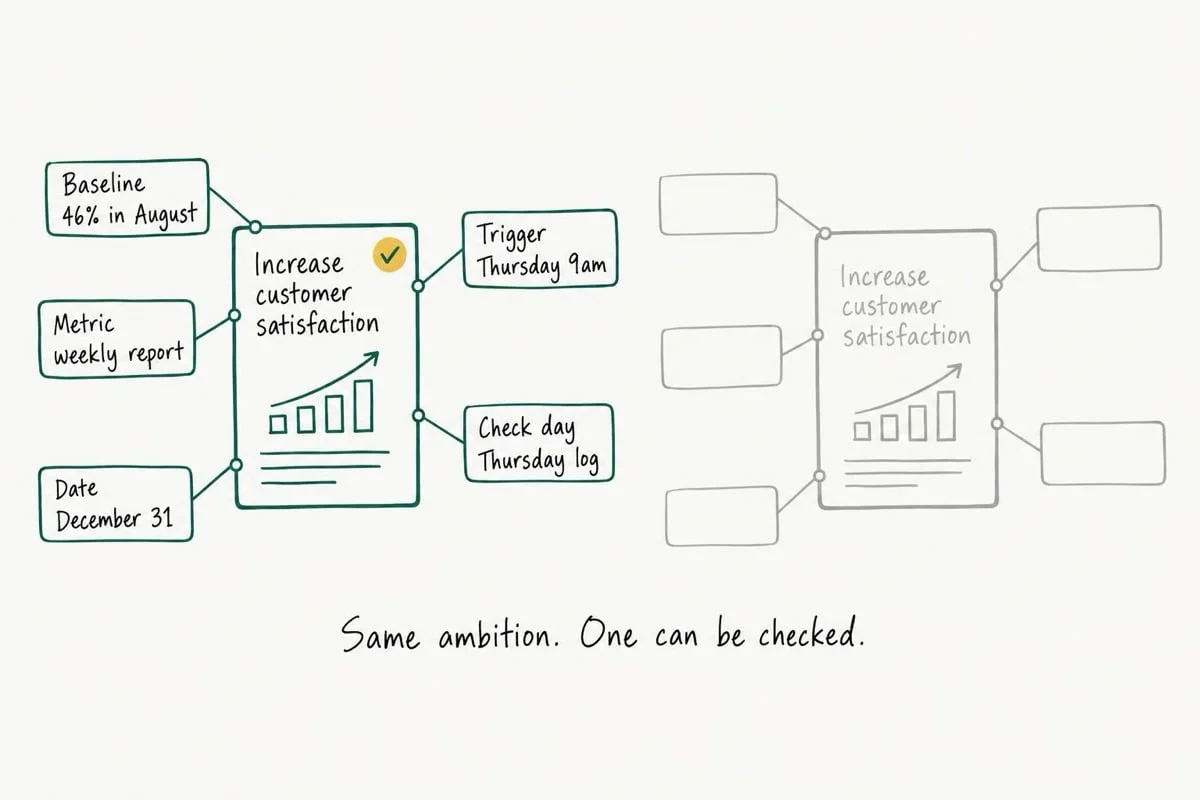
To move from abstraction to action, every goal should share a specific shape: a baseline number, a verifiable metric, a concrete deadline, and a "check day." Below are ten examples across various professional functions, designed to be adapted to your specific data.
1. Individual Contributor: Report Quality
- Vague: Improve the quality of my monthly reporting.
- SMART: Cut the client report from an average of four revision rounds in Q3 to two or fewer by December 31, as measured by tracked-change rounds in the shared document.
- Check Day: Friday, 4:00 PM, immediately after the draft is finalized.
2. Managing People: Leadership Availability
- Vague: Be a more available manager.
- SMART: Hold a 30-minute one-on-one with each of my six reports every two weeks from October 1 to December 19, missing no more than two sessions total, as verified on my calendar.
- Check Day: Monday morning, during the weekly planning phase.
3. Team Delivery: Managing Backlogs
- Vague: Get on top of the backlog.
- SMART: Reduce open handoff tickets from 18 to fewer than 8 by November 30, with each of the four engineers closing two per week. Owner: [Your Name].
- Check Day: Monday standup, where the ticket count is read aloud.
4. Customer Service: Efficiency
- Vague: Respond to customers faster.
- SMART: Raise first-reply resolution on tier-one tickets from 46 percent in August to 60 percent by December 31, as tracked in the helpdesk weekly report.
- Check Day: Thursday, during the weekly data review.
5. Sales: Pipeline Health
- Vague: Build a stronger pipeline.
- SMART: Book eight qualified discovery calls per month through Q4 (up from five in Q3) by blocking 90 minutes for outreach on Tuesday and Thursday mornings.
- Check Day: Friday, verified via CRM activity logs.
6. Professional Development: Skill Acquisition
- Vague: Get better at data analysis.
- SMART: Complete the four-module SQL course and deploy one query that replaces a manual report by February 28, dedicating 45 minutes on Monday, Wednesday, and Saturday mornings.
- Check Day: Saturday, comparing completed modules against the study plan.
7. Process Improvement: Operations
- Vague: Make month-end less painful.
- SMART: Reduce the month-end close cycle from nine working days to six by March, by automating one of the three slowest reconciliations each month.
- Check Day: The first Monday following each month-end close.
8. Review Evidence: Goal Tracking
- Vague: Keep better track of my accomplishments.
- SMART: Document two sentences of evidence against each of my goals every Friday, ensuring the April self-evaluation is based on 26 dated entries rather than memory.
- Check Day: Friday, 4:30 PM, in a consistent, dedicated document.
9. Visibility: Executive Communication
- Vague: Communicate more with my director.
- SMART: Send a five-bullet Friday note covering shipped items, blockers, and required decisions every week through Q4, missing no more than two.
- Check Day: The act of sending the note serves as the check.
10. Workload: Calendar Management
- Vague: Get my calendar under control.
- SMART: Reduce recurring meetings from 22 hours per week in September to under 15 by December 1, by declining or delegating any standing meeting where I hold no decision-making power.
- Check Day: Monday, reviewing the total hours in the calendar view.
The Architecture of Success: Five Critical Components
Why do these examples succeed where others fail? They incorporate five specific levers that transition a goal from a "wish" to a "commitment":

- The Baseline: Without a starting number (e.g., 22 hours, 46 percent), the end result is purely decorative. A baseline allows for an objective assessment of whether improvement has actually occurred.
- Verifiable Metrics: As Locke and Latham’s extensive research on goal-setting indicates, specific and difficult goals consistently outperform vague "do your best" instructions.
- Real Deadlines: Avoid the "December 31" trap. Quarter-end dates often lose their urgency because they are default, artificial markers. Set dates that align with the natural cadence of your projects.
- The Trigger: This is the most overlooked component. Research into "implementation intentions" (if-then planning) shows that specifying exactly when and where you will act (e.g., "Tuesday, 9:00 AM, before email") significantly increases goal attainment.
- The Check Day: A meta-analysis of nearly 20,000 participants found that consistent monitoring and public reporting of progress are the strongest predictors of success. If you don’t have a designated time to look at the data, you aren’t managing a goal—you are hoping for an outcome.
The Review Version vs. The Running Version
One of the greatest mistakes employees make is trying to use a single document for both their performance review and their daily operations. You should maintain two versions:
- The Review Version: This lives on your company’s HR form. It is concise, professional, and written for a manager who will spend 90 seconds reading it.
- The Running Version: This lives in your personal workflow (a task manager, a calendar, or a spreadsheet). It contains the "messy" details: the triggers, the check days, and the weekly progress logs.
Collapsing these two into one document is exactly why goal-setting feels like corporate theater. By keeping the running version visible and private, you ensure that you are actually performing the work, while the review version satisfies the bureaucratic record-keeping requirements.
Managing Through the Collapse: The "Floor" Strategy
Every quarter will eventually encounter friction—a customer escalation, a staff resignation, or a budget cut. Most goals die during these periods because they are binary: either they are hit, or they are failed.
To prevent this, assign a "floor" to your goals. The floor is the minimum acceptable result that still counts as progress. For example, if your target is a 60 percent resolution rate, your floor might be "do not drop below 46 percent, even if the team is short-staffed."
By defining the floor, you remove the emotional burden of failure. When a quarter breaks, you don’t abandon the goal; you pivot to the floor version. This maintains the "recovery loop," allowing you to resume your progress once the crisis stabilizes, rather than starting from scratch during the next planning cycle.
Conclusion: The Path Forward
Before this coming Friday, take ten minutes to audit your current goals. Count how many have a starting baseline and how many have a standing, weekly check day. If the count for either is zero, you have identified why your goals are currently failing.
Fixing the baseline provides the "why," and fixing the check day provides the "when." If you are feeling overwhelmed, remember that a goal that cannot be missed is not a commitment—it is a sentence. Strip away the corporate jargon, anchor your targets to real data, and create a system that thrives on the reality of your Tuesday, not the idealism of your annual review. By focusing on these mechanics, you move beyond the form and into the work that actually generates results.