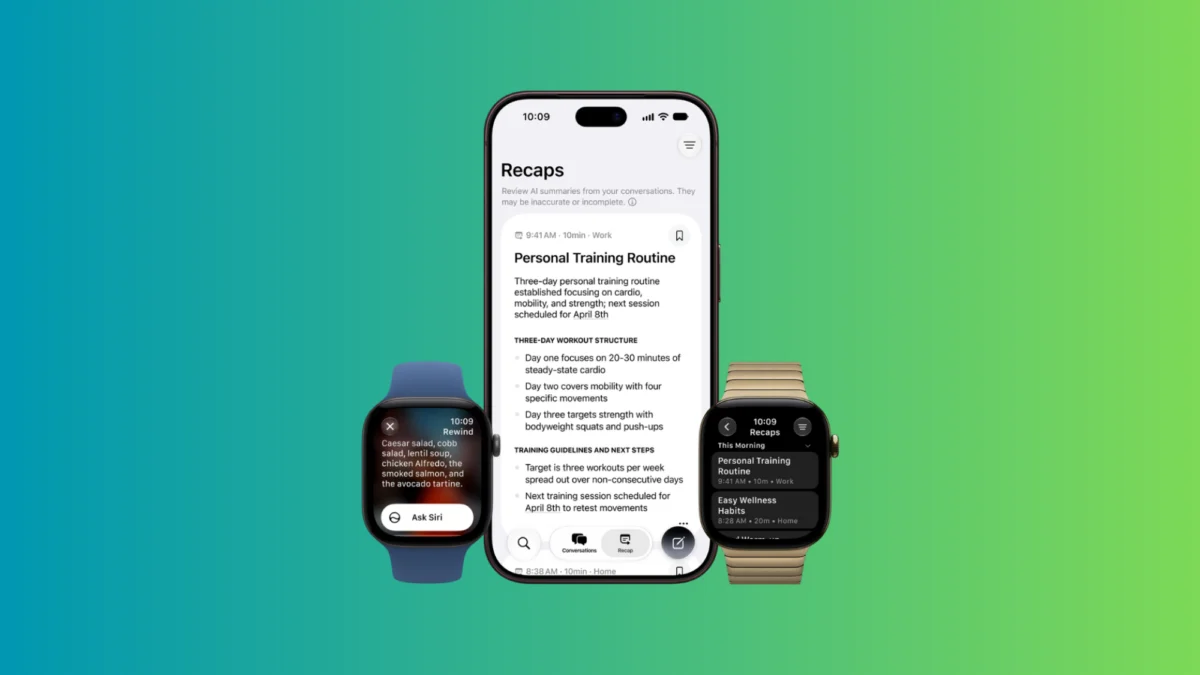
During its highly anticipated keynote on September 9, Apple unveiled the Apple Watch Series 12 and the Ultra 4, devices that signal a paradigm shift in how wearable technology interacts with the human environment. While the hardware upgrades were expected, the true headline was the debut of "Audio Intelligence"—a suite of features that allows the watch to passively listen to, process, and summarize the user’s daily conversations.
While Apple touts this as a revolutionary productivity tool designed to "capture the essence of your life," the technology has ignited a firestorm of debate regarding privacy, consent, and the ethics of ambient surveillance.
The Core Functionality: How the Watch Listens
The Apple Watch Series 12 and Ultra 4 are powered by the new S11 chip, which features a "Secure Exclave"—a physically partitioned section of local storage that operates independently of the watch’s primary operating system.
When the Audio Intelligence feature is active, the watch continuously captures ambient audio. However, Apple emphasizes that this audio is not "recorded" in the traditional sense. Instead, it is routed immediately into the Secure Exclave, where it is encrypted and transmitted to a matching Secure Enclave on the user’s paired iPhone. Once the data reaches the iPhone, an on-device AI model generates a summarized transcript—stripping away identifying information and compressing the content to roughly half the length of the original conversation.
The process is designed to be ephemeral. The raw audio is overwritten in real-time, effectively ceasing to exist as soon as the summary is generated. Only the summarized text, accompanied by generic metadata like timestamps and coarse location data, is sent to Apple’s Private Cloud Compute for further refinement via Siri AI.
Chronology of the Development
Early 2025: Rumors of an "always-listening" AI model begin circulating within the tech industry, initially dismissed as speculative.
June 2026: Apple silently updates its privacy whitepaper protocols to include "Private Cloud Compute," a specialized infrastructure designed to process sensitive data without persistent storage.
September 9, 2026: Apple officially unveils the Series 12 and Ultra 4, explicitly detailing the "Siri Recap" and "Live Rewind" features as part of the Audio Intelligence ecosystem.
September 10, 2026: Privacy advocacy groups, including the Electronic Frontier Foundation and various international data protection agencies, issue initial statements expressing "extreme caution" regarding the lack of clear consent mechanisms for third-party bystanders.
The Technical Safeguards: A Fortress or a Facade?
Apple’s defense of the system rests on the concept of "Data Minimization." By ensuring that raw audio never leaves the local Secure Exclave or the iPhone’s internal buffer, the company claims it has eliminated the possibility of a "recording leak."
To prevent tracking, Apple employs a third-party relay service that masks the user’s IP address during the upload to Private Cloud Compute. Furthermore, the summaries generated by Siri Recap are auto-deleted every seven days. Apple argues that because no audio file ever exists in a permanent format, the device falls outside the scope of traditional "wiretapping" or "recording" laws.
However, the security architecture is not without vulnerabilities. The "Siri Recap" feature allows users to save these summaries to iCloud, Apple Notes, or the Journal app. Once the data moves from the ephemeral cloud environment into a user’s personal storage, it becomes subject to standard account security. Given that over 900,000 iCloud accounts were compromised in a single breach in early 2026, the risk of a "transcript leak" is statistically significant. If a malicious actor gains access to a user’s Apple ID, they could theoretically gain access to years of summarized personal, professional, and intimate conversations.
Official Responses and Corporate Strategy
Apple’s documentation is precise, if not defensive. In their September 2026 Privacy Overview, they state:
"Audio Intelligence features do not create audio recordings that can be accessed by the operating system, apps, the user, or Apple. There is no recording to share, forward, or produce if requested by any party, because no recording exists."
This statement is the cornerstone of Apple’s legal strategy. By redefining "recording" as a permanent digital file, they hope to avoid the regulatory scrutiny faced by companies that store raw audio data in the cloud. However, privacy experts argue that the content of the transcript is just as sensitive as the audio itself. Whether it is a raw file or a text summary, the informational content remains protected under the privacy expectations of the individual being discussed.
Implications for Privacy and Consent
The most profound concern is not how Apple handles the data, but how the device interacts with the public.
The Bystander Problem
While the watch provides a small audio chime and a visual indicator when the "Live Rewind" feature is active, "Siri Recap" operates silently in the background. Bystanders have no way of knowing when they are being "summarized." In a social or professional setting, this creates a profound power imbalance. One individual in a room can effectively turn their wrist into a stenographer, capturing the details of a conversation without the explicit, informed consent of the other participants.
The Legal Grey Area
In the United States, 12 states have strict "all-party consent" laws regarding audio recording. While Apple argues that the technology does not technically "record," the spirit of these laws is to prevent non-consensual surveillance. If a court decides that a summarized text transcript constitutes a "record" of a private conversation, Apple’s users could find themselves in significant legal jeopardy. Similar challenges are expected under the European Union’s General Data Protection Regulation (GDPR), which requires explicit disclosure for the collection of personally identifiable information.
The Dystopian Creep
Beyond the legalities, there is a social dimension. If these features become normalized, the "expectation of privacy" in public spaces may vanish. Meetings, doctor’s appointments, and private discussions in coffee shops could all be captured and archived by a device sitting on a table. Critics argue that this marks the end of "unrecorded" life, forcing a shift in how humans communicate when they know their words are being processed by an AI, regardless of whether that AI is "secure."
How to Manage Your Privacy
Apple has made these features opt-in, recognizing the potential backlash. Users who purchase the Series 12 or Ultra 4 are not forced to activate Audio Intelligence.
To manage these features:
Check Settings: Navigate to the "Privacy & Security" tab in the Watch app on your iPhone.
Audio Intelligence Toggle: You can disable the entire suite or individual components like "Siri Recap" or "Live Rewind."
Audit Saved Summaries: Regularly purge your iCloud storage and Journal app to ensure that summarized transcripts are not accumulating over time.
Hardware Awareness: Be mindful of when you are in sensitive environments. Even if you trust Apple, your colleagues or friends may not share that sentiment.
Conclusion: A Turning Point for Wearables
The Apple Watch Series 12 and Ultra 4 are undeniably impressive pieces of engineering. The ability to distill complex human interactions into actionable summaries could prove to be a massive boon for accessibility, productivity, and memory retention.
Yet, the trade-off is a fundamental shift in the social contract. By prioritizing the user’s convenience over the privacy of those around them, Apple has entered a contentious new era. Whether society will embrace this "always-on" intelligence or reject it as an intrusive overreach remains to be seen. For now, the echo on your wrist is listening—and the responsibility for how that information is used rests, for better or worse, entirely on you.