Bunions, medically known as hallux valgus, are far more than a simple cosmetic foot nuisance. Affecting roughly one in every three adults, these painful bony deformities develop when the big toe gradually drifts inward toward the smaller toes. This progressive malalignment causes the joint at the base of the big toe—the first metatarsophalangeal joint—to become increasingly prominent, inflamed, and vulnerable to friction.
While advanced cases often require clinical interventions or surgical correction, physical therapists and orthopedic specialists emphasize that early detection and targeted at-home exercises can significantly improve foot control, redistribute pressure, and alleviate chronic discomfort.
Main Facts: What Is a Bunion and Who Is Affected?
At its core, a bunion is a structural foot deformity characterized by a prominent medial metatarsal head and an abnormal lateral angulation of the proximal phalanges. As the big toe leans toward its neighbors, the joint pushes outward, creating a visible bump that frequently rubs against footwear. This friction leads to redness, localized swelling, and deep-seated aching. Over time, the discomfort can fundamentally alter an individual’s gait, shifting weight distribution and triggering secondary pain in the ankles, knees, and lower back.
Epidemiological and clinical observations indicate that bunions are remarkably widespread, impacting approximately 33% of the adult population. While anyone can develop the condition, certain demographics face heightened vulnerability. Modern epidemiological insights underscore that foot health is a critical yet routinely neglected public health concern; by the age of 50, nearly half of all Americans experience significant foot pain, driven largely by modern habits such as confinement in restrictive footwear and prolonged walking on unforgiving artificial surfaces.
Furthermore, statistics surrounding structural abnormalities like flat feet (pes planus)—which involves the loss of the medial longitudinal arch with hindfoot valgus—show a prevalence of roughly 5% to 14% in the general adult population. Because flat feet alter how mechanical loads travel through the lower extremities, they create an environment ripe for bunion progression.
Chronology: The Progressive Development of Hallux Valgus
Understanding how bunions form requires tracing the condition from its subtle origins to advanced structural changes:
- Phase 1: Genetic Predisposition and Biomechanical Shifts. The foundation for many bunions is laid early through inherited foot architecture—such as joint shape, ligament laxity, or a natural tendency toward low arches. Even without external pressure, these structural traits mean the big toe bears uneven loads during everyday movement.
- Phase 2: External Aggravators and Early Signs. The introduction of external stressors—such as frequent use of high heels, narrow toe boxes, or rigorous dancing—accelerates the malalignment. High heels compress the forefoot and shift body weight forward, robbing the foot of its natural shock-absorbing capacity. Early warning signs emerge: mild swelling at the base of the big toe, occasional redness from shoe friction, and the initial inward drift of the digit.
- Phase 3: Gait Alteration and Chronic Inflammation. As the deformity advances, the natural walking cycle breaks down. Instead of force transferring smoothly from the heel, along the outer edge of the foot, and finally pushing off evenly from the big toe, the compromised joint absorbs a disproportionate amount of pressure. This leads to chronic inflammation, bursitis, and the potential overlapping of the first and second toes.
- Phase 4: Established Bunion and Advanced Deformity. In late-stage hallux valgus, the bony changes become fixed. While conservative measures can still manage symptoms, the structural displacement can no longer be reversed through exercise alone, frequently necessitating orthopedic devices or surgical intervention.
Supporting Data: Mechanics, Vulnerability, and Evidence
To grasp why certain individuals are disproportionately affected by bunions, experts point to the mechanics of load distribution. During a standard, healthy gait cycle, kinetic forces enter through the heel, travel across the lateral midfoot, and culminate in a balanced push-off across the ball of the foot.
However, individuals who frequently wear narrow, pointed high heels—whose structural flaws begin well before the elevated heel itself due to cramped toe boxes—disrupt this sequence entirely. Dancers and individuals with flat feet experience similar disruptions, as their feet fail to spread impact forces evenly across the transverse arch. Consequently, the highly mobile big toe absorbs excessive mechanical stress, wearing down the stabilizing tissues of the joint.
Clinical literature supports the role of conservative management in mitigating these effects. A recent systematic review highlights that targeted exercise programs can modestly improve joint alignment and reduce pain in patients with mild-to-moderate hallux valgus. These benefits are amplified when exercise is combined with auxiliary therapies such as medical taping or custom orthoses.
Nevertheless, clinical consensus remains clear: while physical therapy successfully strengthens the intrinsic foot muscles, improves stability, and aids post-surgical rehabilitation, it cannot reliably reverse an established, rigid bony deformity in advanced cases.
Official Responses and Professional Guidance
Medical and rehabilitation professionals stress that while at-home care is valuable, certain warning signs demand formal clinical evaluation. Patients experiencing persistent, unyielding pain, rapidly progressing deformities, localized numbness, severe difficulty walking, or those managing systemic conditions like diabetes must seek professional assessment from a podiatrist, physical therapist, or orthopedic specialist.
When conservative management steps up beyond simple exercise, footwear modification plays a cornerstone role. Experts emphasize that orthopedic and therapeutic footwear should not be judged merely by aesthetics, but by functional adaptability. As noted by clinical rehabilitation specialists, truly functional footwear provides specialized support ranging from cradling collapsed arches to alleviate strain, to shock-absorbing heel cushioning and spacious toe boxes designed to evenly distribute plantar pressure.
For severe cases, medical management expands to include custom orthotics, specialized physical therapy regimens, and—when conservative protocols fail to control pain or restore mobility—surgical procedures designed to realign the bones, tendons, and ligaments of the forefoot.
Implications: Three Physical Therapist-Recommended Exercises for Foot Control
Duke Pan, a physical therapist, emphasizes that while structural bone changes cannot be undone, strengthening the small intrinsic muscles of the foot can dramatically improve overall stability, redistribute pressure away from the vulnerable big toe, and alleviate early symptoms. Pan outlines three at-home exercises designed to enhance foot control while the joint remains flexible:
1. Toe Separation Training
- How to Perform: Stand with your body weight supported primarily on your heels, and slightly lift all ten toes off the ground. Spread all five toes on each foot as wide apart as possible. While maintaining this wide spread, slowly press all five toes back down onto the floor.
- The Benefit: You should feel a gentle muscle activation along the inner side of the big toe and within the medial arch. Hold this position for approximately 10 seconds, relax, and repeat. Consistent training of these intrinsic muscles helps pull the big toe back toward a more neutral alignment.
2. Arch Training (Short Foot Exercise)
- How to Perform: Begin with your feet in a neutral, straight-ahead position—neither excessively pronated nor supinated. Spread your toes, press them firmly into the ground, and then lift all five toes together to an equal height, ensuring the big toe does not disproportionately outclimb the others. As the toes elevate, actively engage the muscles of the inner arch to lift the midfoot without letting the ball of the foot lose contact with the floor. Slowly lower the toes while maintaining inner-arch tension.
- The Benefit: Because the intrinsic muscles of the foot are exceptionally small, this exercise requires patience and mindfulness. Consistent, daily practice builds neuromuscular control, helping to stabilize the arch and prevent collapse during the gait cycle.
3. Balanced Calf Raise Training
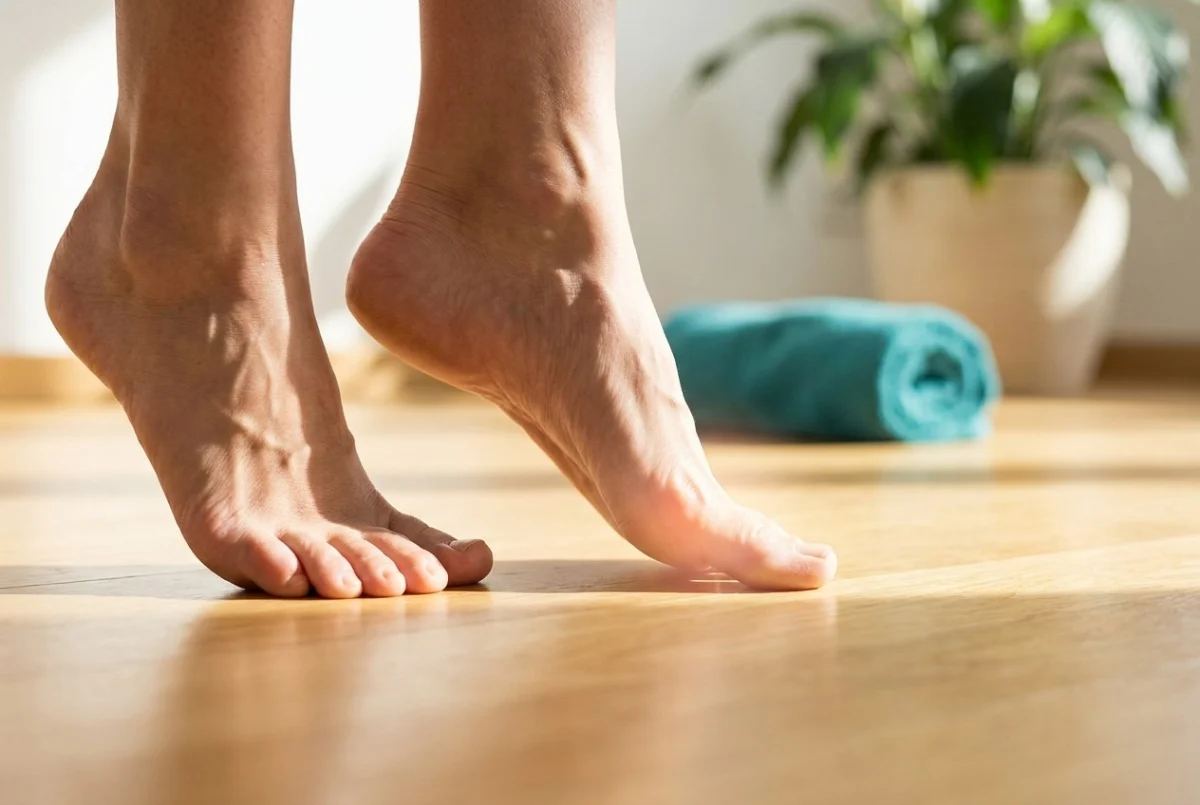
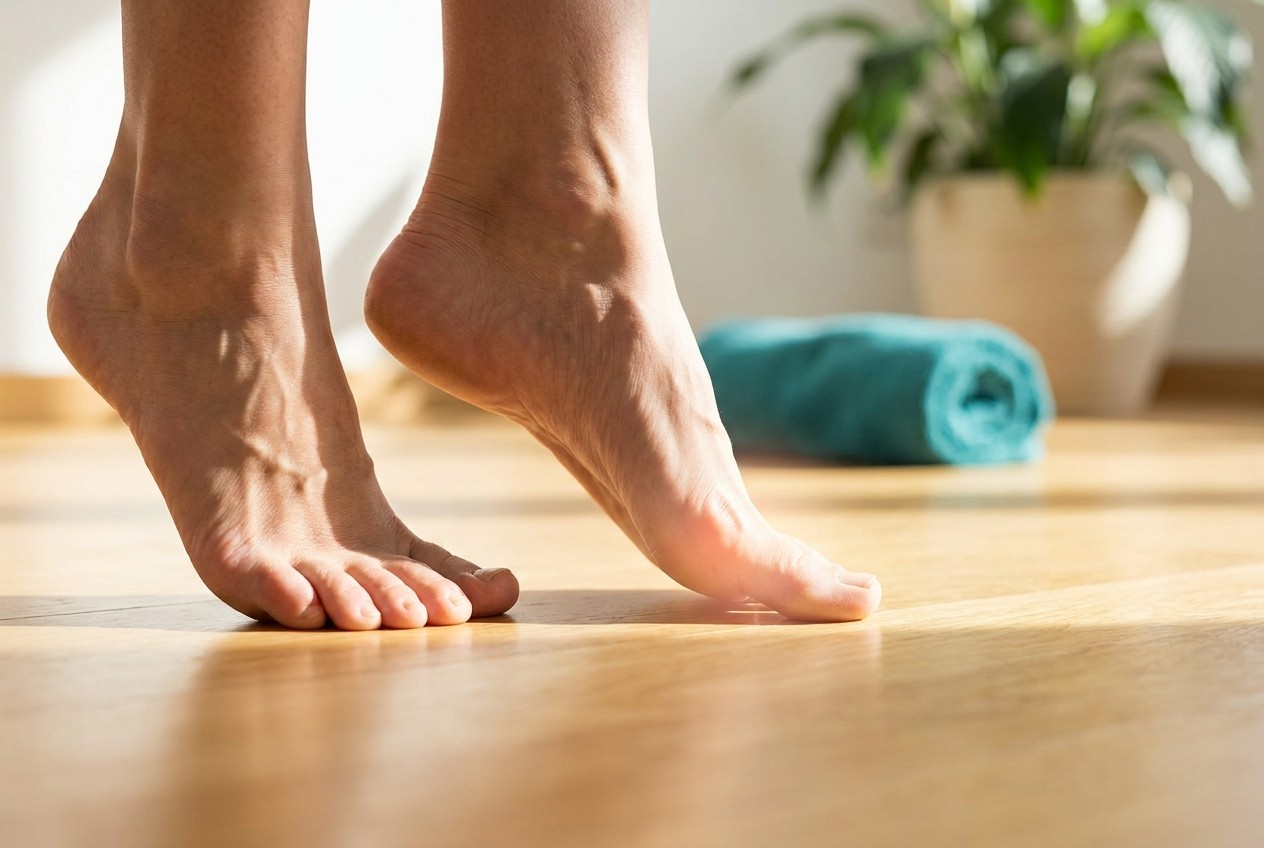
- How to Perform: Stand with both feet flat on the floor. Slowly rise onto the balls of your feet, consciously shifting your center of gravity so that the load rests evenly between the second and third toes rather than dumping entirely onto the big toe. Ensure your ankles do not roll inward or outward as you elevate.
- The Benefit: This movement trains the lower leg and foot complex to work in harmony, preventing faulty movement patterns that place undue lateral stress on the big-toe joint. Note: Practitioners should also remain mindful of trigger points in surrounding lower leg muscles, as referred pain patterns from the calf and shin can frequently mimic or exacerbate foot discomfort.
Conclusion
Bunions are a prevalent challenge affecting a significant portion of the adult population, driven by a complex interplay of genetics, inherited foot structure, and modern mechanical stressors like restrictive footwear. While exercise cannot reverse advanced bony deformities, early intervention through targeted physical therapy—such as toe separation, arch training, and balanced calf raises—offers a powerful conservative strategy to restore foot control, reduce pain, and improve overall mobility. By combining mindful foot strengthening with supportive, wide-toe-box footwear, individuals can take proactive steps to protect their long-term foot health and prevent minor misalignments from escalating into debilitating conditions.