
Retirement marketing is a multi-billion-dollar industry built on a specific, glossy aesthetic. The advertisements are uniform: a serene lake at sunrise, a vintage leather suitcase resting by a beach house, or two high-end bicycles leaning against a white picket fence. These images sell the idea of a permanent, sun-drenched Saturday.
Yet, the most seasoned retirees—those who have navigated the transition from career to "freedom"—rarely speak of the endless weekend. Instead, their advice almost always returns to the concept of the Tuesday.
Tuesday at 10:40 a.m. is the true barometer of a successful retirement. It is the moment when the office no longer requires your presence, your emails have ceased, and the novelty of a "day off" has worn thin. Tuesday evening, when you and your partner have occupied the same four walls for ten consecutive hours, is where the reality of your new life is exposed. Work once provided a clock, a community of peers, a set of useful problems to solve, and the social permission to save for the future. When the paycheck stops, those structural "hidden supplies" vanish with it.
A bucket list is a wonderful tool for a few excellent Saturdays, but it cannot sustain a life. For retirement to be successful, it must be engineered to work on a Tuesday.
The Anatomy of an Ordinary Retirement
Why does the most profound retirement advice sound so relentlessly ordinary? Retirees who have successfully navigated the post-work transition rarely describe "permanent leisure" as their ideal. Instead, their counsel is pragmatic: prioritize your physical health while your body allows, create a structured rhythm for open time, maintain intentional human connections, adhere to a safe spending plan, and engage in transparent dialogue with your partner about the daily reality of your shared lives.
These lessons sound small because they concern the mundane fabric of existence—the repeatable weekday—rather than once-in-a-lifetime events.
The Voices of Experience
Kathryn Brookfield, who transitioned from a career in teaching and public service, offers a poignant perspective on the necessity of timing. Eleven years into her retirement, and following the passing of her husband, she remarked to The Globe and Mail: "If you’re healthy enough and have the finances, go traveling as soon as possible." Her point was not that everyone needs a passport, but that retirement is a time-sensitive venture. We must utilize the physical and financial capacities we possess while they still align.
Retired teacher Glenn Cuthbertson offers a quieter, more tactical warning: "Think about how you’ll structure your days." His routine is not a rigid military schedule, but a balanced ecosystem of exercise, household maintenance, walks, social events, and time with friends.
Then there is the financial psychological barrier, as highlighted by John Tak. After a career spent mastering the art of accumulation, retirement demanded a jarring pivot: the art of distribution. "We’ve been programmed to save, not spend," Tak noted at age 68. He balances travel and supporting his children with a conscious effort to enjoy the fruits of his labor—a skill that, for many, is harder to learn than the act of saving itself.
The Tuesday Test: Five Anchors for a Stable Life
The "Tuesday Test" is a diagnostic framework designed to see if your retirement plan holds water. It asks whether an ordinary weekday contains five essential anchors: physical activity, social contact beyond the household, a role that provides utility, a defined financial withdrawal plan, and a balanced approach to partnership. You do not need all five every single day, but you must be able to identify where each anchor lives in a typical week.
1. Mobility: The Foundation of Independence
Do not turn age into a countdown. Retirement does not come with a universal "warranty" on your health, and illness can unexpectedly narrow your horizons. The goal is to move your body now—not because you are racing against time, but because mobility is a skill maintained through usage.
The LIFE (Lifestyle Interventions and Independence for Elders) randomized trial, which followed 1,635 sedentary adults aged 70 to 89, provided compelling evidence that structured activity significantly mitigates mobility disability. While this result is specific to the cohort, the takeaway is universal: put the ordinary practice before the extraordinary trip. Schedule the Tuesday walk, the Thursday strength session, and the Saturday balance class. Let your bucket list adventures draw upon a body that you are actively maintaining.
2. Social Capital: Replacing the "Weak Ties"
Work provides what sociologists call "weak ties"—the receptionist who knows your coffee order, the client who calls once a month, or the colleague who notices your new glasses. These low-stakes social interactions are the glue of a day. A Finnish study of 2,319 employees found that while close inner-circle relationships often remain stable during retirement, the "outer ring" of peripheral ties tends to wither.
Do not wait for your social world to shrink. Choose two recurring points of contact that exist outside your home. Your partner cannot—and should not—be expected to fill every social role, from spouse and lunch companion to audience and sole confidant.

3. Purpose: The Role That Needs You
Purpose is often romanticized as a grand revelation, but in practice, it is better defined as a role. Instead of seeking a "life’s mission," ask yourself: Who expects something useful from me next week?
Whether it is tutoring a student, repairing a chair for a neighbor, covering a shift at a local nonprofit, or picking up a grandchild, a role provides a reason to begin the day before motivation even arrives. Studies of retirees in England have shown a strong association between frequent, meaningful volunteering and improved life satisfaction and reduced social isolation. Whether the role is paid or unpaid, the title matters less than the fact that someone is counting on you.
4. Financial Guardrails: The "Now" Bucket
Retirement money has two competing functions: keeping "Future You" secure and allowing "Present You" to live. Without a clear boundary, many retirees fall into a paralysis of fear, hoarding assets they will never use, or conversely, spending in ways that jeopardize their long-term solvency.
The Employee Benefit Research Institute (EBRI) found that while 38% of retirees identify with a "savings mindset," nearly a third admitted to spending more than they could actually afford. The solution is to move beyond abstract numbers. Work with a fiduciary to establish three buckets:
- The Survival Bucket: Essential living expenses.
- The Safety Bucket: A liquid buffer for emergencies and healthcare.
- The "Now" Bucket: A dedicated, safe amount for current enjoyment.
5. Partnership: The Art of Shared Time
When one or both partners retire, the sudden influx of time can be a shock. Trouble begins when partners assume they have the same internal picture of a "good day." One might envision a life of slow, quiet breakfasts, while the other might be planning a workshop, a golf league, or intense travel.
Research suggests that couples who proactively align their goals experience an easier transition and higher wellbeing. Compare four details: your preferred morning routine, your threshold for "alone time," your shared hobbies, and your individual social needs. Test your arrangement for two weeks, and treat it as a living document rather than a fixed contract.
Implementation: The 90-Day Transition
The Tuesday Test is not a one-time audit; it is a tool for different stages of the retirement journey.
Before Retirement: Conduct a "trial day." Take a day off without traveling or working on the house. Run the Tuesday you think you want. Does it provide enough structure? Who did you speak to? Did you feel the "gap" where work used to be?
The First 90 Days: Avoid the temptation to declare a "new you." Build a provisional week with two fixed anchors—perhaps exercise and a specific volunteer role. Review this schedule every fortnight. Keep what pulls its weight and discard what feels performative.
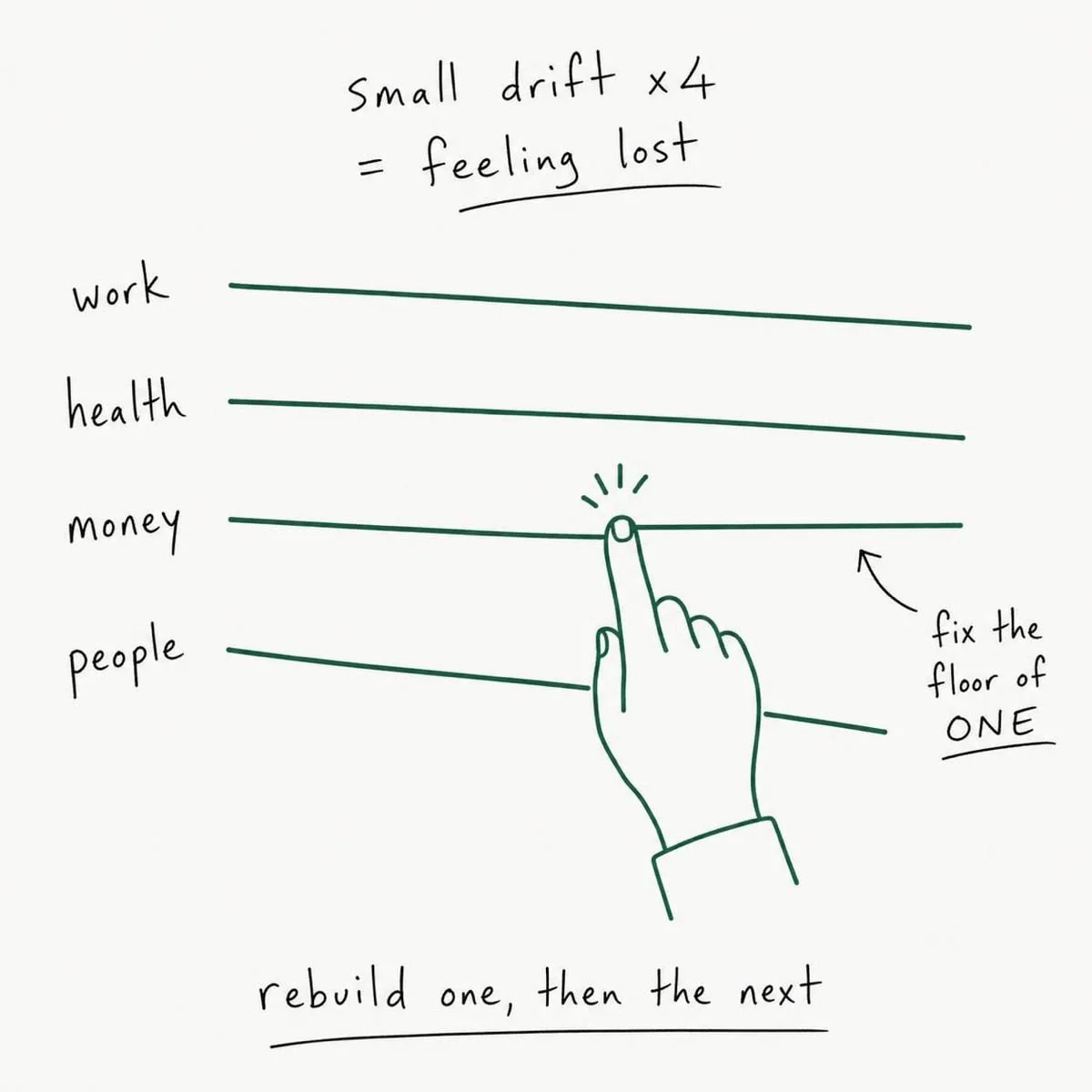
After Year One: Retirement drifts just as working life does. Use the Tuesday Test to diagnose why the drift is occurring. If you feel bored, you may have neglected your "role" anchor. If you feel isolated, your "people" anchor has likely thinned. If you feel anxious about money, it is time to revisit your withdrawal plan.
Conclusion: Build Next Tuesday, Not the Decade
The greatest danger in retirement planning is the tendency to postpone the "real" life until some distant, undefined future. We treat the early years as a dress rehearsal for an eventual decline, or worse, as a void that must be filled with "busyness" to distract from a lack of direction.
The best retirement advice is a warning: do not wait for the decade to feel complete. Take a single sheet of paper. Draw your five rows—body, people, purpose, money, and partnership. Place one concrete, recurring action in each row for next week. Use names, times, and locations.
Do not try to build the rest of your life yet. Simply build a Tuesday you would be willing to repeat. By mastering the ordinary day, you secure the extraordinary decade.