The ritual is as predictable as the changing seasons: it is Friday, the deadline for your quarterly goal submission. You open the portal, type four bullet points that sound sufficiently industrious, and hit submit. Your manager will skim them once, offer a perfunctory nod, and by the third week of the quarter, the documents will be buried under the mounting debris of daily crises.
This is the "Goal Theater" that plagues modern corporate culture. The problem is not a lack of ambition or a deficiency in character. The problem is structural. Most SMART goals are grammatically correct but operationally empty. They lack the connective tissue required to survive an ordinary Tuesday—that volatile period when a client escalates, a key team member resigns, and a long-planned project suddenly faces a budget freeze.
To transform goals from static text into active performance drivers, we must move beyond the acronym and toward a rigid, five-part framework that demands accountability, baseline measurement, and a "recovery loop" for when things inevitably go sideways.
The Evolution of an Acronym: From Management Tool to Performance Theater
The acronym SMART (Specific, Measurable, Assignable, Realistic, Time-related) was introduced by George Doran in the November 1981 issue of Management Review. Doran’s original intent was to provide managers with a blueprint for assigning tasks to subordinates.
Over the decades, however, the acronym has drifted. In most corporate HR portals, the "A" has shifted from Assignable to Achievable, and the "R" from Realistic to Relevant. This drift is not merely semantic; it represents a fundamental change in ownership. When a manager assigns a goal, the accountability is external. When we write our own, we are prone to internalizing the ambiguity, creating goals that sound impressive to a reader but offer no actionable path for the doer.
A goal without a starting number—a baseline—is not a goal; it is a wish. To reclaim the efficacy of the SMART framework, we must strip away the corporate buzzwords and return to the bedrock of metrics and ownership.
Anatomy of a Functional Goal: The Five Essential Components
A professional, high-performance goal must be written with enough precision that a colleague could audit your progress without ever asking for clarification. To achieve this, every objective must contain five specific elements:
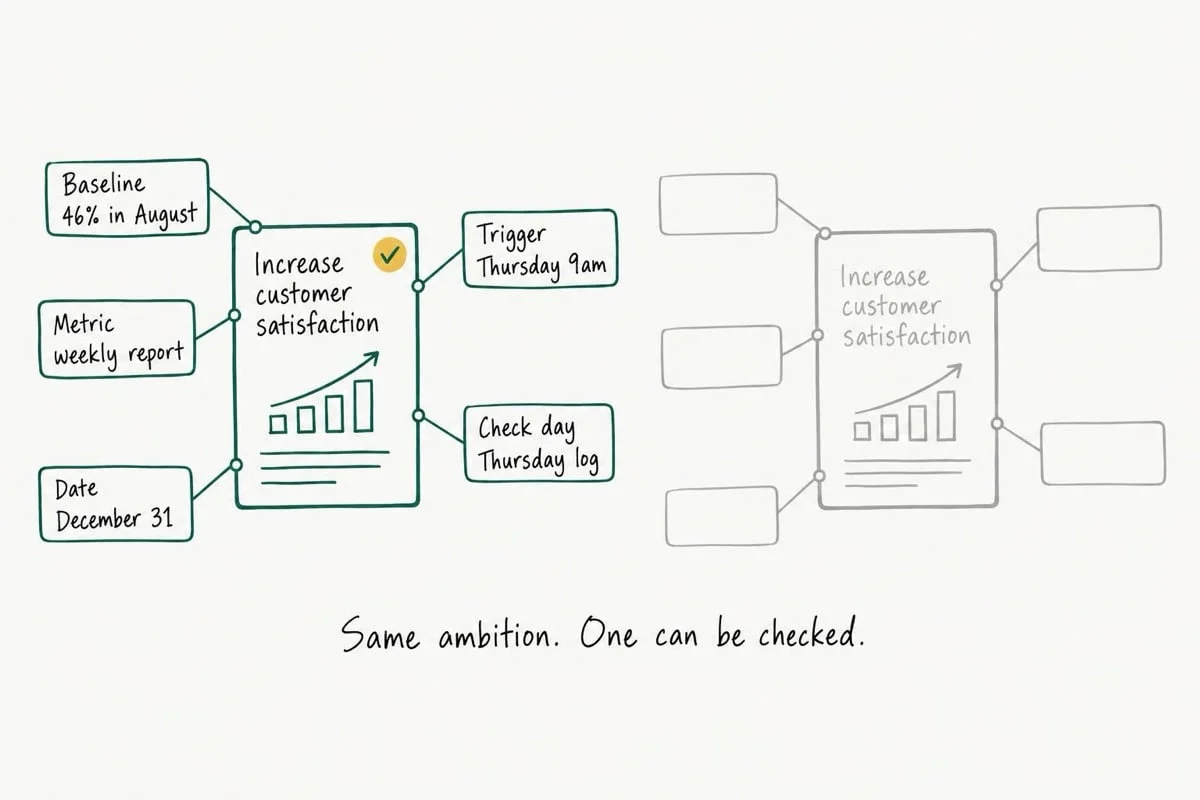
- The Baseline: A starting point (e.g., "four revision rounds"). Without this, any "improvement" is purely subjective and impossible to prove.
- The Verifiable Metric: A measurement that is independent of your opinion.
- The Specific Deadline: A date that is tied to the project lifecycle, not just the generic "end of Q4."
- The Trigger: A "when-then" statement that anchors the task to a specific time and location (e.g., "Tuesday, 9:00 AM, before email, outreach block").
- The Check Day: A standing appointment on your calendar where you physically record your progress.
Research supports this granular approach. A meta-analysis of 138 studies involving nearly 20,000 participants found that the act of monitoring progress—and making that information visible—significantly increases the likelihood of attainment. When we skip the "Check Day," we essentially decide that our goals only matter when we remember them.
Ten Examples of Operational SMART Goals
To move from theory to practice, consider these templates. They are designed to cover individual output, leadership, team coordination, and process efficiency.
1. Individual Contributor: Report Quality
- Vague: "Improve the quality of my monthly reporting."
- SMART: "Cut the client report from an average of four revision rounds in Q3 to two or fewer by December 31, as tracked in the shared file."
- Check: Friday, 4:00 PM, immediately after the draft submission.
2. Leadership: Managing People
- Vague: "Be a more available manager."
- SMART: "Hold a 30-minute one-on-one with each of my six reports every two weeks from October 1 to December 19, with no more than two sessions missed, as verified on my calendar."
- Check: Monday morning, during weekly planning.
3. Team Delivery: The Shared Goal
- Vague: "Get on top of the backlog."
- SMART: "Reduce open handoff tickets from 18 to fewer than 8 by November 30, with each of the four engineers closing two per week. Owner: [Name], reported on the Monday board."
- Check: Monday standup meeting, ticket count read aloud.
4. Customer Service: Efficiency
- Vague: "Respond to customers faster."
- SMART: "Raise first-reply resolution on tier-one tickets from 46 percent in August to 60 percent by December 31, as measured in the helpdesk weekly report."
- Check: Thursday, during the weekly reporting window.
5. Sales: Pipeline Management
- Vague: "Build a stronger pipeline."
- SMART: "Book eight qualified discovery calls a month through Q4, up from five in Q3, by dedicating 90 minutes for outreach on Tuesday and Thursday mornings."
- Check: Friday, as counted in the CRM.
6. Professional Development: Skill Acquisition
- Vague: "Get better at data analysis."
- SMART: "Complete the four-module SQL course and ship one query that replaces a manual report by February 28, studying 45 minutes on Monday, Wednesday, and Saturday mornings."
- Check: Saturday, comparing modules completed against the syllabus.
7. Process: Operational Excellence
- Vague: "Make month-end less painful."
- SMART: "Cut the month-end close from nine working days to six by the March close, automating one of the three slowest reconciliations each month."
- Check: First Monday after the close.
8. Visibility: Documentation
- Vague: "Keep better track of my accomplishments."
- SMART: "Write two sentences of evidence against each of my goals every Friday, ensuring the April self-evaluation draws on 26 dated entries rather than memory."
- Check: Friday, 4:30 PM, in the designated documentation file.
9. Communication: Stakeholder Management
- Vague: "Communicate more with my director."
- SMART: "Send a five-bullet Friday note covering ‘Shipped,’ ‘Blocked,’ and ‘Decisions Needed’ every week through Q4, missing no more than two."
- Check: The act of sending the note is the check.
10. Workload: Calendar Control
- Vague: "Get my calendar under control."
- SMART: "Reduce recurring meetings from 22 hours a week in September to under 15 by December 1, by declining or delegating every standing meeting where I hold no decision-making power."
- Check: Monday, during the weekly calendar audit.
Navigating the Collapse: When the Quarter Blows Up
Even the most robust plan will eventually face a stress test. A team leader might resign, a market shift might invalidate your project, or a sudden emergency might consume your resources. Most professionals handle these moments in one of three ways: they abandon the goal, they burn out trying to achieve the impossible, or they wait until the next quarter to pretend it never happened.

A professional approach requires a "Floor Version"—the absolute minimum result that still constitutes success. If you are aiming for a 60 percent resolution rate but two agents resign, your floor might be "Maintain 46 percent and prevent further slippage."
Crucially, you must maintain the Check Day even when the goal is failing. The goal that you stop looking at is the goal that dies. If you keep the check running, you create a "recovery loop," allowing you to recalibrate your strategy the moment conditions stabilize.
Implications for Corporate Culture
The shift toward rigorous, metric-driven goal setting has significant implications for how organizations function.
The Review Version vs. The Running Version
The most effective performers maintain two versions of their goals. The "Review Version" is the one you place on your performance form—polished, concise, and aligned with company KPIs for your manager’s 90-second review. The "Running Version" lives in your personal workflow—it includes your triggers, your floor, and your weekly log. Never collapse these into one document; one is for administrative record-keeping, the other is for your personal professional evolution.
Performance and Promotion
While it is popular to criticize performance reviews as "theater," they remain the primary document used during promotion and restructuring discussions. According to Gallup, only 14 percent of employees strongly agree that their performance reviews inspire them to improve. This is largely because the reviews are based on vague, anecdotal memories rather than hard data. By maintaining a weekly evidence log, you effectively write your own performance review, insulating yourself from the whims of subjective managerial bias.
The Myth of the Acronym
We must keep the SMART acronym in proportion. It is a formatting checklist for a sentence, not a substitute for strategy. The true power lies not in the letters, but in the baseline, the trigger, and the check day. If you want to change your trajectory, stop focusing on the "Achievable" and "Relevant" labels and start focusing on the "How" and the "When."
Final Steps to Implementation
If you are currently managing five goals, do not attempt to overhaul them all at once. Take the most important one, define your baseline, assign a check day, and set your trigger. Schedule the rest for next week.
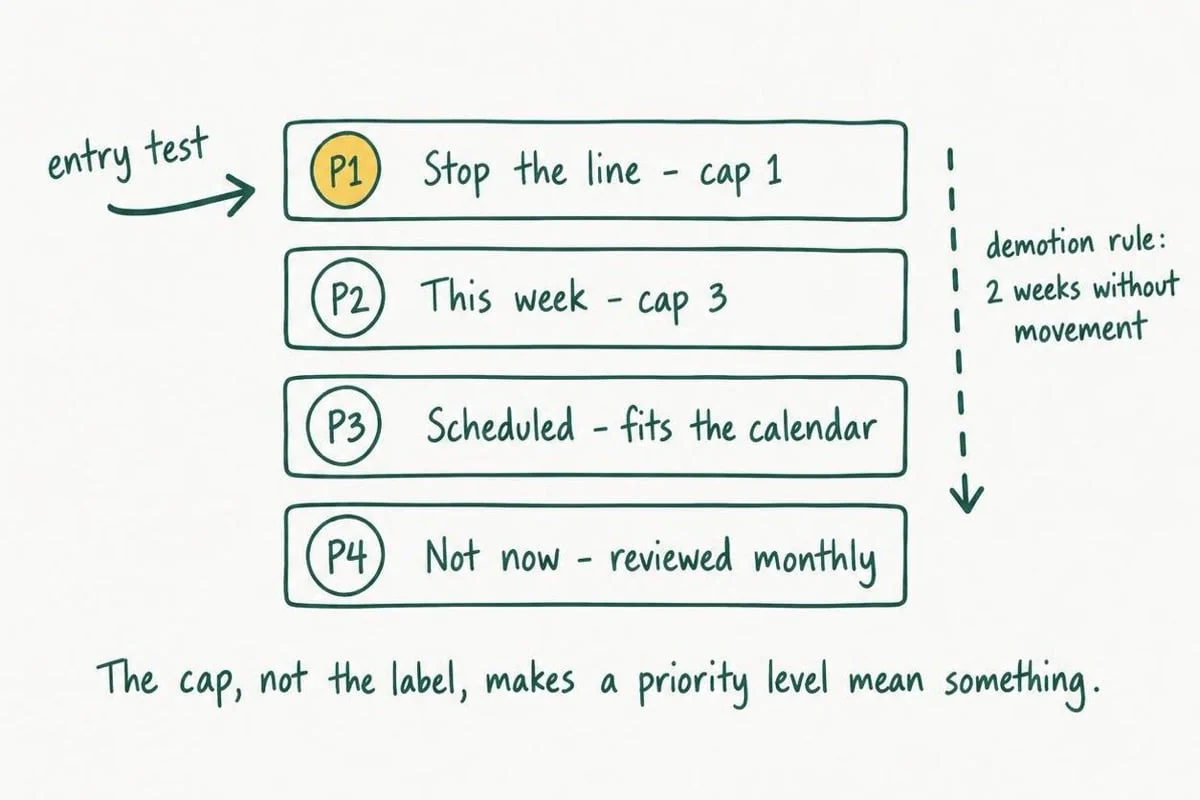
If you find that your goals are consistently in competition with one another for your limited time, acknowledge that you do not have a "goal-setting problem"—you have a "prioritization problem." Once you identify the difference, you can begin to distinguish between the goals that change your career and the goals that merely occupy space on a form.
Ultimately, the difference between a high-performer and everyone else is the willingness to look at the numbers every Friday, regardless of whether the results are favorable. In the world of professional growth, consistency beats intensity every time.