In January, the blueprint looked flawless. You committed to four workouts a week, a professional certification to be completed by June, and a rigorous savings plan to bolster your financial security. It is now September, and the reality is stark: none of those three objectives lasted more than five consecutive weeks.
This is not a failure of character, nor is it a deficiency in your goal-setting mechanics. The goals were, by every traditional definition, "SMART"—Specific, Measurable, Assignable, Realistic, and Time-bound. The sentences were grammatically perfect and logically sound. However, the arithmetic underpinning those sentences was pure fiction.
The primary culprit is the letter ‘R’. While it stands for "Realistic," it is the most frequently skimmed and misunderstood component of the SMART framework. When people sit down with a fresh notebook, "realistic" is often misinterpreted as a subjective question about self-belief—a test of optimism. But goals are not built on optimism; they are built on resources. To bridge the gap between intent and outcome, we must redefine realism not as a feeling, but as a rigid accounting of your actual capacity.
The Evolution of Realism: From Management Theory to Personal Failure
To understand why our goals crumble, we must return to the origin of the acronym. George Doran, who introduced the SMART framework in the 1981 issue of Management Review, did not intend for "Realistic" to be a pep talk. He framed it as a resource-based inquiry: What results can be achieved given the constraints of time, capital, and skill?
Doran’s original criteria—Specific, Measurable, Assignable, Realistic, and Time-related—were designed as a "supply check." Yet, over the decades, the acronym has drifted. Modern iterations often swap "Realistic" for "Relevant" or "Assignable" for "Achievable." This semantic migration has diluted the core technical requirement of the framework.
The distinction between "achievable" and "realistic" is the difference between success and burnout. "Achievable" asks if a task is possible in a vacuum. "Realistic" asks if it is possible for you, right now, given your existing obligations. A goal can be perfectly achievable—like running a marathon—while being fundamentally unrealistic if you are currently working 60 hours a week and caring for an aging parent. SMART formats the sentence, but it does not account for the life that happens between the words.
Why Your Intuition is Your Greatest Liability
Human beings are notoriously poor at forecasting their own capacity. Psychological studies, including those focused on student project management, consistently show that individuals suffer from an "optimism bias." We predict our future productivity based on our "best-case" weeks rather than our "ordinary" weeks.
This bias is compounded by the "commitment trap." Each goal, viewed in isolation, feels entirely reasonable. The error occurs when we aggregate them. If you commit to four goals, each requiring five hours of focused time, you have effectively claimed 20 hours of discretionary time. If your actual weekly surplus is only eleven hours, you are not facing a "discipline problem"—you are facing a "capacity failure."
Discipline cannot manufacture time that does not exist. Without conducting a formal life audit to determine the hard floor of your commitments—work, health, family, and financial maintenance—you are merely setting yourself up for a cycle of perpetual disappointment.
The Mathematics of Execution: Beyond Motivation
A goal becomes realistic only when it is treated as a math problem. Belief is not a valid input for an execution strategy. If a target requires six hours of weekly labor but your honest surplus is three, the ambition is not "too big"—the timeline is simply incorrect. By doubling the duration or halving the scope, the target becomes realistic without losing its challenge.
Critically, "realistic" should not be confused with "easy." Research conducted by Locke and Latham over 35 years confirms that "specific, difficult goals" consistently outperform vague, easy ones. The danger arises when goals are set so high that they exceed the limits of available resources. As explored in Harvard Business School’s "Goals Gone Wild" research, over-prescribed goal setting often leads to unethical behavior, narrow-mindedness, and the neglect of critical non-goal areas of life.

The Four-Question Realism Check
Before committing to any new objective, we recommend a four-part "realism check." This is a rigorous diagnostic that forces you to confront the arithmetic of your life before the work begins.
1. The Baseline Count
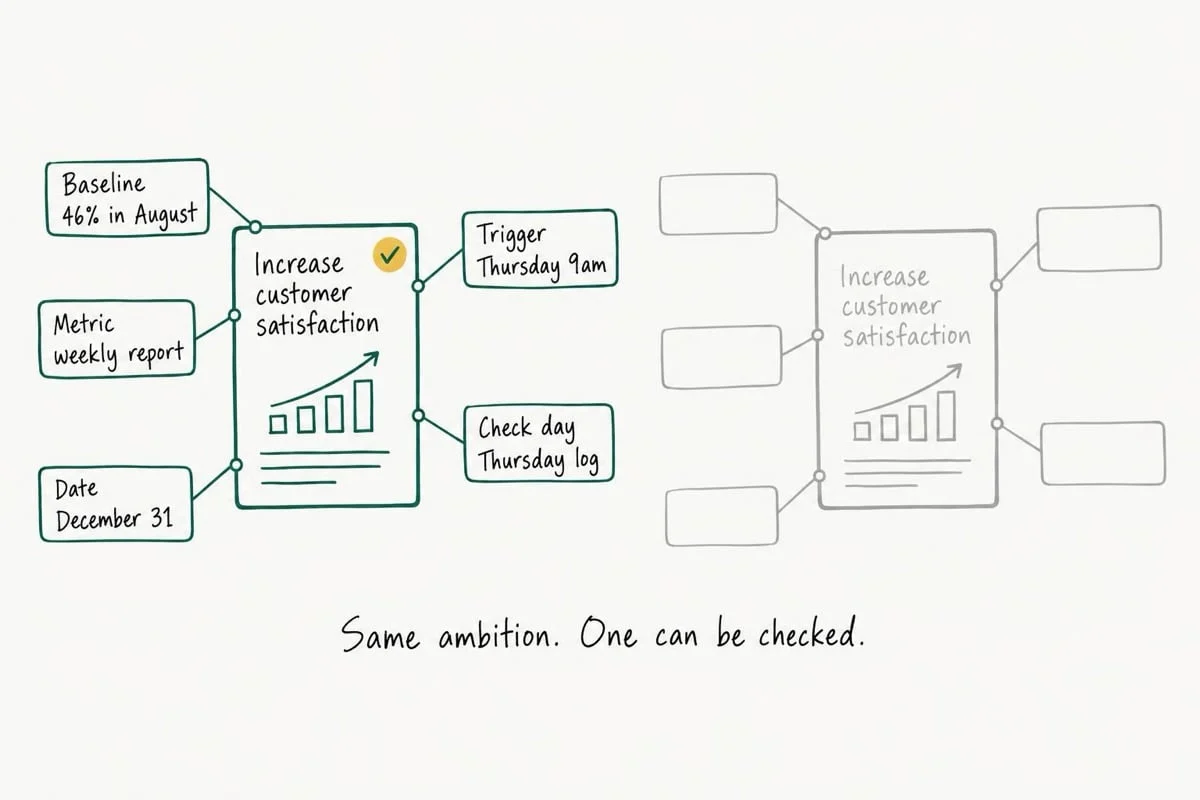
Go back eight weeks. Ignore what you intended to do and count what actually happened. How many pages did you write? How many sessions did you attend? If you aim for five workouts a week but your baseline is one, you are not setting a goal; you are expressing a wish. A realistic jump is an incremental increase from an honest starting point.
2. The Cost-Transfer Analysis
Every goal is a transfer of energy. If you are adding a goal, you are taking time away from something else. Explicitly define what loses those hours. If you cannot name the source, the goal will inevitably be funded by your sleep or your health. Use time-blocking to see if the hours actually fit into your week.
3. The Competency Assessment
Are you trying to achieve an outcome you don’t yet have the skills for? Trying to "increase conversion by 20%" when you have never run a marketing funnel is not realistic. In this instance, your goal should be a "learning goal" (e.g., "Run four structured tests") rather than an "outcome goal." Acquire the method first; the outcome follows.
4. The Aggregate Audit
This is the step most people skip. You must calculate the sum of all your goals. If you have three goals that each require four hours a week, you have a 12-hour deficit against an 11-hour surplus. Even if each goal is realistic on its own, they are collectively impossible. If the total exceeds your surplus, you must drop or defer a project now, while you are in control, rather than letting the calendar decide for you in Week Six.
Case Studies in Right-Sizing
Consider the case of Denise, an operations manager who wanted to get fit and earn a certification simultaneously. Her original plan failed because it lacked a resource-based foundation. After applying the realism check, she switched to a "learning-first" model: she focused on the certification modules during set hours on Tuesday and Thursday, while reducing her fitness target to two 30-minute sessions. By accepting a smaller, funded scope, she ensured her success.
Similarly, consider Frank, a consultant who aimed to save $24,000 annually. His baseline was $400 a month. To reach $24,000, he needed $2,000 a month—a $1,600 gap he had no plan to cover. By resetting his goal to $900 a month and explicitly identifying which subscriptions to cut and which client rates to raise, he turned a fantasy number into a structural plan.
Implications: The Role of the "Minimum Version"
When a goal begins to slip, the common reaction is to abandon it entirely. Instead, use a "minimum version"—the smallest possible action that keeps the habit alive. If your four-session-a-week goal becomes impossible due to a crisis, drop to one or two sessions rather than zero. The minimum version is not the goal itself; it is the tether that prevents you from losing your momentum while you navigate life’s inevitable fluctuations.
Final Thoughts: The Power of the Capacity Statement
The worry that a realistic goal makes you "soft" is unfounded. Evidence consistently suggests that resourced, specific goals lead to higher long-term performance than unresourced, overly optimistic ones.
If your goals are dictated by management or external pressures, you may not be able to change the target, but you can always change the "capacity statement." Communicating that a project requires six hours when you only have three is a professional, productive conversation that forces stakeholders to prioritize.
Before you write your next goal, set aside the notebook. Sit down with your calendar and your bank statement. Count your actual hours. Count your actual baseline. Start with the math, and the ambition will follow. When you align your goals with the reality of your resources, you move from the realm of fiction into the realm of consistent, sustainable achievement.