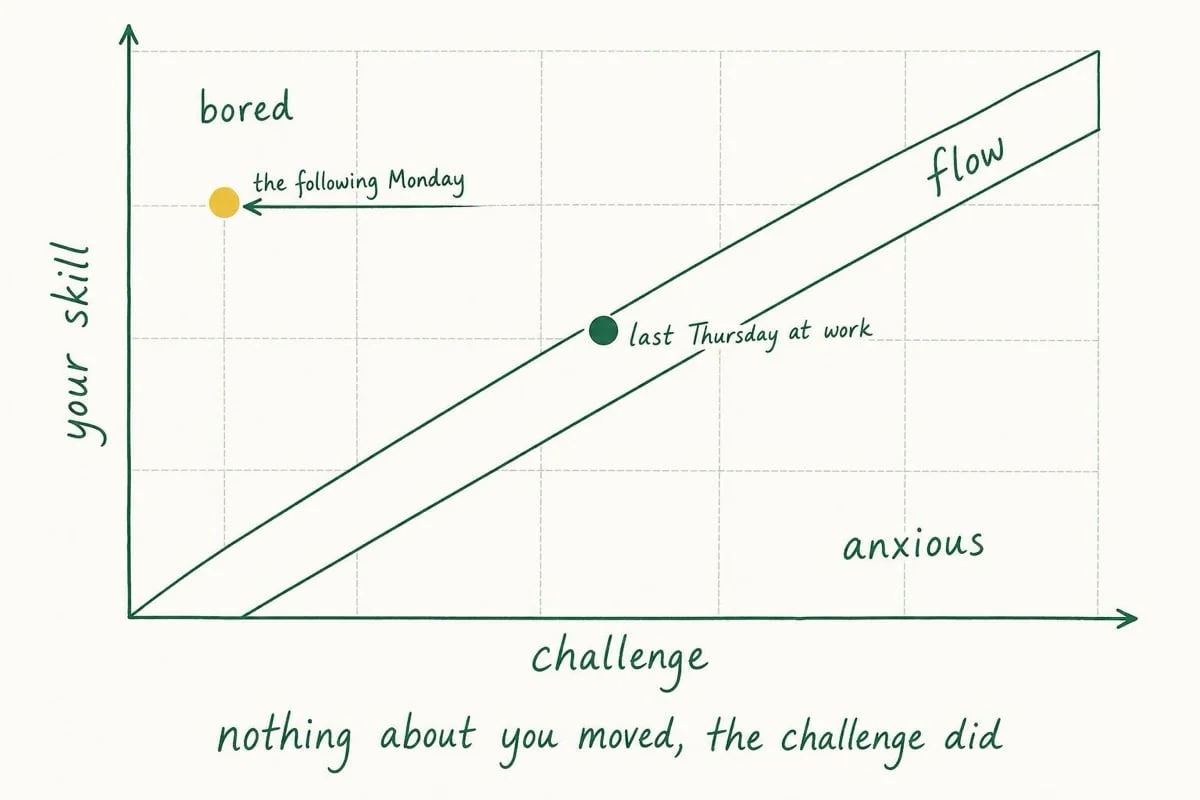
Fourteen items on the to-do list. Eleven are marked as "High Priority." Two arrived via an urgent morning email from your manager, three are the result of a customer escalation, and one is that lingering strategy memo you have dutifully moved across four consecutive Mondays.
Every single item on this list is, from a business perspective, entirely defensible. That is the fundamental problem.
In the modern workplace, priority levels are intended to function as a sorting mechanism for chaotic information. In practice, however, they often serve only to rename that chaos. Teams introduce fields like P1, P2, and P3, but within a month, every request that holds any significance to any stakeholder is pre-stamped as a "P1." The labels become tidier, the interface looks more professional, and yet, you still find yourself at 7:00 PM on a Thursday, staring at a screen, agonizing over which professional promise you are about to break.
The reality is that labels are not a functional mechanism for productivity; they are a tax on your decision-making capacity. A priority level only functions effectively when it exacts a cost: a lost time slot, a forfeited day, or the displacement of another task in the queue. A level that costs nothing will be spent freely by every stakeholder in your ecosystem. A scale where everything is a "Level One" is not a management system—it is simply a list with extra, bureaucratic steps.
The Anatomy of True Priority: What Labels Actually Are
At their core, priority levels are fixed, rigid labels designed to rank work based on the damage prevented and the velocity of required resolution. In the realm of IT service management, these labels are derived from a strict matrix: Impact (the scope of business loss) multiplied by Urgency (the expected speed of resolution). The highest combination maps to Priority 1, or "Critical."
On a personal task list, the objective should be identical: to define what you do now and what you must consciously abandon to make that possible.
The heritage of this system is instructive. Incident response teams define their top-level tiers with excruciating detail. For instance, a major network vendor defines a Priority 1 event as a complete business outage affecting multiple sites or critical applications. Notably, this definition ignores the "who"—it does not matter who shouted the loudest or how recently the request landed in an inbox. It matters only that the system is broken.
How Many Levels Are Enough?
There is no universal standard for the number of tiers a system should contain. Some software providers rely on a lean three-tier system: P1 (Urgent), P2 (High), and P3 (Normal). Conversely, companies like Cisco utilize four severity levels, while PagerDuty suggests schemes often run from P1 through P5.
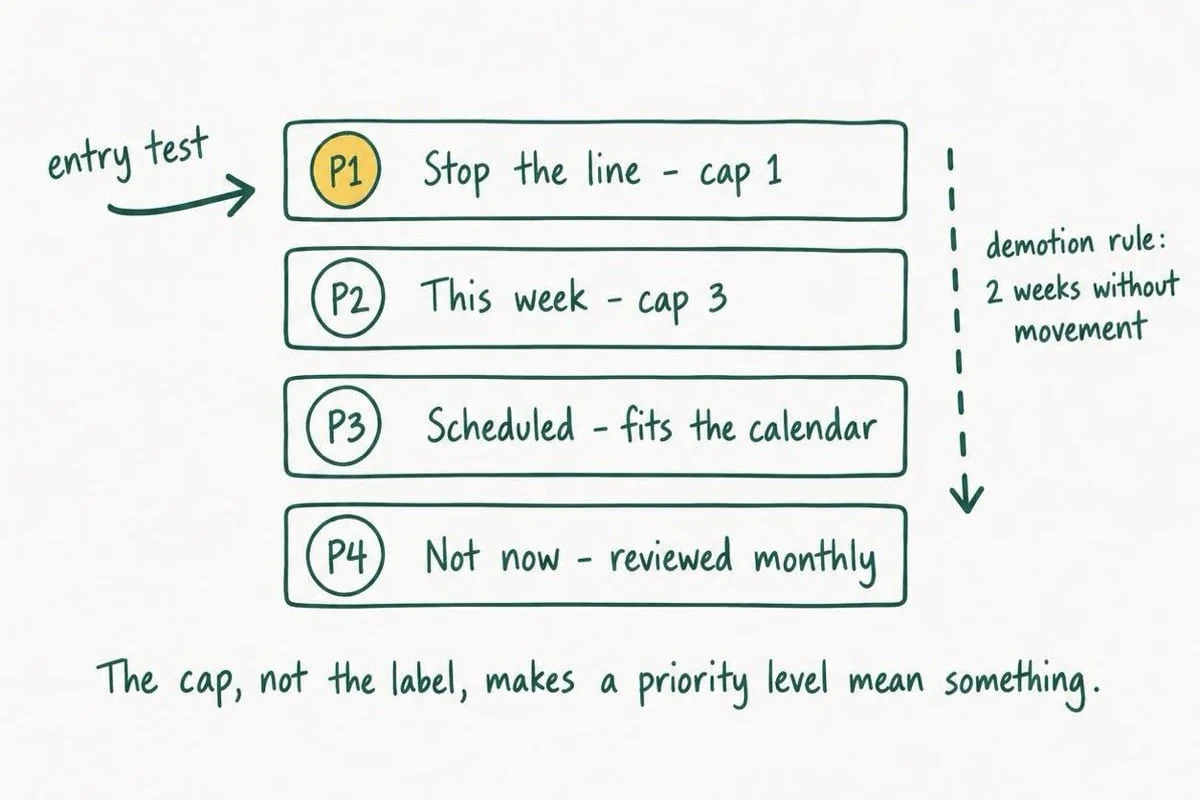
The exact count—three, four, or five—is largely irrelevant. What makes a scale function is not the number of tiers, but the "entry test" for each one. This is the component most professionals fail to import into their own personal productivity workflows.
The Structural Failure of Priority Inflation
Labels inflate for a boring, predictable reason: the label is free, but your Tuesday is not. Because any stakeholder can mark a request as "urgent" at zero cost to themselves, the top tier inevitably fills until it loses all diagnostic value. By week three, "P1" no longer denotes a business-critical emergency; it denotes something that is recent, loud, or requested by someone with a high-ranking title.
The Psychology of "Mere Urgency"
Urgency cues exert a profound, often irrational influence on our choices. Across five landmark experiments, researchers observed that subjects consistently prioritized objectively lower-payoff tasks simply because those tasks carried an "urgent" or "expiring" cue. This phenomenon, dubbed the "mere urgency effect," suggests that humans are hardwired to favor the immediate over the important, even when the immediate pays significantly less.
This distinction between the urgent and the important—famously popularized by President Dwight D. Eisenhower—remains the bedrock of modern time management. Yet, the classic 2×2 Eisenhower Matrix is often insufficient. It sorts tasks into quadrants, but it does not solve the resource problem. If you have eleven tasks in the "Important" box, you still only have one Tuesday.

Furthermore, the act of re-sorting your list forty times a day creates a "decision tax." Cognitive research indicates that the mental energy cost of switching tasks increases with the complexity of the rules involved. This is why "decision fatigue" settles in by 4:00 PM, leaving you with a list that has remained untouched since lunch.
A Proposed Four-Level Scale to Force Choice
To regain control, one must implement a scale that incorporates not just impact and urgency, but a strict "cap" on how many items can inhabit each level. The following framework serves as a model for forcing actual, tangible choices.
| Level | Definition | Entry Test | Cap | The Cost |
|---|---|---|---|---|
| P1 | Stop the Line | Outside party blocked / Date-specific failure | 1 | Everything else slips by one day |
| P2 | Weekly Promise | Dated commitment to a named person | 3 | No new P2 enters until one closes |
| P3 | Scheduled | Real work with a reserved slot | Variable | Reviewed weekly; move up or out |
| P4 | Not Now | Everything else | None | Reviewed monthly; deleted at 90 days |
The Power of the Cap
The "cap" is the mechanism that prevents system collapse. Based on Little’s Law—a principle from queueing theory—the number of items in a system is directly proportional to the time each item spends in that system. By limiting your open "P2" tasks to three, you force yourself to finish work before accepting new obligations.
Writing this "entry test" on a Sunday, when you are not under the duress of a Monday morning backlog, is critical. A rule you write in a state of calm is significantly harder to talk yourself out of when a colleague stands at your desk demanding immediate action.
Chronology of a Productive Tuesday
To understand how this functions, consider the example of an operations lead at a logistics firm.
- 9:12 AM: A warehouse integration fails. Because this meets the P1 criteria (an outside party is blocked), it takes the sole P1 slot. The previously planned board memo is moved to Wednesday, and the stakeholder is notified immediately. By making the movement visible, the lead transforms a "broken promise" into a managed trade-off.
- 11:40 AM: The CFO requests a pricing analysis "as soon as possible." The P1 slot is occupied. The lead responds: "I can start this at 2:00 PM once the integration is resolved, or I can take it now, and the integration will wait. Which is the priority?"
- 4:30 PM: Three new requests arrive. Because the P2 cap of three is reached, these requests are relegated to P3 with specific dates attached. The lead leaves the office having completed the most critical work, rather than having spent the day reacting to the loudest request.
Strategic Implications for Stakeholder Management
The most frequent objection to this system is the assumption that you do not control the inputs. You may feel that your CEO or your best client dictates your priorities.
However, even when you do not control the input, you can control the negotiation. When a stakeholder asks for something "urgent," you are not arguing about the label. You are engaging in a resource discussion. "I am happy to make this a P1. That will mean the X project will be delayed until Friday. Does that work for you?"
Most senior stakeholders, when presented with the trade-off, will answer honestly because it shifts the burden of prioritization from your emotional bandwidth to the reality of finite capacity.
Conclusion: How to Audit Your System
To begin, do one thing today: write the entry test and the cap for your top level on a single piece of paper. Keep it visible. This single line is the smallest, most effective version of the system.
After two weeks, perform an audit. Count your P1 declarations. If you have declared more than two per week, your entry test is too loose; tighten the criteria until the label carries the weight of a true emergency. If you find your P2s are constantly exceeding the cap, your "promises" are purely decorative.
These metrics do not measure how hard you are working; they measure what your system actually permits. In the end, the goal is not to be busier—it is to ensure that your effort is aligned with the promises you have actually committed to keeping. If the results are uncomfortable, that discomfort is not a failure—it is the most important data point you have.