Ray’s calendar is, by all outward appearances, the envy of the modern retiree. On Mondays, he is at the gym; Tuesdays are reserved for picking up his grandson; Wednesdays find him in a woodworking shop at the local community center. He maintains a rigorous four-mile walking habit, consumes two books a month, and has reorganized his garage so thoroughly that every bolt has a designated home.
Yet, Ray is profoundly bored. And he feels like an ingrate for saying so. He possesses his health, his savings, and his family—the very trifecta of retirement success. Forty years ago, he would have traded a kidney for this schedule.
The disconnect here is not a failure of character; it is a fundamental misunderstanding of what human beings need to thrive. Retirement boredom is rarely a shortage of things to do. It is a shortage of things that are "hard enough to hold you." To understand why the golden years often lose their luster, we must dismantle the myth that retirement is merely a long-form vacation.
The Anatomy of the Boredom Gap
Researchers define boredom as the aversive experience of wanting—but being unable—to engage in satisfying activity. For the newly retired, the "wanting" remains perfectly intact. What has vanished is the necessity of engagement. After four decades of operating at the peak of one’s ability, the average retiree finds that most available leisure activities sit well below their intellectual and physical capacity.
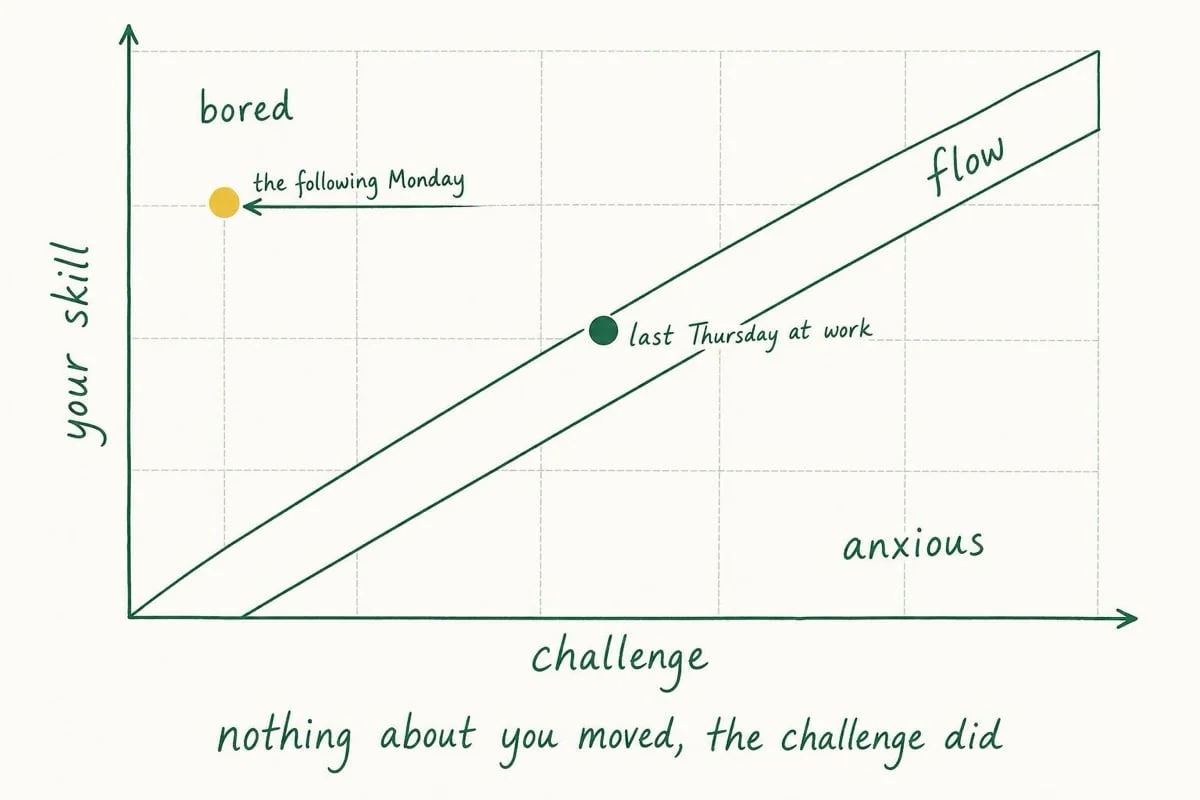
This creates a psychological mismatch. In the classic "Flow" model, anxiety occurs when demands exceed skills, while boredom occurs when skills significantly exceed demands. For forty years, the average professional lived on the "Flow" diagonal: high skill matched with high challenge—deadlines, complex interpersonal navigation, and problems that required genuine problem-solving. When retirement hits, the challenge drops to zero, but the skill remains.
You did not lose your competence when you retired; you lost the environment that required it.
The Chronology of the "Honeymoon-to-Slump" Cycle
The trajectory of retirement is rarely linear. While industry literature often promises a "honeymoon phase" of relaxation, psychological researchers have identified that retirees tend to move through distinct, non-linear phases.
- The Honeymoon (Months 1–6): A release from the pressures of the workplace. The calendar is a blank slate, and the focus is on recovery and decompression.
- The Disenchantment (Months 6–18): As the novelty of "no schedule" fades, the lack of structural demand becomes apparent. This is where the "agitated" boredom described by researchers often sets in.
- The Reorientation (Year 2+): This is the critical juncture. Some retirees effectively bridge the gap by shifting from "pastimes" to "pursuits," while others succumb to the apathy of a life without friction.
Supporting Data: The Cost of a Frictionless Week
The data on how we spend this time is sobering. According to Pew Research Center’s analysis of federal time-use data, Americans aged 60 and older spend an average of four hours and sixteen minutes per day in front of screens—more than half of their total leisure time.
More granular research, involving the use of audio recorders and accelerometers on 257 adults over the age of 65, found that television consumption occupied roughly 37% of waking time. Crucially, these were the hours when participants were most sedentary and, for those living alone, the hours they reported the highest levels of loneliness.
While television and radio, when used in moderation, are linked to better outcomes in "successful aging" studies, six hours a day is rarely a choice. It is a surrender—the default state a week collapses into when nothing within it demands a higher level of focus.
The Distinction: Pastimes vs. Pursuits
Robert Stebbins, a sociologist who spent half a century studying leisure, offers the most vital distinction for the modern retiree: the difference between "casual leisure" and "serious leisure."
- Casual Leisure: Short-lived, pleasant, and requires little training. It is the woodworking class where you make what the instructor makes. It is the book you read for pleasure.
- Serious Leisure (Pursuits): The systematic pursuit of an amateur activity so substantial that the participant builds a "career" within it. It requires perseverance, a need to gain skill, and a social world of others who share the same standard of excellence.
The research is clear: difficulty is the active ingredient in happiness. In the Synapse Project, adults aged 60 to 90 who spent 16.5 hours a week learning a difficult new skill—such as digital photography or complex quilting—saw significant improvements in episodic memory. Those who merely socialized or engaged in low-demand tasks showed no such cognitive gain.
The Implication: How to Re-Engineer Your Week
If you are bored, the answer is not a new list of hobbies. The answer is to introduce "resistance" into your current routine. You can do this through three specific, actionable mechanisms:
- Add a Standard You Cannot Currently Meet: Stop doing the hobby you are good at and start doing the version of it that makes you feel incompetent. If you are a woodworker, stop making birdhouses and commit to a complex piece of furniture that requires joinery you haven’t mastered.
- Add an Audience: Accountability is the primary substitute for a boss. If you read, start a book club where you are responsible for the questions. If you play an instrument, commit to a recital. When others are waiting for your output, you cannot "quietly exit" on a slow morning.
- Add a Deadline You Did Not Set: Register for a competition, a county fair, or a certification exam. A hard date on a calendar acts as the civilian equivalent of a professional deadline. It forces your brain out of the "maintenance" mode and into "achievement" mode.
When Boredom Masked as Depression
It is imperative to address the clinical distinction between boredom and depression. While both are correlated with lower quality of life, they require fundamentally different interventions.
Research indicates that about 13.2% of older Americans report clinically significant symptoms of depression. If your boredom is accompanied by a change in appetite, persistent sleep disruption, or a feeling that "nothing matters," this is not a problem for a hobby. It is a health issue that requires professional medical intervention.
The "apathetic" profile of boredom—where nothing seems worth the effort—is often a red flag for deeper physiological or psychological needs. If you find yourself in this state, do not attempt to "work through it" with a harder hobby. Reach out to a primary care physician to rule out clinical depression or other age-related health declines.
Conclusion: The Right to Be Bad at Something
The culture of retirement often sells a vision of "ease." We are told we have earned the right to take it easy, to avoid stress, and to relax. But for the high-functioning individual, "easy" is a trap.
Being bad at something in public is, for many retirees, the most terrifying thing they can do. It invites the possibility of failure. But that same failure is the evidence that you are challenging your boundaries.
There is no clock on this transition. Whether you are in your first year of retirement or your tenth, the remedy remains the same: stop looking for things to fill the time, and start looking for things to fill your capacity. Find the activity you would miss the most if it disappeared, then find the version of it that is currently beyond your grasp.
Being bad at something again is not a step backward. It is the first step toward a retirement that isn’t just full—but worth living.