In a significant reversal of strategy, the popular journaling platform Day One has announced that its experimental “Labs” feature—previously restricted to the higher-tier Gold subscription—is once again available to Silver-level subscribers. This decision marks a pivotal moment in the company’s relationship with its user base, underscoring a commitment to community-driven development and acknowledging the critical role that early adopters play in the software’s evolution.
Starting with version 2026.17, Silver subscribers can once again access, test, and influence the experimental features currently in development. For a platform that positions itself as the digital home for millions of personal memories, this move is more than just a pricing adjustment; it is a recalibration of how the company builds its future.
The Chronology of a Policy Shift
To understand the weight of this announcement, one must look at the recent history of Day One’s subscription model. In March, the company introduced a tiered system—Silver and Gold—designed to better reflect the diverse needs of its global user base. During that transition, access to Labs was moved exclusively to the Gold tier.
The reaction from the community was immediate and vocal. Long-time users who had spent months providing detailed feedback on experimental features suddenly found themselves locked out of the very development pipeline they had helped nurture. For many, this wasn’t just a loss of functionality; it was a perceived severance of a collaborative partnership.
The company admits that the backlash was both expected and warranted. In an official statement, the team acknowledged, “Subscribers who had spent months trying and helping shape experimental features lost them. Several of those features graduated into Gold the same day. That was a real loss and people were honest with us about it. We heard you and are bringing Labs back to Silver.”
This return is not a debut, but a restoration. By reintegrating the Silver tier into the Labs ecosystem, Day One is attempting to heal the friction caused by the March reorganization, effectively placing the “lab coat” back on the shoulders of its most consistent daily users.
The Philosophy of "Journaling Out Loud"
The current iteration of Labs is defined by a singular, cohesive theme: the evolution of "journaling out loud." The developers have identified a common psychological hurdle in the journaling process—the paralysis induced by a blank page.
Data suggests that users often find the physical act of typing to be a friction point that interrupts the flow of thought. Conversely, verbalizing thoughts is faster and often captures a more authentic emotional spectrum. However, the traditional trade-off for voice-to-text has been the creation of messy, unformatted, and difficult-to-read transcripts that rarely get revisited.
To combat this, Labs is currently testing two critical AI-driven tools:
- The Rebuilt Audio Recorder: Designed for iPhone and iPad, this tool does more than capture sound. It integrates AI-powered summaries, allowing users to distill a rambling six-minute reflection into a concise, meaningful digest.
- AI Format Transcription: This feature addresses the "wall of text" problem. By applying intelligent punctuation, grammar correction, and structural formatting to raw speech, the tool turns spoken musings into polished entries that are far more likely to be read and cherished later.
These features remain in a state of flux, intentionally designed to be rough around the edges. By opening these tools to the Silver tier, Day One aims to increase the volume of feedback, ensuring that the final products are not merely "technologically impressive," but genuinely useful for the diverse ways in which people document their lives.
Supporting Data: Why User-Led Testing Matters
The efficacy of the Day One Labs model relies on a feedback loop that the company describes as an "active workshop." While internal testing can identify bugs, it cannot replicate the chaotic, unpredictable, and deeply personal ways that thousands of individuals use a journaling app.
When a feature is tested by a few hundred people, the data points toward functionality—does the button work? Does the recorder capture audio clearly? However, when the user base scales to thousands, the data shifts toward utility—does this feature actually belong in a person’s daily life?
By expanding the test pool, the company gains access to a broader demographic of journalers, ranging from students and professionals to retirees and world travelers. This diversity is essential for ensuring that features like AI transcription are inclusive of various dialects, speech patterns, and subject matters. The company maintains that if a feature proves its worth through this expanded testing, it is more likely to graduate from the lab and into the core application, potentially becoming a standard offering for all.
Official Responses and Privacy Protocols
A central concern regarding the integration of AI tools is, naturally, user privacy. Day One has built its reputation on the sanctity of private, encrypted journaling. In its announcement, the company was careful to delineate the boundaries of its AI features.
"Nothing is processed unless you choose it, nothing is stored on our servers, and nothing is used to train models," the company stated, emphasizing that their core privacy principles remain the bedrock of the service.
Furthermore, the company has clarified the distinction between “Labs AI” and “General AI.” The AI features found within Labs—such as the audio summarizer—are explicitly opt-in. They are separate from the broader AI toggle in the main settings, which governs features like Daily Chat and other advanced tools that remain exclusive to the Gold tier. This segmentation ensures that users who are skeptical of AI or prefer a "pure" manual journaling experience can keep those features disabled without compromising the rest of their app functionality.
The Implications: A New Era of Transparency
Perhaps the most significant aspect of this update is the company’s commitment to radical transparency regarding the lifecycle of a feature. Day One has pledged to communicate at three distinct milestones to avoid the "subscription shock" that caused the initial friction in March:
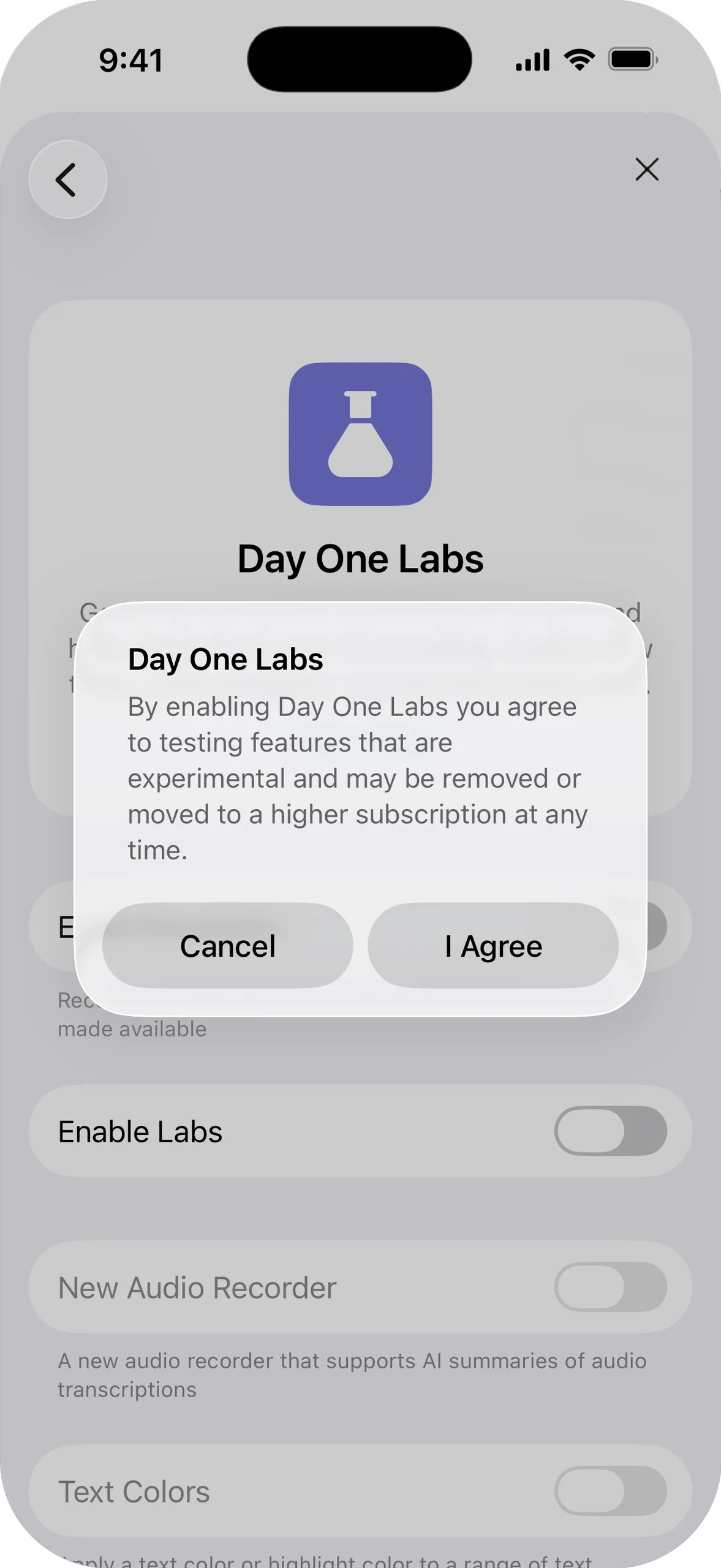
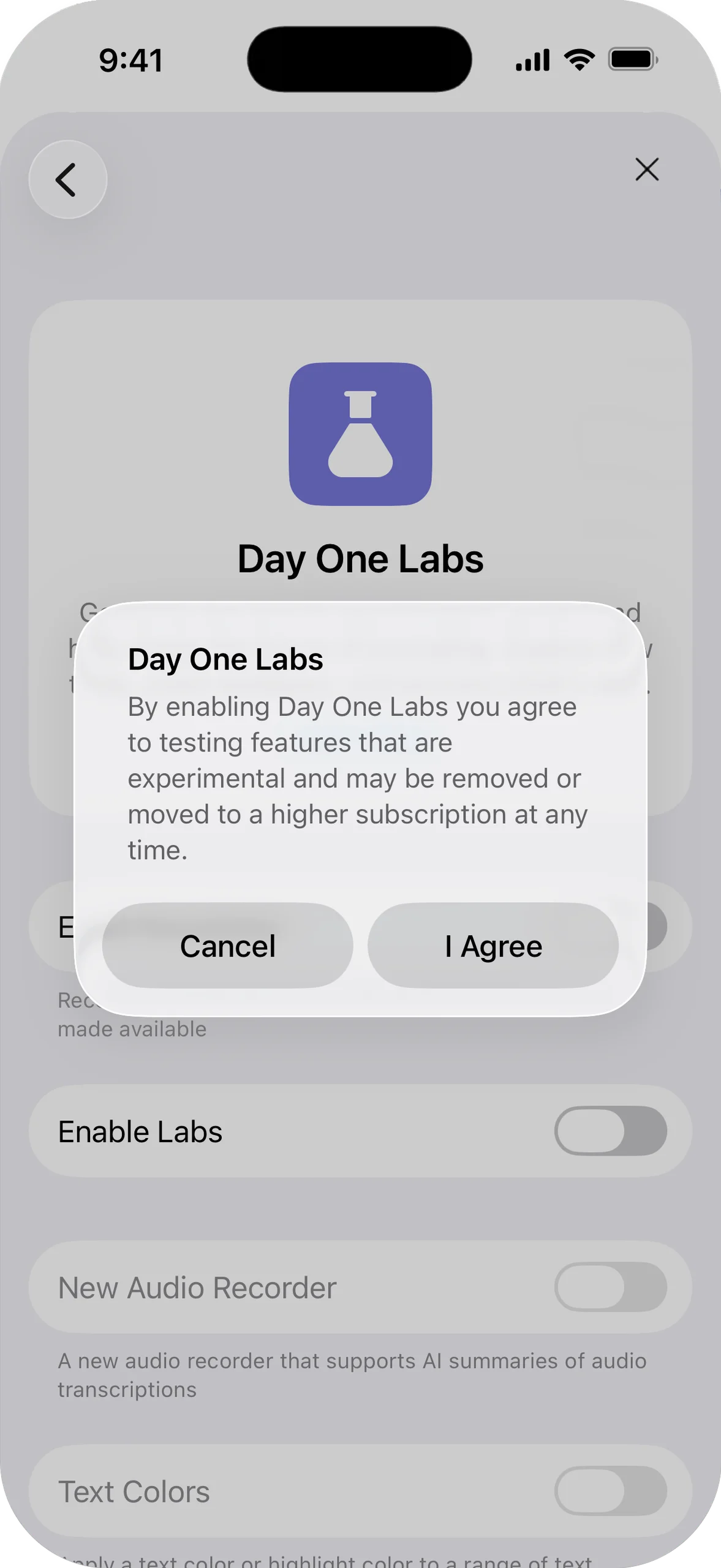
- The Opt-In: When a user enables Labs, they are presented with a clear disclaimer: these features are experimental and subject to change, removal, or migration to a higher subscription tier.
- The Visual Cue: Every experimental feature is clearly marked with a "Labs" badge, acting as a constant, subtle reminder that the tool is a work in progress.
- The Roadmap Alert: Before any feature is moved out of Labs—whether it is being permanently added to the app or shifted to a different tier—the user will be notified in-app.
This creates a "no-surprises" policy that respects the user’s intelligence and investment. It acknowledges that users are not just customers; they are stakeholders in the development process.
Looking Ahead: Building with the Community
For the average Silver subscriber, the return of Labs is a net positive. It provides access to bleeding-edge tools while offering a direct line to the development team via the “Share Feedback” button.
However, the implications for the broader software industry are equally notable. In an era where companies often hide behind proprietary, black-box development cycles, Day One is betting that the most successful products are those that are built in the open. By admitting fault in their previous strategy and pivoting to restore access, they have signaled that their priority is the long-term health of the user community over short-term gatekeeping.
As the company continues to refine its AI offerings and expand its platform, the "Labs" section will likely remain the most important area of the app. It is a space where the company’s vision meets the user’s reality. For those willing to trade some stability for the chance to shape the future of their digital archive, the doors are officially open again.
As the developers themselves noted, “Many of you have trusted Day One with years of memories and everyday moments… We didn’t build Labs as a perk or a preview. It’s part of how Day One gets made.” For the users who were instrumental in holding the company accountable, this return is a victory for community-led software design.