It is 6:10 a.m. Your alarm is screaming, yet you remain entombed in your sheets, staring at the ceiling with the vacant expression of someone trying to recall a forgotten language. By 6:12, you are upright, stumbling into the kitchen by 6:15, yet you could not recite your own phone number if your life depended on it. You stare at the open refrigerator, a cavernous void of choice, unable to decide between milk or juice. You read the same text message three times, the words sliding off your brain like rain on a windshield.
Then, around 6:40 a.m., the atmospheric pressure in your head finally lifts. The fog thins, the world snaps into focus, and you finally feel like a functioning human being. Unfortunately, this is precisely when you need to be out the door.
For millions, this daily cycle of incompetence is followed by a lingering sense of guilt—the suspicion that they have a "sleep problem" or, worse, a character flaw. But science suggests that the twenty-minute blackout you experience isn’t a result of poor willpower. It is a well-documented physiological state called sleep inertia, and it is governed by biological mechanisms that are almost entirely set in motion the night before, not the morning of.
Main Facts: The Reality of Sleep Inertia
Sleep inertia is not a sign of laziness or a byproduct of a "bad" personality. It is a clinical reality defined as the transition period immediately following waking, characterized by a temporary degradation in both cognitive performance and physical alertness.
According to research published by Hilditch and McHill (2019), this state is a standard feature of human biology, affecting even those who enjoy high-quality sleep. When you wake up, your brain is not merely "turning on" like a light switch; it is undergoing a complex neurochemical reboot. During this phase, the brain—specifically the prefrontal cortex, which governs executive function, decision-making, and impulse control—remains in a state of relative hibernation.
The frustration most people feel stems from trying to treat this biological necessity as an obstacle to be overcome with "hacks." Cold showers, blaring alarms, and excessive caffeine are often ineffective because they attempt to force a system to perform at peak capacity before it has completed its necessary startup sequence.
The Chronology of the Morning Fog
Understanding why you feel the way you do requires a look at the "sleep-wake transition" timeline.
- 0–5 Minutes Post-Alarm: The brain is emerging from the depths of sleep. During this phase, you are prone to "micro-sleeps" and significant lapses in judgment. This is why you might turn off your alarm and immediately fall back asleep without remembering doing so.
- 5–20 Minutes Post-Alarm: The "fog" phase. Physiological alertness is beginning to climb, but executive function remains severely hampered. This is the window where you might read a text and fail to comprehend it, or stand in the kitchen staring at the fridge.
- 20–40 Minutes Post-Alarm: The "clearing" phase. Cortisol levels begin their natural morning rise (the Cortisol Awakening Response), and body temperature begins to increase. By the end of this window, most individuals return to their baseline level of functioning.
The critical insight here is that you cannot accelerate this process. The biological clock requires a specific sequence of hormonal shifts to fully awaken, and trying to bypass these via sheer grit is not only frustrating but usually futile.
Supporting Data: The Science of the "Low"
Why is the fog sometimes thicker on certain days? The severity of sleep inertia is dictated by three primary variables, all of which are determined before you open your eyes:
1. Sleep Debt
Sleep deprivation is the most significant contributor to prolonged inertia. Studies show that individuals who are chronically sleep-deprived experience significantly higher levels of cognitive impairment upon waking compared to those who have met their full sleep requirements. If you consistently cut your sleep short, you are essentially starting your day with a "performance deficit."
2. Circadian Timing
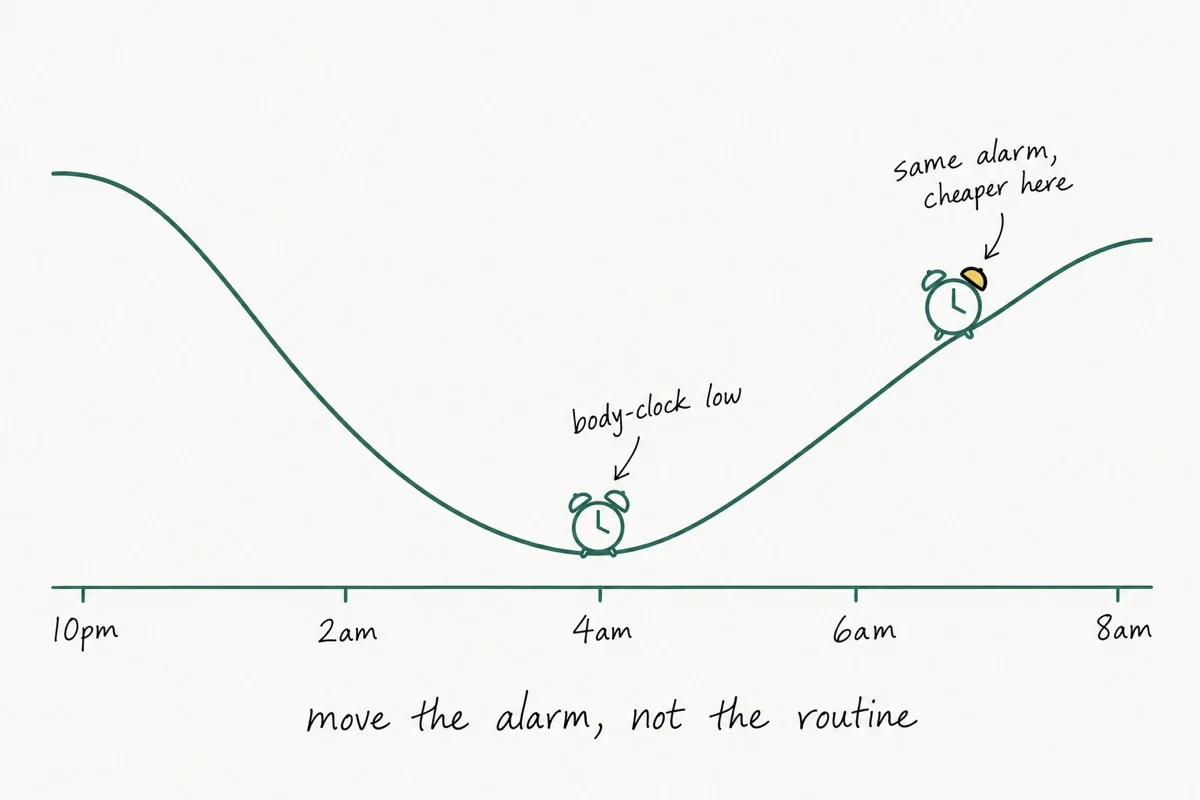
Your body follows a 24-hour cycle known as the circadian rhythm. Every person has a "circadian trough"—a low point in their biological night where core body temperature and alertness hit their nadir. For most, this occurs between 3:00 a.m. and 5:00 a.m., though this shifts based on your individual chronotype (whether you are an "early bird" or a "night owl"). If your alarm goes off while your body is still in its biological trough, the resulting inertia will be significantly more severe than if you wake up during the natural "rise" of the cycle.
3. Sleep Stage Dynamics
Waking from deep, slow-wave sleep (SWS) is significantly more disorienting than waking from light sleep. While many smartphone apps promise to track your sleep stages and wake you during "light sleep," the scientific consensus is mixed. Because sleep pressure and timing are so complex, these apps are often unable to accurately predict the perfect moment to wake you, making them an unreliable solution for eliminating morning grogginess.

Official Responses and Clinical Perspectives
The medical community is clear: if you are experiencing severe, daily, or debilitating morning grogginess that does not resolve within 30 to 60 minutes, it may transcend the bounds of normal sleep inertia.
Clinical experts like Dr. Trotti emphasize that "sleep drunkenness"—a state of prolonged, extreme difficulty waking—can be a diagnostic marker for underlying conditions. Idiopathic hypersomnia, a neurological disorder characterized by excessive daytime sleepiness, and obstructive sleep apnea are common culprits.
When to consult a professional:
- If you find yourself unable to function for more than an hour after waking.
- If your grogginess is accompanied by severe physical exhaustion throughout the day.
- If you experience "sleep paralysis" or frequent, uncontrollable falling back asleep despite an alarm.
Doctors suggest that patients bring a "sleep diary" to consultations, documenting not just the time they wake up, but the time they go to bed and how many times they wake in the night. This data helps clinicians determine whether your morning fog is a scheduling issue or a sleep pathology.
Implications: How to "Outsmart" the Fog
Since we cannot delete the first twenty minutes of the day, we must change our strategy. Instead of fighting the fog, we should design our mornings to be "fog-proof."
The "Dumb" Morning Routine
The most effective strategy is to reduce the cognitive load of your first half-hour. If you are not a functioning human until 6:40 a.m., do not schedule your brain to perform at 6:15 a.m.
- Prep the Night Before: Lay out your clothes, pack your bags, and set your coffee maker to brew automatically. By offloading these decisions to your "night-before" self, you ensure that your "morning-after" self only needs to execute simple, repetitive tasks.
- The "No-Decision" Zone: Move all high-stakes decision-making to later in the day. Do not answer work emails, manage finances, or resolve family conflicts before you have had your first window of recovery.
- Strategic Caffeine Use: Caffeine takes 30 to 40 minutes to reach peak levels in the bloodstream. If you drink coffee the moment you wake up, it isn’t "waking you up" instantly; it is a delayed-release tool. Consume it with the understanding that you are buying yourself a buffer, not a magic reset button.
Moving the Alarm
If your job allows it, consider moving your alarm by as little as 20 or 30 minutes. If you are consistently waking in the middle of a deep sleep cycle or at the absolute nadir of your circadian rhythm, this small shift can move your wake-up call to a point where your body is naturally beginning to rise, drastically reducing the intensity of the inertia.
The Role of Light
While not a cure-all, light exposure is a powerful synchronizer of the circadian clock. Studies have shown that artificial "dawn simulators" or simply opening curtains immediately upon waking can improve subjective feelings of alertness. While light might not make you "sharper" in a cognitive sense immediately, it can make the experience of waking up significantly more pleasant.
Conclusion: Accepting the Cost
The most important takeaway is to stop auditioning "morning tricks." Cold showers, ice-cold water, and frantic workouts are merely distractions that do not address the root cause of sleep inertia.
The first twenty minutes of your day do not belong to you; they belong to your biology. By accepting this reality, you stop viewing your morning fog as a failure and start viewing it as a predictable, manageable, and temporary physiological state. By protecting your sleep opportunity and shifting your most difficult tasks to the other side of the fog, you don’t just survive your morning—you reclaim your day from the unnecessary anxiety of trying to be sharp when your brain is still dreaming.
The fog will always pass. The goal is to ensure that when it does, you haven’t already spent your limited energy trying to fight it.