Feeling lost in your 40s rarely arrives with the cinematic flair of a midlife crisis. There is no sports car, no sudden resignation letter, and no dramatic walk-out. Instead, it arrives as a persistent, low-frequency hum. On paper, your life is a success story: the career trajectory is solid, the mortgage is being serviced, and the household remains functional. Yet, somewhere between the ages of 44 and 47, a haunting, flat question begins to follow you from room to room: Is this it?
You are not necessarily depressed, nor are you in the midst of a mental health collapse. You are simply experiencing a misalignment. The life you spent two decades meticulously building no longer seems to fit the person you have become. This is not a failure of character; it is a structural phenomenon unique to the decade.
The Anatomy of the Midlife "Dip"
The sensation of feeling lost in your 40s has a specific texture. It feels like wearing a suit that was tailored for you five years ago, but which now pulls at the shoulders and bunches at the waist. Your work, once a source of intellectual stimulation, has transitioned into a series of automated tasks. Your body, once resilient enough to bounce back from a missed night of sleep, now demands a "recovery tax" that leaves you feeling perpetually behind.
Social science confirms that you are not imagining this. Researchers studying subjective well-being across 145 countries have identified a consistent "U-shaped curve" of life satisfaction. For the vast majority of the global population, life satisfaction hits its nadir in the late 40s and early 50s. This is not a personal failing; it is a developmental stage. You are currently standing at the bottom of the curve, where the old infrastructure of your early adulthood has worn thin, but the new framework for your later years has yet to be constructed.
The Myth of the "Midlife Crisis"
The popular narrative suggests that midlife is a period of explosive, irrational behavior. However, data from Cornell University suggests otherwise. When researchers analyzed national survey data, they found that only about 23% of midlife adults report experiences aligning with a traditional "midlife crisis." Of those, a mere 8% attributed their distress to the simple fact of aging.
Most people experiencing this "lost" feeling are not undergoing an existential meltdown; they are reacting to a crushing, non-stop workload. Your 40s are the "engine room" of the human experience. You are likely balancing the demands of children, the increasing health needs of aging parents, peak career responsibilities, and the maintenance of long-term relationships. You are running more concurrent life processes than at any other time in your existence, often on less sleep and with higher stakes. The feeling of being "lost" is simply the weight of this convergence.
Chronology of the Drift: How We Lose Our Way
To understand how you reached this point, one must look at how the "drift" occurs. It is rarely a singular event that causes the foundation to crack; it is a series of subtle, incremental shifts.
- The Early 40s (The Saturation Phase): The initial years are defined by the accumulation of responsibilities. You are at the height of your career, and your social and familial networks are at their most demanding. You begin to sacrifice "non-essential" personal habits—exercise, quiet time, or hobby-driven engagement—to accommodate the sheer volume of daily logistics.
- The Mid-40s (The Misalignment Phase): By age 45, the small, "temporary" compromises you made in your 30s have become permanent habits. You realize that your professional identity is tethered to a version of yourself that no longer exists. Relationships, particularly long-term marriages or friendships, have entered "maintenance mode," where the primary focus is survival rather than growth.
- The Late 40s (The Realization Phase): This is the "is this it?" moment. You notice the fatigue. You notice the disconnect. You realize that your life is a highly efficient machine that serves everyone else’s needs, leaving little room for your own evolution.
The Strategy: Rebuilding the Floor
The most common mistake people make when they feel lost is to seek a "ceiling" goal—a grand, sweeping change designed to rectify years of stagnation. They quit their jobs, move to a new city, or overhaul their lifestyle in a weekend. This is often the wrong approach. Dramatic change in a state of exhaustion is rarely sustainable; it is, more often than not, a form of avoidance.
The solution is not a leap, but a "floor."
The Difference Between Ceilings and Floors
A "ceiling" is the impressive, aspirational goal: running a marathon, reaching a specific net worth, or finding a "calling." These are excellent, but they are fragile. They require high levels of willpower, and when you are already running on empty, they are the first things to collapse.
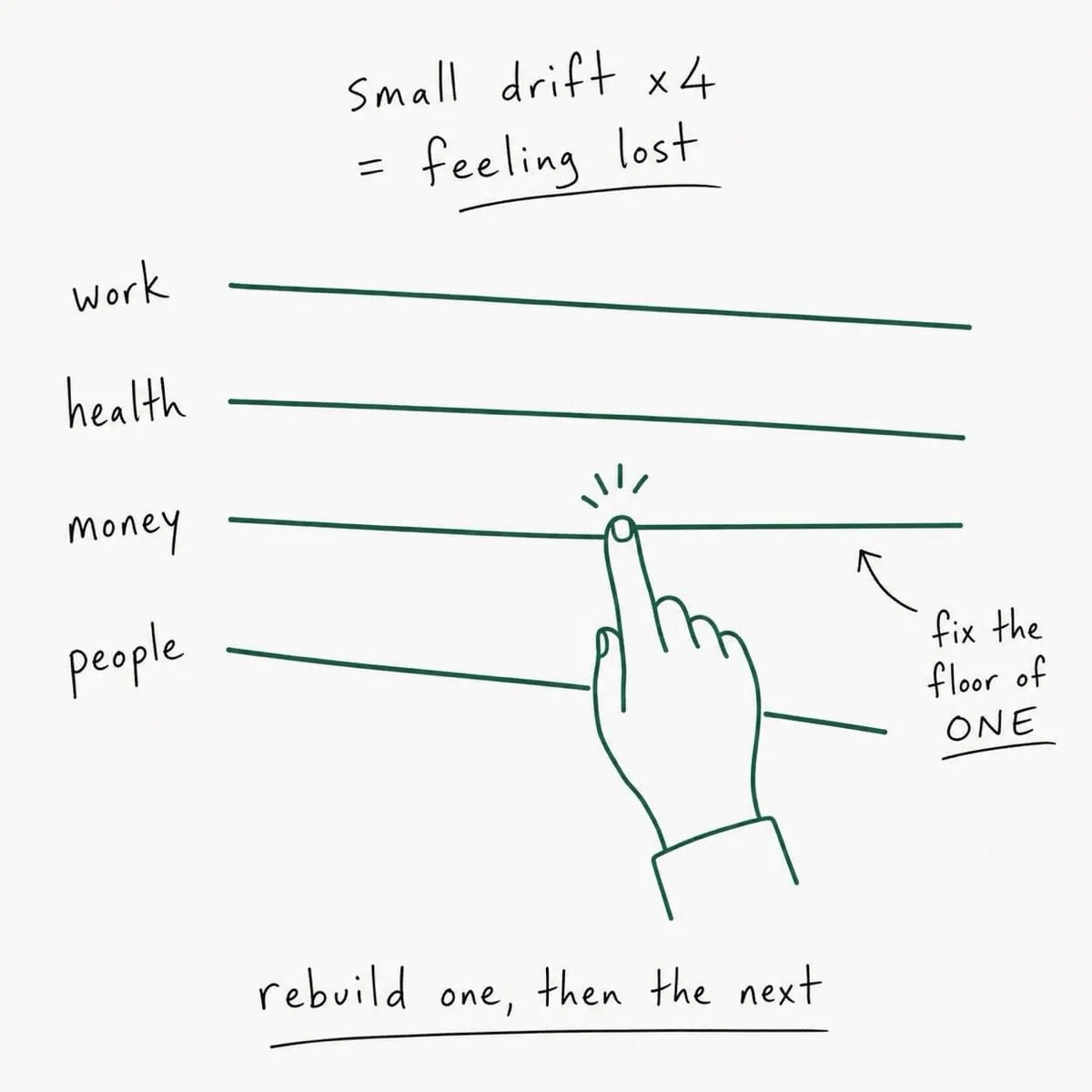
A "floor," by contrast, is your safety net. It is the absolute minimum requirement you can sustain even on your worst, most exhausted day. It is a ten-minute walk instead of a gym membership. It is a five-minute review of your bank accounts instead of a complete financial overhaul. When you feel lost, it is because your floors have fallen out. The structure of your life is sagging. By rebuilding the floor, you create a stable surface upon which you can eventually stand to reach for those higher ceilings.

Implementation: The Science of Small Wins
Behavioral science, particularly the work of researchers like BJ Fogg, emphasizes that habit formation is most successful when it is anchored to existing routines. To stop feeling lost, you must move away from relying on willpower and toward creating "situational cues."
The 5-Second Drift Read
Before attempting to change your life, you must audit it. Take five seconds to evaluate four key domains:
- Work: Does it fit, or are you just going through the motions?
- Health: Are you recovering, or are you running on fumes?
- Money: Do you have a system, or are you avoiding the numbers?
- Relationships: Is the closest connection alive, or on autopilot?
Identify the one domain that causes you to "flinch"—the one that feels the most neglected. That is your first floor.
Establishing the "If-Then" Plan
Once you have identified your domain, anchor a tiny, non-negotiable habit to a cue you already possess. For example: "If I have just poured my first cup of coffee, then I will step outside for a ten-minute walk." By using an "if-then" plan, you remove the need for motivation. The cue (the coffee) triggers the behavior (the walk).
Research into implementation intentions shows that this method significantly increases success rates, even in high-stress, low-energy environments. When you don’t have to "decide" to be healthy, you save the mental energy required to address the more complex, existential questions about your career or your future.
Implications: The Long-Term Reset
Rebuilding your life one floor at a time changes the nature of the midlife transition. It transforms the experience from a "crisis" (which implies destruction and loss) into a "rebuild" (which implies intentional growth and stabilization).
The Power of Sequencing
The danger in trying to fix work, health, money, and relationships simultaneously is that you will almost certainly fail at all of them within a month. A meta-analysis of multi-behavioral interventions suggests that targeting one behavior at a time yields vastly superior results.
Start with one domain. Let the "win" of maintaining that floor for three weeks provide the neurological reward necessary to tackle the next. As your foundation stabilizes, the fog begins to lift. You will find that when you are not chronically exhausted, your ability to make decisions about your career or your marriage improves significantly. You are no longer acting out of desperation; you are acting out of clarity.
Moving Forward
The "lost" feeling is not a sign that you have wasted your life. It is a signal that your old operating system is out of date. You are at the beginning of a second act that requires a new set of structural supports.
Do not look for a grand, cinematic revelation. Look for the floor that has fallen away. Pick one. Define the smallest possible version of a fix. Anchor it to a morning habit. And then, tomorrow morning, simply start. You are not behind. You are merely in the necessary, albeit uncomfortable, phase of the rebuild. The curve is about to start climbing again—but only if you have a solid place to stand.