You have a critical decision in front of you. It might be a job offer with a ticking clock, a property purchase that stretches your financial limits, or a passion project you’ve been subsidizing for two years. You turn to the internet, and every list offers the same stack of books in the same predictable order: Daniel Kahneman’s Thinking, Fast and Slow followed by a collection of heavy-hitting academic titles. While these books are intellectually stimulating, they often fail to address the immediate, burning question: What do I do today?
This guide moves beyond sales rankings. We have categorized these books by the specific decision-making challenge they solve, evaluating them not by their theoretical elegance, but by the practical "drills" they provide to sharpen your judgment.
The Philosophy of the Practical Drill
We evaluated these titles based on a specific, non-academic rubric: Does this book provide a concrete action that improves the quality of a real-life choice?
Research in the field of geopolitical forecasting—specifically the four-year tournaments funded by the U.S. intelligence community—reveals a stark truth: intellectual exposure to concepts is not the same as skill acquisition. A study by Chang, Chen, Mellers, and Tetlock (Judgment and Decision Making) demonstrated that a structured training module of less than one hour improved forecasting accuracy by 6 to 11 percent. Conversely, there is no credible evidence suggesting that merely reading a book improves decision-making.
Therefore, we have graded these books by the "drill" you can extract from their pages. If you finish a book without running a mental experiment or a physical exercise, you have not made a decision—you have simply watched a documentary about your own cognitive biases.
The Seven Essential Titles for Better Decisions
1. Decisive: How to Make Better Choices in Life and Work (Chip and Dan Heath)
The Heaths argue that we often decide within a frame someone else has drawn for us. We ask, "Should I take this job?" instead of "What are the three best ways I could spend the next two years?"
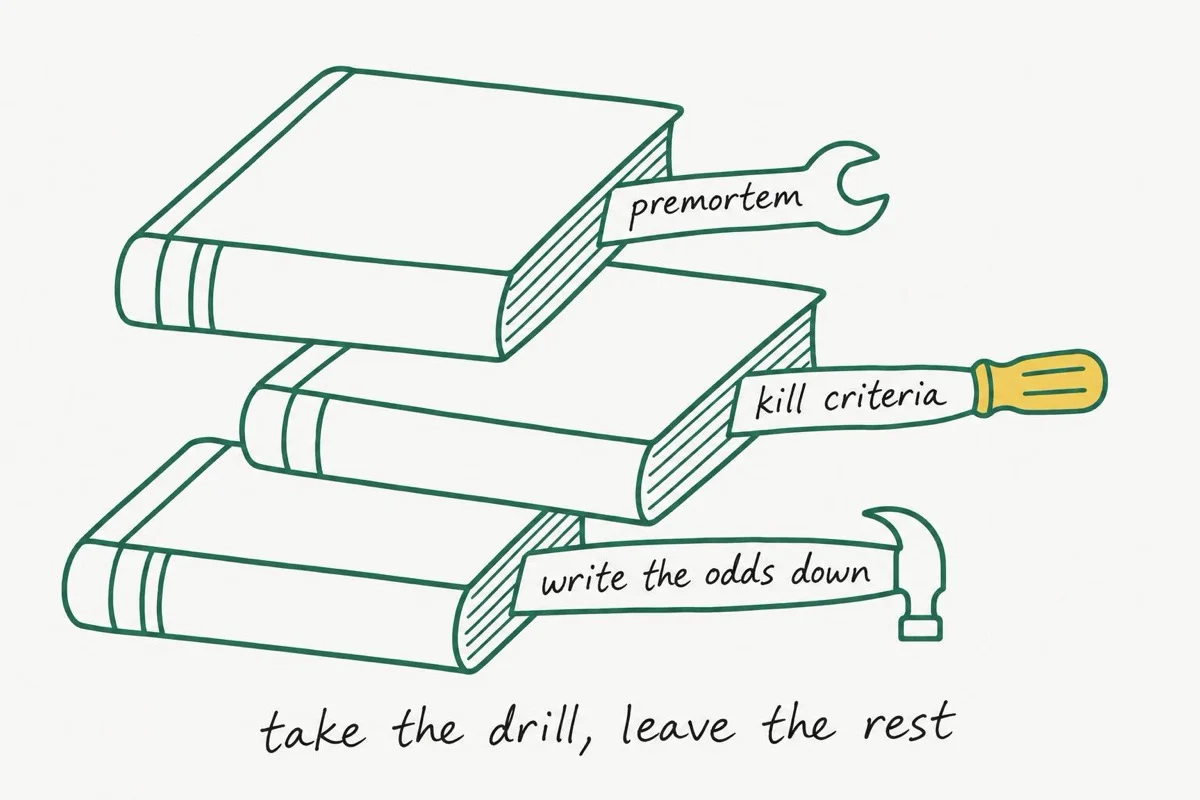
- The Drill: Run a premortem. Before finalizing your choice, assume the decision has already failed. Then, spend ten minutes writing down exactly why it happened. Gary Klein’s research suggests this "prospective hindsight" increases the ability to identify potential failure points by approximately 30 percent.
- The Catch: The examples are heavily corporate, and the book borrows heavily from other frameworks, such as the 10/10/10 rule.
2. Quit: The Power of Knowing When to Walk Away (Annie Duke)
Most literature focuses on the act of starting or choosing. Duke shifts the focus to the often-neglected art of stopping.
- The Drill: Set exit criteria while you are still calm. If your business hasn’t hit $2,000 in monthly revenue by March 31, or if a certification hasn’t led to a paid gig in six months, you exit. By writing these lines in advance, you prevent yourself from negotiating with your own emotions when the time comes to pull the plug.
- The Catch: If your struggle is choosing rather than quitting, this book is not your starting point.
3. Thinking in Bets: Making Smarter Decisions When You Don’t Have All the Facts (Annie Duke)
The core insight here is the concept of "resulting"—the error of judging a decision by its outcome rather than the quality of the process.

- The Drill: Keep a written decision record. Document the information you had, your logic, and your goals before the outcome lands. This prevents "hindsight bias," where you retrospectively convince yourself that a bad outcome was inevitable.
- The Catch: While effective for peace of mind, there is no hard data validating that a decision journal statistically improves future accuracy.
4. Thinking, Fast and Slow (Daniel Kahneman)
This is the seminal text on System 1 (automatic) and System 2 (effortful) thinking. It is the best available account of why our judgment fails.
- The Drill: Treat instant certainty as a warning signal. When you feel a flash of absolute conviction, force yourself to slow down and map out the opposing evidence.
- The Catch: Some research cited in the "social-priming" chapter has been criticized for being underpowered. Kahneman himself has admitted to placing too much faith in certain studies, though the foundational "two-system" framework remains robust.
5. Noise: A Flaw in Human Judgment (Daniel Kahneman, Olivier Sibony, Cass R. Sunstein)
Where bias is a consistent direction, "noise" is the scatter—the variability in judgment among people who should be making the same decision.
- The Drill: Practice decision hygiene. Break a complex judgment into separate, independent components. Assess them individually before aggregating them to prevent one initial impression from "swallowing" the entire process.
- The Catch: This is written for institutions and group environments. It holds little utility for an individual choosing between two apartments.
6. Smart Choices: A Practical Guide to Making Better Decisions (Hammond, Keeney, and Raiffa)
This is the most procedural book on the list. It treats decision-making as an engineering problem.
- The Drill: Build a consequences table. List your objectives against your alternatives. It forces you to explicitly acknowledge the trade-offs you are making and usually exposes "dominated options"—choices that are inferior in every category.
- The Catch: It is dry, dated, and assumes you can accurately state your preferences, which modern behavioral science suggests is often impossible.
7. Superforecasting: The Art and Science of Prediction (Philip Tetlock)
Hard choices are often just forecasts in disguise.
- The Drill: Write down a probability with a resolution date. Instead of saying "I think this will happen," say "I am 60% sure this will happen by December 31." Scoring yourself against reality is the only way to calibrate your intuition.
- The Catch: Personal life decisions rarely resolve as cleanly as a tournament question, so be prepared to argue with yourself about whether your "forecast" actually came true.
Two Titles to Avoid (and Why)
- The Art of Thinking Clearly (Rolf Dobelli): This is a glossary, not a methodology. It is excellent for identifying biases like "survivorship bias," but it provides no mechanism to help you resolve a specific, high-stakes dilemma.
- Predictably Irrational (Dan Ariely): While a fascinating tour of human irrationality, it lacks a procedural "how-to." It explains why you act against your own interests, but it doesn’t give you a toolkit to stop doing it on a Tuesday morning.
Implications: Building Your Strategy
To choose effectively, you must first define your hurdle:
- If you have one urgent decision: Start with Decisive. Widen your options, run a premortem, and stop reading.
- If you are struggling to quit: Read Quit and write your exit criteria immediately.
- If you are plagued by self-doubt after the fact: Thinking in Bets will help you detach from "resulting."
- If you need to lead a team to a choice: Use Noise and Smart Choices.
The Final Rule: The 20-Minute Pre-Investment
Before you spend money on these books, try this:
- Write your current decision as a question at the top of a page.
- Force yourself to write a third option that no one has suggested yet.
- Assume you have already made the choice and it resulted in failure.
- Spend five minutes writing down exactly why it failed.
This twenty-minute drill is the distilled essence of the Decisive methodology. If this exercise clarifies your path, buy the book. If it tells you that the real problem is something you should have quit a year ago, buy Quit.
Books are inexpensive; the cost of a poor decision, however, is rarely small. Start with the drill, leave the theory for later, and focus on the action required to move your life forward.