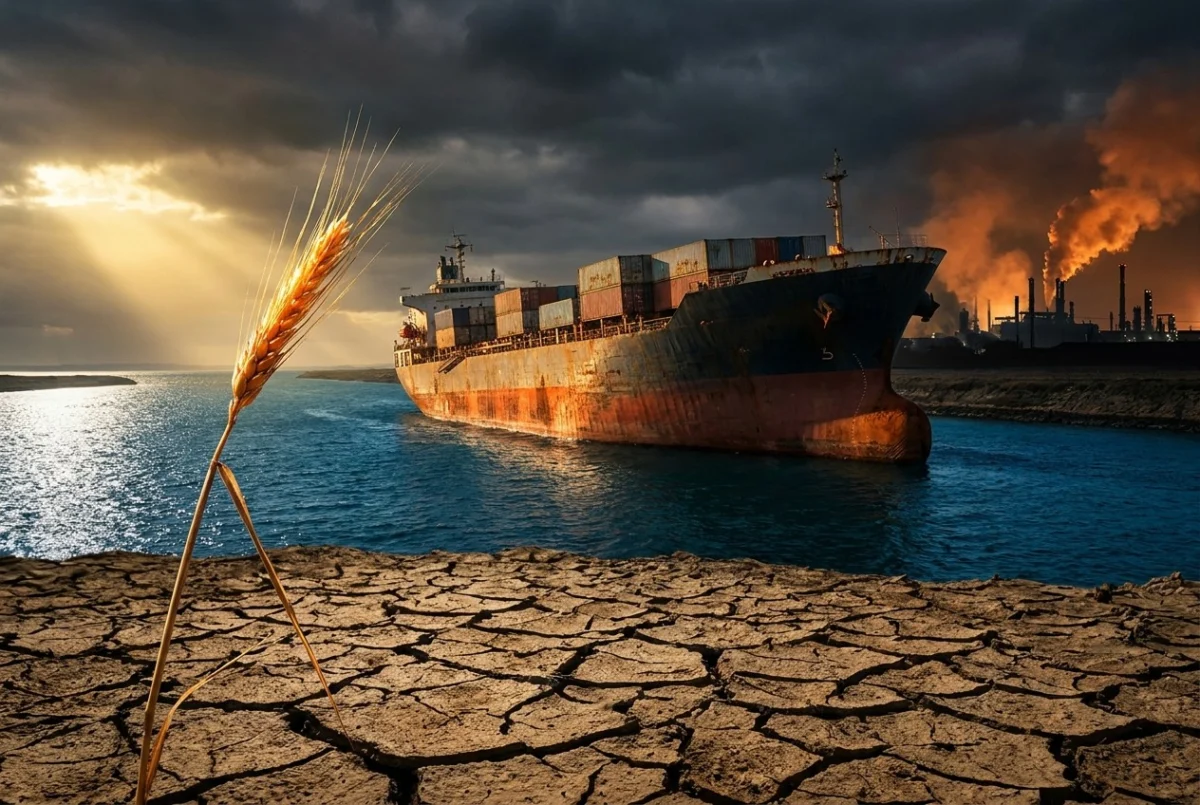
Main Facts
As geopolitical tensions in the Middle East reach a critical threshold, the prospect of a renewed kinetic military campaign against Iran by the United States has once again moved to the forefront of international discourse. Critics and geopolitical analysts argue that such an escalation extends far beyond a localized military strike, threatening to trigger a cascading series of catastrophic events across the global economy.
At the center of this looming crisis is the Strait of Hormuz—a vital maritime bottleneck through which a massive percentage of the world’s petroleum, liquefied natural gas (LNG), and critical industrial chemical inputs pass daily. Intelligence assessments and defense projections indicate that any direct military conflict involving Iran would almost certainly result in the immediate disruption or closure of this strategic chokepoint.
Beyond petroleum markets, the disruption of Persian Gulf trade routes directly endangers global food security and industrial manufacturing. The region serves as a primary global supplier of natural gas, which is chemically indispensable for producing the nitrogen-based fertilizers required to sustain modern high-yield agriculture. Furthermore, the supply chains for essential industrial acids, such as sulfuric acid—critical for phosphate fertilizer refinement, copper extraction, and electrical grid infrastructure development—are fundamentally tied to Gulf energy processing.
Experts warn that a military intervention aimed at Iranian targets would not remain contained. Instead, it would act as a systemic shock to an already fragile global economy burdened by historic levels of sovereign debt, severely fractured supply chains, and minimal excess manufacturing capacity. The resulting convergence of energy scarcity, agricultural input shortages, and financial instability threatens to precipitate an economic depression surpassing the scale of the 1929 financial collapse, with severe implications for global food supplies, social stability, and geopolitical order.
Chronology of Escalation
To understand the current trajectory toward potential conflict, it is necessary to examine the steady accumulation of political and military friction over recent years:
- Pre-2024 Economic Pressures: Decades of economic sanctions and targeted trade blockades against Iran create an environment of persistent regional instability, driving Tehran to integrate the defense of its maritime borders and energy corridors as an existential priority.
- The Qatar LNG Facility Disruptions: Incidents impacting critical energy infrastructure in the Persian Gulf demonstrate the vulnerability of global LNG trains, with preliminary industry repair estimates stretching from three to five years, highlighting the fragility of modern energy logistics.
- Previous Ceasefire and Policy Reversals: Tensions repeatedly fluctuate between diplomatic engagement and military posturing, punctuated by short-lived ceasefires and tactical withdrawals that highlight deep divisions within international policymaking circles regarding how to handle Iran’s nuclear and regional ambitions.
- Renewed Ultimatums: Political leadership in Washington and allied capitals issue repeated warnings of potential kinetic action against Iranian military and nuclear infrastructure, framed publicly around national security concerns while critics point to domestic political pressures in both the United States and Israel.
- Current Standpoint: Intelligence communities and commodity markets price in the rising probability of a blockade or direct military exchange in the Strait of Hormuz, forcing governments, logistics firms, and independent analysts to model the catastrophic outcomes of a complete Persian Gulf shipping shutdown.
Supporting Data and Economic Implications
The mathematical realities underpinning modern global trade leave little room for error. When evaluating the potential economic fallout of a major energy shock, economists look past nominal oil price spikes to analyze multiplier effects across dependent sectors.
The GDP Math and Market Multipliers
Historically, the Great Depression of 1929 featured a gross domestic product (GDP) contraction of approximately 20 percent. Economic models assessing a prospective 20 to 25 percent immediate energy shock indicate that secondary and tertiary consequences—such as widespread agricultural failures, transportation paralysis, and industrial shutdowns—could easily amplify the total global economic contraction to between 30 and 40 percent.
This severity is driven by several compounding factors:
- Debt Overhang: The global financial architecture currently operates under nearly $40 trillion in sovereign and corporate debt, making markets exceptionally sensitive to sudden credit freezes or liquidity crunches.
- The Haber-Bosch Dependency: Modern agriculture relies entirely on natural gas for the Haber-Bosch nitrogen fixation process. A sustained interruption in gas supplies directly translates to a collapse in fertilizer production, yielding diminished crop harvests one to two growing seasons later.
- The Sulfur and Sulfuric Acid Crisis: Beyond energy, Persian Gulf facilities account for a significant share of the world’s elemental sulfur recovery. Sulfuric acid is irreplaceable in the processing of phosphate rock into usable fertilizer, as well as in the refining of copper and zinc necessary for electrical grid maintenance and the green energy transition.
When these foundational elements are simultaneously suppressed, the economic shock wave travels rapidly from energy markets to food production, mining, manufacturing, and consumer retail.
Official Responses and Geopolitical Posture
The official narrative presented by political leaders in Washington, D.C., and allied capitals typically emphasizes deterrence, national security, and the necessity of neutralizing asymmetric threats posed by the Iranian government and its regional proxies. Proponents of a firm military stance argue that decisive action is required to prevent regional proliferation and protect international shipping lanes from long-term disruption.
However, a divergence exists between official statements and the private assessments of independent economists, logistics experts, and energy analysts.
- The Western Political Establishment: Maintains that military preparedness and retaliatory capabilities are essential components of maintaining deterrence in the Middle East. Official communications often minimize the probability of prolonged supply chain blockades, suggesting that any military operation would be swift, targeted, and strategically contained.
- Critical Analysts and Geopolitical Observers: Contend that public justifications mask domestic political calculations. Critics argue that foreign policy escalations frequently serve as a mechanism to consolidate domestic political support, divert attention from internal economic or legal pressures, and project strength during electoral cycles.
- International Markets and Maritime Agencies: Reflect profound anxiety through their behavioral shifts. Insurance premiums for shipping vessels navigating the Persian Gulf have surged, and major logistics operators contingency-plan for prolonged route alterations around the Cape of Good Hope, acknowledging that a closure of the Strait of Hormuz cannot be swiftly resolved through diplomatic channels alone.
Global Implications and Societal Fallout
The ultimate cost of a kinetic conflict with Iran will not be borne by policymakers, but by ordinary citizens navigating the downstream effects of systemic supply chain failure.
Famine and Social Unrest
Should the Strait of Hormuz remain closed or severely restricted for an extended period, the scarcity of fuel and agricultural inputs will inevitably manifest as food inflation and localized famines in import-dependent regions. Nations lacking domestic food and energy self-sufficiency face the highest risk of acute humanitarian crises, potentially triggering mass migration events and severe political destabilization across the developing world.
Domestic Institutional Responses in Advanced Economies
In developed nations, prolonged economic contraction and resource scarcity are anticipated to drive sweeping government interventions. Analysts warn that severe crises frequently serve as catalysts for authoritarian policy measures, including:
- The implementation of emergency decrees or the suspension of normal political processes under the guise of national security.
- The acceleration of digital surveillance frameworks, such as Central Bank Digital Currencies (CBDCs) and digital ID systems, designed to manage resource distribution and rationing.
- Heightened reliance on law enforcement and emergency powers to maintain public order amid escalating civil unrest, fuel shortages, and civil infrastructure vulnerabilities.
The Shift Toward Localized Resilience
As confidence in centralized supply chains wanes, a growing segment of the population is independently pursuing defensive preparation strategies. Investments in decentralized energy generation (such as residential solar and battery storage), local food production, rainwater harvesting, and alternative trade networks reflect a pragmatic adaptation to a volatile global outlook.
Ultimately, the choice facing international leadership remains stark: pursue military escalation with unpredictable, planet-scale consequences, or prioritize diplomatic restraint to preserve the fragile foundations of the global economy before critical infrastructure passes the point of irreversible damage.