You arrive at your desk with a list that looks like a war zone. Fourteen items are staring back at you, all clamoring for attention. Eleven are marked "High Priority." Two were dropped into your lap by your boss before you even finished your morning coffee. Three are the result of a customer escalation that threatens to derail your entire week, and one—the strategy memo—has been moved from Monday to Monday for an entire month.
Every single one of these items is defensible. That is the fundamental problem. When everything is a priority, nothing is. We rely on priority levels—P1, P2, P3—as a way to impose order on chaos. Yet, within a month, most systems suffer from "label inflation," where every task that matters to anyone is stamped with a P1. The labels are tidy, but you are still sitting at your desk at 7:00 PM on a Thursday, agonizing over which promises to break.
The truth is that labels are not a prioritization mechanism. A true priority level only works when it demands a sacrifice: a slot, a day, or the removal of another task from the line. If a label costs nothing to assign, it will be spent freely. A scale where everything is a "Priority 1" is merely a to-do list with extra steps.
The Anatomy of Priority: What Levels Actually Are
At their core, priority levels are a fixed set of markers designed to rank work based on the damage it prevents and the speed at which it must be addressed. In the world of IT service management, this logic is derived from a strict matrix: Impact (the scale of business loss) multiplied by Urgency (the required speed of resolution). The highest combination creates a "Critical" incident.
This heritage is vital. Incident response teams define their top-tier tasks with surgical precision. A network vendor might define a P1 as "a major business outage affecting critical sites, multiple VPN users, or core applications." Notice what is absent from this definition: who asked, how loudly they asked, or how recently the request arrived. In a professional environment, priority is about system integrity, not personal convenience.
The Debate Over Scale Size
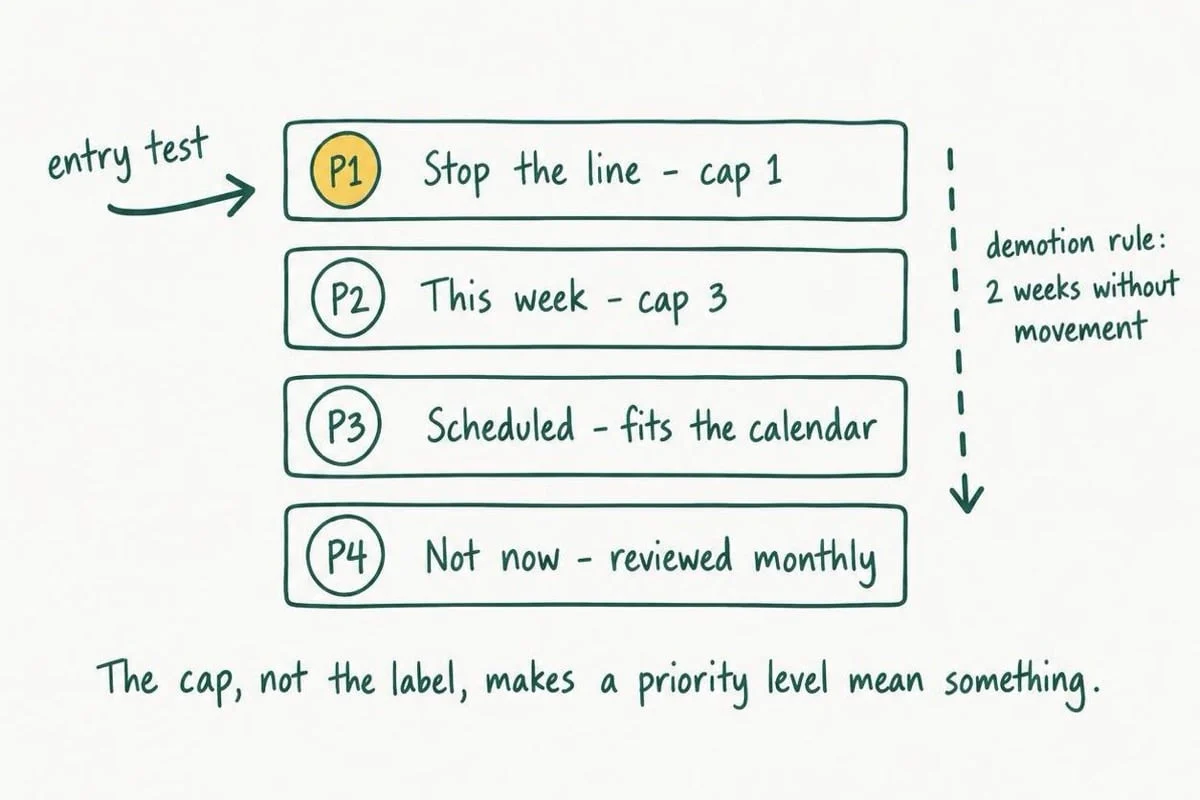
How many levels should you maintain? There is no universal standard. Some software providers operate on a three-tier system (P1 Urgent, P2 High, P3 Normal). Cisco utilizes a four-tier severity scale, while platforms like PagerDuty often scale from P1 to P5. Whether you use three, four, or five levels is irrelevant; the number of tiers is not what makes the system work. What makes it work is the entry test—a strict, non-negotiable set of criteria that a task must meet to earn a specific label. Most professionals fail to import these rigorous entry tests into their personal task lists.
The Structural Failure of Priority Inflation
Labels fail because they are cheap. In an organizational setting, the cost of labeling a task "urgent" is effectively zero for the person making the request. Consequently, the top level fills up until it ceases to provide any meaningful information. By week three, "P1" no longer denotes critical business impact; it denotes "recent," "loud," or "requested by someone senior."
This phenomenon is exacerbated by the "mere urgency effect." Psychological studies have shown that individuals frequently choose lower-payoff tasks simply because they carry an urgent or expiring cue, even when a more important, high-impact alternative is available. When your list has eleven high-priority items and one has a red flag, your brain is hardwired to gravitate toward the flag, regardless of the objective value.
The Eisenhower Myth
We often look to the Eisenhower Matrix—the four-quadrant grid popularized by Stephen Covey—to solve this. The distinction between "urgent" and "important" is sound, but it is incomplete. Sorting tasks into four boxes does not solve the underlying issue of resource scarcity. You may have twelve items in the "Important" box, but you still only have one Tuesday. Furthermore, the act of re-sorting these tasks throughout the day imposes a "switching tax." Research on task-switching shows that the mental cost of alternating between tasks increases with the complexity of the rules. Constant re-prioritization leads to decision fatigue, which is why your list remains untouched by 4:00 PM.
A Four-Level System for Radical Choice
To regain control, you need a system that forces a trade-off. Below is a framework designed to replace vague labels with concrete, resource-backed promises.

| Level | What it means | Entry Test (Checkable) | Cap | What it costs you |
|---|---|---|---|---|
| P1: Stop the Line | Prevents damage today | External block or failed commitment | 1 | Everything else slides |
| P2: This Week’s Promise | Dated commitments | Due date inside this week + Named person | 3 | No new P2 enters until one closes |
| P3: Scheduled | Future work | Calendar block | Unlimited | Weekly review |
| P4: Not Now | Held in reserve | "Would I trade a P2 for this?" | None | Monthly review |
The "Cap" column is the most vital component. Based on Little’s Law—which states that the number of items in a system is a product of arrival rate and time spent—we know that holding too many items open stretches the time required to complete any single one. By capping your P2 items at three, you prevent the mental clutter of managing a dozen open projects.
Establishing the Entry Test
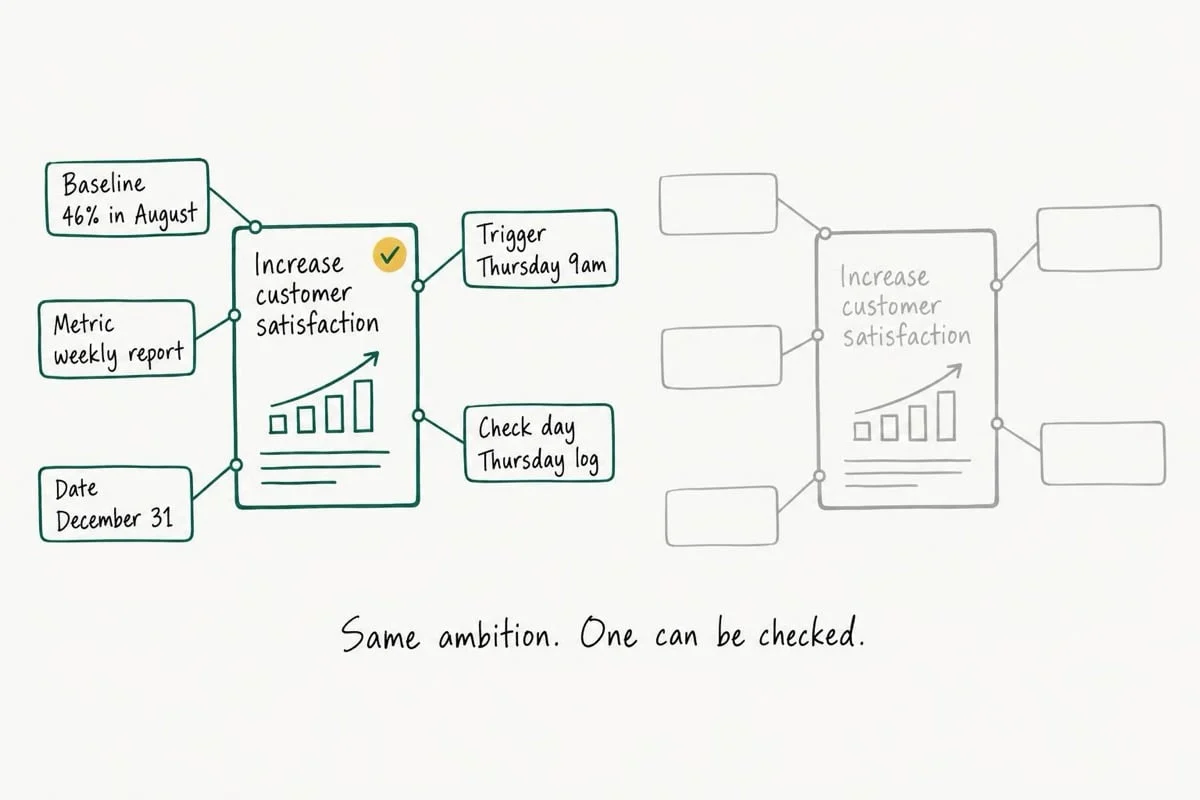
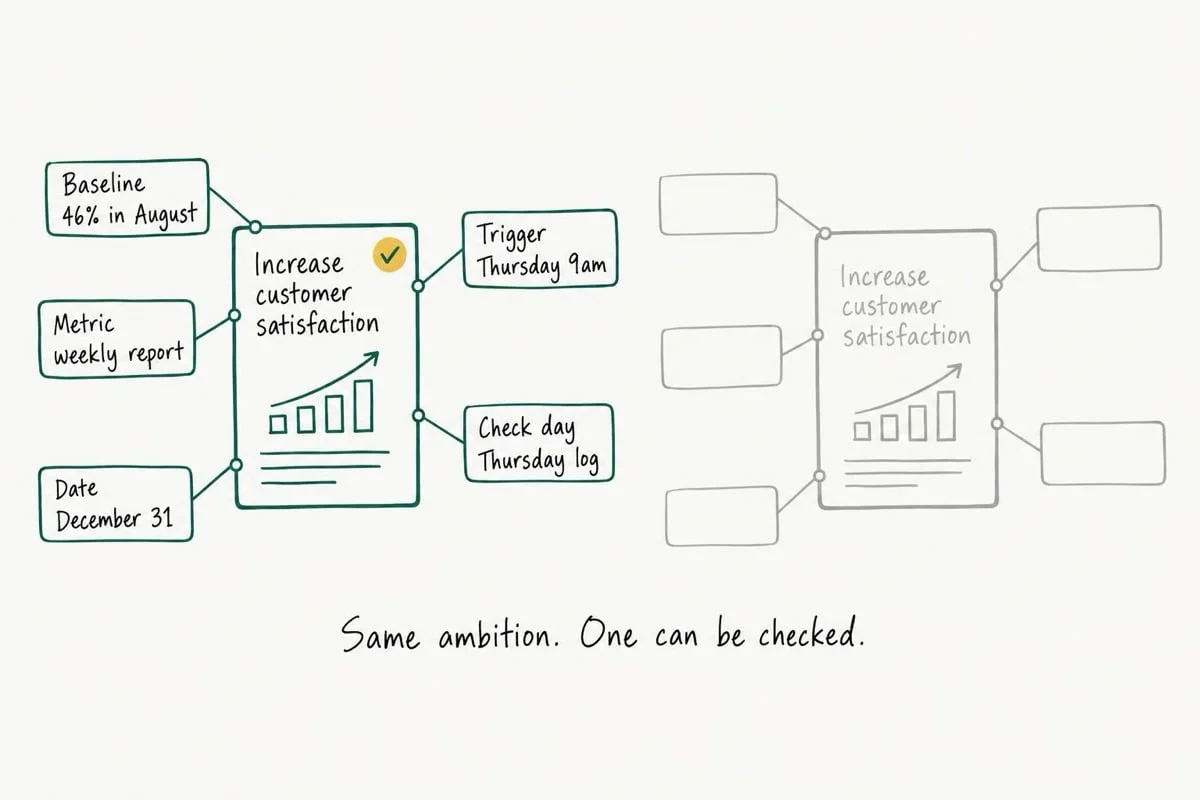
You must write your entry tests before the week begins. A rule established on a quiet Sunday is far more resilient than a judgment made under the pressure of a ringing phone or an incoming Slack message. When you define the test in advance, you remove the emotional labor from the decision-making process. You aren’t "choosing" to say no; you are simply observing that the task did not pass the test.
Implementation: The Reality of an Ordinary Tuesday
Consider the case of a logistics operations manager, "Curt." On a Tuesday morning, he has a board memo (P2) due Thursday. His P1 slot is empty.
At 9:12 AM, a warehouse integration fails. This meets his P1 criteria (external parties are blocked). He immediately shifts his focus to the integration. Because he has a rule, he doesn’t experience "guilt-based task switching." He simply moves the board memo to Wednesday and informs the CFO. Because the change is communicated transparently, the broken promise is converted into a managed expectation.
At 11:40 AM, the CFO asks for a pricing analysis "asap." Because Curt’s P1 slot is occupied, he employs a capacity statement: "I can start that at 2:00 PM once the integration is resolved, or I can start it now and the integration waits. Which would you prefer?" This is not pushback; it is professional resource management. He has turned an emotional demand into a logical trade-off.
When Others Set Your Priorities
The most common pushback to this system is: "My boss doesn’t care about my labels." If your CEO marks everything as P1, your system still provides value because it makes the trade-off visible.
When you are told to add another P1, you don’t argue about the label. You ask: "Happy to make that the new P1. To do so, the current P1 will have to move to tomorrow. Should I proceed with that change?" By forcing the stakeholder to acknowledge the cost, you shift the burden of prioritization back to where it belongs.
Conclusion: Two Weeks to Clarity
To implement this, start small. Write your entry test and your cap for your top level on a single sticky note. That is your baseline. For the next two weeks, track two metrics:
- The P1 Count: If you declare more than two P1s a week, your entry test is too loose. Tighten it until the label feels significant.
- The P2 Throughput: If you open more P2s than you close, your cap is not binding.
These metrics do not tell you what you intended to do; they tell you what your system actually permitted you to do. By making the invisible visible, you transition from a cycle of reactive chaos to a system of intentional, high-impact productivity. The goal isn’t to get everything done—it’s to ensure that the things you choose to leave undone were the right ones to sacrifice.