For millions of women, the transition through menopause is marked not just by a change in hormones, but by a profound, haunting erosion of the night. It begins quietly: a slightly longer time to drift off, a bit more tossing and turning. Soon, it becomes a systemic disruption. You fall asleep by 11:00 p.m., only to snap awake at 2:40 a.m., drenched in sweat, kicking off the covers, and pulling them back in a repetitive, exhausting cycle. By 4:15 a.m., you are awake again, and by 6:00 a.m., the alarm signals the start of a day you are already too tired to face.
This is not "ordinary" insomnia. When the nights repeat without external changes in your life, you are likely experiencing a specific, physiologically driven disruption associated with the menopausal transition. Generic sleep advice—the kind that suggests herbal tea or dimming the lights—often fails because it treats a complex, multi-layered physiological event as a simple case of poor habits.
The Reality of the Wake-Up Pattern
The Study of Women’s Health Across the Nation (SWAN), which tracked over 3,000 women during their transition, confirmed that the odds of sleep disturbances—both falling asleep and staying asleep—rise significantly as hormone levels shift. By the time a woman reaches late perimenopause, nearly half report symptoms of insomnia occurring at least three times a week.
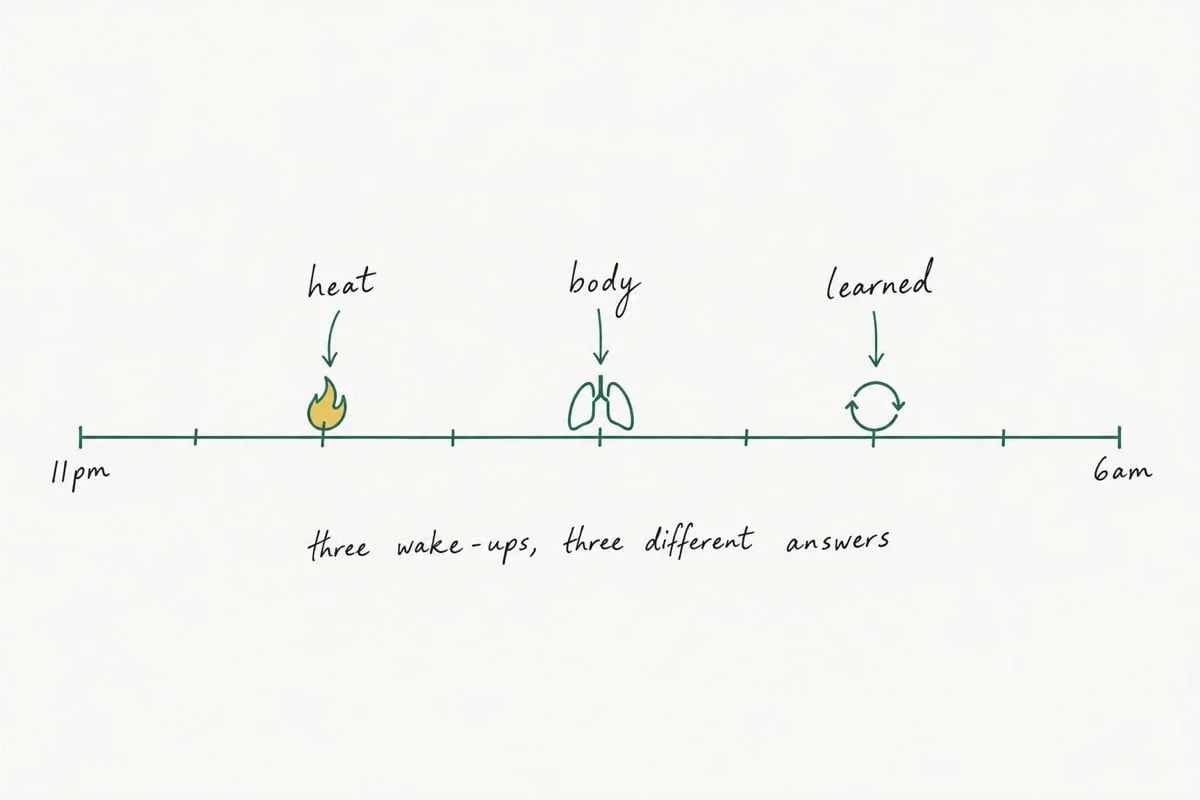
However, the medical community has begun to recognize that "menopause insomnia" is a misnomer. It is not one single problem; it is a collection of distinct wake-up patterns, each requiring a different approach.
1. Heat-Driven Waking
The most commonly cited culprit is the vasomotor symptom, or the hot flash. Actigraphy studies have demonstrated a clear correlation: a vast majority of nocturnal hot flashes are followed by a period of wakefulness. The body’s thermoregulatory system, sensitive to fluctuating estrogen, triggers a thermal dump, raising the core temperature and jolting the brain out of deep sleep.
2. Body-Driven Waking
Often overlooked, this pattern relates to breathing. Research indicates that the apnea-hypopnea index—a measure of breathing events during sleep—tends to rise after menopause. Because women often present with symptoms like fatigue, low mood, and insomnia rather than the "classic" loud snoring associated with sleep apnea, they are frequently misdiagnosed. If your sleep is fragmented, it may be your body struggling for oxygen rather than your brain simply refusing to rest.
3. Learned Waking
Even after the hot flashes subside, many women find themselves wide awake at 3:00 a.m. This is the "learned" pattern. Over months or years, the bed has been transformed from a sanctuary into a site of anxiety, where you mentally calculate the hours left until the alarm goes off. This is no longer a hormonal issue; it is a conditioned neurological response.
Chronology of a Disrupted Night
To understand the persistence of this problem, one must look at the timeline of a typical night for a woman in midlife.
- 11:00 PM: Sleep onset is achieved, often after a period of anxious anticipation.
- 2:40 AM: The first "event" occurs. If it is heat-driven, the sympathetic nervous system activates, causing a spike in heart rate and body temperature.
- 3:15 AM: The "thought loop" begins. The brain, now hyper-aroused, begins to process the stresses of the upcoming day.
- 4:15 AM: A secondary awakening. If the root cause is apnea, the brain may wake the individual to resume normal breathing patterns.
- 6:00 AM: Forced arousal. The cumulative effect of these micro-awakenings results in significant cognitive impairment, irritability, and a diminished capacity to function at work or home.
The Failure of Natural Remedies
The supplement aisle is a graveyard of broken promises for menopausal women. Many remedies, such as valerian root or melatonin, are marketed with little to no robust clinical evidence for this specific life stage.
Pooled data from randomized trials suggest that melatonin, while effective for jet lag or shift work, does not significantly improve sleep quality for menopausal women. Similarly, umbrella reviews of valerian have found the evidence to be inconclusive. When women try these supplements for two weeks and see no results, they often internalize the failure, believing that their condition is "untreatable." The truth is that they were never given the right tools; they were simply sold a guessing game.
Evidence-Based Interventions
When prioritizing treatments, the scientific consensus shifts away from the supplement aisle and toward structured, behavioral, and medical interventions.

Cognitive Behavioral Therapy for Insomnia (CBT-I)
CBT-I is the gold standard, recommended by the American College of Physicians as the initial treatment for chronic insomnia. Unlike generic "sleep hygiene," which focuses on tips like limiting blue light, CBT-I is a structured 4–8 week program that addresses the mechanics of sleep. It involves sleep restriction (aligning time in bed with actual sleep time), stimulus control (re-associating the bed with sleep), and cognitive restructuring (dismantling the 3:00 a.m. thought loops). Trials have shown that CBT-I provides more sustained, significant improvements in sleep severity than any herbal supplement.
Exercise as a Support Tool
While regular exercise is vital for overall health, its impact on sleep is modest. Data from the MsFLASH trials suggest that exercise can improve insomnia scores by roughly 2 points, whereas CBT-I can improve them by over 5 points. Exercise is an excellent foundation for health, but it should not be viewed as a silver bullet for severe insomnia.
The Role of Hormone Therapy (HT)
The North American Menopause Society (NAMS) highlights that hormone therapy remains the most effective treatment for hot flashes and night sweats. For women whose sleep disruption is directly caused by vasomotor symptoms, HT can be transformative. However, it is not a cure-all for insomnia and requires a personalized benefit-risk assessment conducted by a physician.
Professional Perspectives and Official Guidance
The medical community has shifted its stance from "waiting it out" to active management. The American Academy of Sleep Medicine (AASM) emphasizes that "sleep hygiene" is merely the floor—the bare minimum—and that true treatment for chronic insomnia requires the full, multicomponent approach of CBT-I.
Furthermore, clinicians are increasingly urged to screen for sleep-disordered breathing in midlife women who complain of fatigue. The assumption that "it’s just menopause" is a dangerous clinical bias that can lead to years of unnecessary suffering.
Implications for the Patient
The most critical takeaway for any woman struggling with these patterns is the importance of objective tracking. Before purchasing a new pillow, an app, or a supplement, spend one week keeping a "Sleep Log."
The Log Format:
- Wake Time: Record exactly when you woke.
- Heat Column: Note if a hot flash preceded the wakefulness.
- Breathing/Feeling Column: Note any snoring (if observed by a partner) or feelings of daytime fatigue.
This log is your most powerful tool. It transforms the vague, frustrated complaint of "I never sleep" into actionable data for your doctor. It can distinguish between a hormonal issue that requires HT, a respiratory issue that requires a sleep study, or a psychological conditioning issue that requires CBT-I.
Conclusion: Stop the Guesswork
If your nights are being hijacked by the hormonal transition of menopause, stop stacking remedies. You are not failing; you are simply dealing with a complex physiological shift that requires a strategic, evidence-based approach.
Start by isolating your wake-up pattern. Hold a consistent wake time, regardless of how the night went. If you find yourself in the 3:00 a.m. thought loop, consult a therapist trained in CBT-I. If you suspect your breathing is the problem, speak to your physician specifically about sleep apnea, even if you don’t fit the stereotypical profile.
Midlife is a time of immense transition, but chronic, sleep-depriving exhaustion should not be an inevitable part of that journey. By moving away from the "shelf of guesses" and toward evidence-based, clinician-led care, you can reclaim your nights and, by extension, the rest of your life.