NEW YORK — In November 1965, a sudden and catastrophic grid failure plunged the northeastern United States and parts of Canada into darkness. For 30 million people, daily life ground to an abrupt halt. Among them was Lynn Lowin, then just a teenager traveling by subway from Brooklyn to Manhattan.
Now in her senior years, Lowin has stepped forward to share her remarkable firsthand account of the historic event with the Good News Network. Her story offers a deeply human perspective on a night that tested the resilience of a metropolis—and proved that even in total darkness, human connection can illuminate the way forward.
Main Facts: The Night the Lights Went Out
On the evening of November 9, 1965, a relay malfunction in Ontario, Canada, triggered a cascading failure across the transmission lines of the Northeast. Within minutes, major cities including New York, Boston, Buffalo, and Toronto were entirely blacked out.
The scope of the emergency was unprecedented:
- Total Affected Population: Approximately 30 million people.
- Geographic Reach: Parts of Ontario and seven U.S. states (New York, Pennsylvania, New Jersey, Connecticut, Rhode Island, Massachusetts, and Vermont).
- Underground Impact: More than 800,000 subway riders were abruptly trapped in subterranean tunnels and cars across New York City when the power failed instantaneously.
For Lowin and hundreds of thousands of other commuters, the blackout was not merely an inconvenience above ground; it was an entrapment in pitch-black, subterranean networks with no immediate explanation, no communication with the outside world, and no clear path to safety.
Chronology: Six Hours Beneath the East River
The Sudden Stop
Lowin’s journey began like any other routine afternoon commute. Traveling from Brooklyn toward Manhattan, her subway train hurtled through the subterranean darkness before coming to a violent, abrupt halt.
"The train suddenly stopped and all the lights went out," Lowin recalled. "I remember thinking I was going to be late for my orthodontist appointment if they didn’t fix it quickly."
At the time, neither Lowin nor her fellow passengers had any way of knowing that the local disruption was actually part of a massive regional crisis.
Navigating the Unknown
As minutes turned into hours, the reality of their situation set in. Evacuating the train on one’s own volition was entirely out of the question.
"There is a ‘third rail’ in a subway system that can be very dangerous if anyone should step on it, so none of us wanted to leave our subway car and take the risk of sudden death," Lowin explained. "Even if we knew which rail was the third one, we weren’t able to see in the darkness that surrounded us."
Stuck in a tunnel beneath the East River, the passengers faced complete isolation. In an era long before cellular phones, portable radios, or digital notifications, information was non-existent. Rumors quickly filled the vacuum. Some passengers whispered anxiously about a potential military bombing—a frightening thought that paradoxically made staying inside the protective concrete tunnel seem preferable. Others feared they would never escape the subterranean labyrinth at all.
Community in the Dark
As the hours dragged on, however, the atmosphere inside the cramped subway car shifted dramatically from fear to camaraderie. Strangers began to lean on one another, bridging social divides through simple acts of kindness.
"People began to share whatever food they had," Lowin said. "I was given half a doughnut and, in turn, I shared part of the peanut butter sandwich my mother had packed for me that morning."
As the hours mounted, conversations blossomed. Passengers began to encourage one another, actively working to lift the spirits of fellow commuters who were rapidly transforming from anonymous faces into supportive neighbors. The collective anxiety was further soothed when a doctor and two nurses walked methodically through all the subway cars, checking on passengers to ensure no one was injured or in medical distress.
The Rescue
After six agonizing hours in the dark, salvation finally arrived. Emergency personnel—including members of the New York City Fire Department and Police Department—navigated the dark tunnels to reach the stranded train.
"As we followed the firefighters and police officers leading us through the dark tunnels, I was conscious of being thankful not only for our rescue, but for all the people who reached out to one another to keep our spirits up," Lowin reflected. "I was less scared, because I was not alone."
Supporting Data: The Calm Amidst the Chaos
While popular culture often depicts widespread disasters as catalysts for panic, looting, and social breakdown, the reality of the 1965 Northeast blackout defied cynical expectations, particularly in New York City.
Data compiled by law enforcement agencies following the event revealed a stunning statistic: only five reports of looting were recorded across the entire city during the blackout. According to historical crime tracking, this marked the lowest amount of criminal activity recorded on any single night in New York City’s history since official record-keeping began.
Instead of rioting, citizens banded together. Motorists stepped up to direct chaotic traffic at major intersections where streetlights had failed. Thousands of stranded commuters walked miles home in the dark, guided only by the light of car headlights and handheld flashlights, while homeowners opened their doors to offer strangers a cup of coffee, a phone call, or a safe place to sleep.
Official Responses: Commending the Public’s Resilience
Local and state governments were quick to praise the extraordinary composure of the public. Municipal transit authorities recognized that disaster management plans alone could not have prevented catastrophe if not for the remarkable self-discipline of the civilian population.
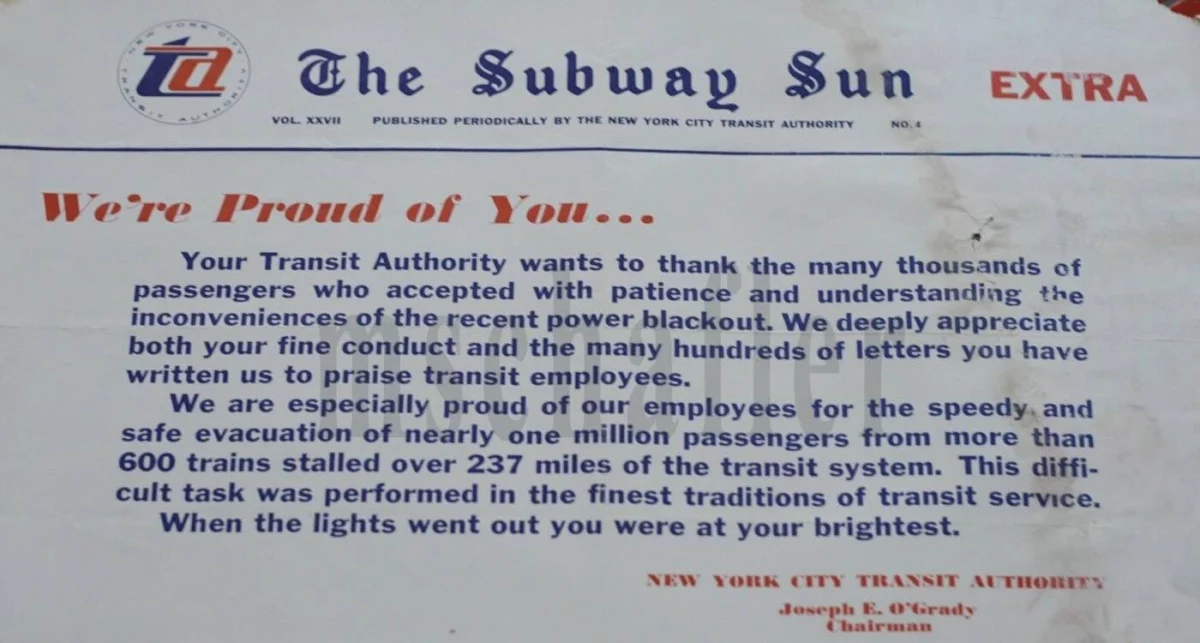
In the weeks following the crisis, the New York City Transit Authority took the unusual step of publishing tributes to the city’s riders. Most notably, Volume 27, Issue 4 of The Subway Sun—a beloved series of informational and community poetry posters displayed inside subway cars—was dedicated entirely to thanking subway riders for their calm, cooperative, and courageous response to the emergency.
Public officials emphasized that the resilience demonstrated by ordinary citizens under extreme pressure served as a testament to the character of the region. First responders, who worked tirelessly through the night to clear tunnels, rescue stranded passengers, and manage urban infrastructure without power, were lauded as heroes, but the collective public behavior was hailed as nothing short of miraculous.
Implications: A Lifelong Lesson in Community
Decades after stepping out of the dark East River tunnel into the crisp November night air, Lynn Lowin still carries the lessons of 1965 with her.
In a modern world increasingly defined by hyper-connectivity through screens and digital devices—yet often plagued by social isolation—Lowin’s childhood experience offers a timeless reminder of the power of physical, human-to-human solidarity.
"That is the lesson I learned from that experience and carried with me throughout my life," Lowin concluded.
By choosing empathy over fear, and sharing a half-doughnut and a peanut butter sandwich with a stranger in the pitch black, a teenage girl caught in the twentieth century’s most famous blackout discovered a foundational truth: even when the lights go out, we are never truly in the dark as long as we have each other.