In a landmark achievement for neurotechnology, researchers at the Feinstein Institutes for Medical Research have successfully utilized a groundbreaking "double neural bypass" to restore both movement and sensation to a paralyzed man. This medical milestone, recently published in the prestigious journal Nature, offers a glimmer of hope to millions worldwide who suffer from spinal cord injuries, signaling a new era where the biological gap between the brain and the body can be bridged by artificial intelligence and precision engineering.
The Genesis of a Medical Breakthrough
The story of this technological triumph begins with a life-altering tragedy. Keith Thomas, a resident of Massapequa, New York, led a vibrant, active life until the summer of 2020. During a routine day by the pool, a split-second decision to dive in "aggressively," as he had done countless times before, resulted in a catastrophic accident. Thomas broke his neck, an injury that left him paralyzed from the chest down.
For many, such a diagnosis would mark the end of an independent life. However, just three months after his accident, while Thomas was still processing the gravity of his new reality, he was approached by a team of visionary scientists from the Feinstein Institutes for Medical Research. They invited him to participate in a pioneering three-year clinical trial involving a sophisticated "double neural bypass" procedure. This trial aimed to do what was once considered science fiction: physically reconnecting the brain to the limbs by bypassing the damaged spinal cord entirely.
The Mechanics of the Double Neural Bypass
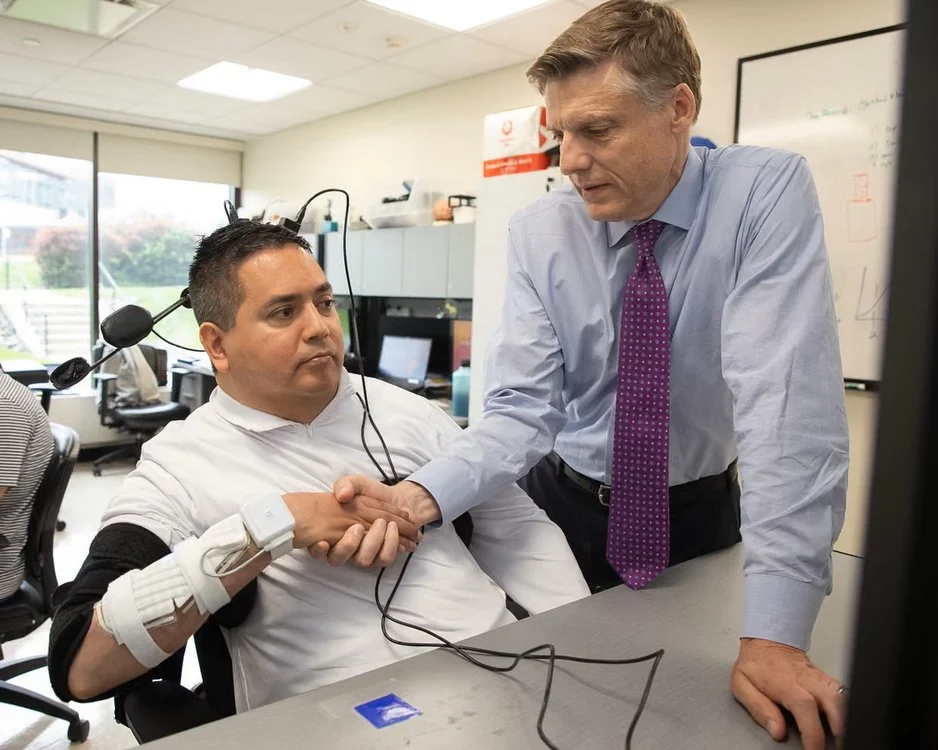
At the heart of this innovation is a complex interplay between neurosurgery and advanced artificial intelligence. The procedure involves the implantation of micro-electrodes directly into the motor cortex of the patient’s brain. These electrodes serve as the "bridge," intercepting the electrical signals the brain generates when the patient intends to move.
The "double" aspect of the bypass—what distinguishes this study from previous iterations of brain-computer interfaces (BCI)—is its bidirectionality. While traditional BCIs focus on translating brain activity into motor output (moving a robotic arm or a digital cursor), this system completes the sensory loop. Sensors embedded in the fingertips of the patient act as artificial nerve endings, detecting the pressure, texture, and shape of objects. This sensory data is then routed back to the brain via the electrodes, allowing the patient to "feel" what they are touching.
For Keith Thomas, this meant he was no longer just operating a machine; he was regaining his sense of touch. He reported being able to feel the coarse fur of his dog and the gentle pressure of his sister’s hand—sensations he thought he had lost forever. Furthermore, the system allows for nuanced motor control, enabling Thomas to differentiate between a ball, a coffee cup, or an egg, and to adjust his grip pressure accordingly to avoid crushing fragile items.
A Chronology of Recovery and Adaptation
The journey from total paralysis to partial restoration of function has been one of rigorous discipline and scientific precision. Following the surgery, Thomas embarked on a 35-week intensive training program.
- Initial Phase (Weeks 1-12): The focus was on mapping the brain’s motor signals to the computer interface. Thomas learned to visualize the movement of his hands to trigger the software, which then translated these thoughts into electrical impulses sent to his limbs.
- The Sensory Calibration (Weeks 13-24): Researchers began integrating the sensory feedback loop. This was a critical phase where Thomas had to retrain his brain to interpret the electrical signals from his fingertips as tactile sensations.
- Optimization (Weeks 25-35): With the system fully operational, the focus shifted to increasing muscle strength and coordination.
The results have been nothing short of extraordinary. After 35 weeks of therapy, Thomas showed an 86% increase in strength in his right arm and a 62% increase in his left. Perhaps most poignantly, he regained a range of motion that was previously impossible. Simple, reflexive actions—like scratching his nose or wiping his mouth—which most people take for granted, became personal victories for Thomas.
Perhaps the most significant finding from the study is that the benefits are not merely transient. Researchers observed that the neural pathways appear to be "re-learning" or strengthening their connections, as Thomas has demonstrated a persistent ability to feel and move even when the computer system is powered down.
Supporting Data and Scientific Significance
The study, as detailed in Nature, provides a quantitative foundation for the success of this neural bypass. The data shows that the synergy between the brain’s natural intent and the artificial stimulation of muscles creates a "plasticity" effect. The spinal cord, while damaged, is not necessarily dead, and the bypass provides the necessary stimulus to encourage the brain and the remaining neural tissues to reorganize.
The clinical trial data highlights:
- Increased Muscle Tone: The constant stimulation of the muscles through the bypass prevented the rapid muscle atrophy typical of paralyzed limbs.
- Sensory Integration: The ability to distinguish between objects suggests that the brain is successfully integrating the artificial sensory feedback into its somatosensory cortex.
- Sustainability: The fact that function persists when the device is off indicates that the therapy might eventually lead to a level of "neural repair" rather than just providing a temporary "workaround."
Official Perspectives: A Vision for the Future
Professor Chad Bouton, the lead researcher at the Feinstein Institutes, has expressed profound optimism regarding these findings. In a recent video statement, Bouton emphasized that the ultimate goal of his team was not just to create a temporary fix, but to provide a restorative solution.
"For years, we have been wanting to really tackle the restoration of movement and the sense of touch and bring those together, and we’ve also wanted to create lasting effects," Bouton stated. "I think we’re going to continue to see progress, and I think it will be applicable to the millions of folks around the world who really need this technology."
The professional community has lauded the study for its rigorous approach to bioethics and clinical trial safety. By focusing on the integration of hardware and biological systems, the Feinstein team has set a new benchmark for how we treat neurological trauma.
The Broader Implications for Global Healthcare
The success of Keith Thomas’s case creates a ripple effect across the medical landscape. For the millions of individuals living with spinal cord injuries, strokes, or degenerative neurological conditions, this technology represents a pivot point in modern medicine.
1. Shift from Compensation to Restoration
Historically, treatment for paralysis has focused on compensatory strategies—wheelchairs, voice-activated software, and specialized physical therapy. The double neural bypass shifts the paradigm toward restoration. It treats the body as a system that can be rewired, rather than a broken machine that must be managed.
2. Economic and Social Impact
Paralysis imposes a massive economic burden on families and healthcare systems. The ability to restore even partial hand and arm function can significantly increase a patient’s independence, reducing the need for full-time caregivers and allowing individuals to return to the workforce or pursue educational goals.
3. Future Challenges
Despite the success, the path to widespread adoption is complex. The technology currently requires invasive brain surgery, a sophisticated, non-portable computer interface, and months of intensive, highly specialized training. The next phase of research will likely focus on miniaturizing the hardware, moving from wired to wireless systems, and developing "off-the-shelf" neural interfaces that can be implemented more easily in clinical settings.
Conclusion: A New Horizon
As the 35-week milestone passes and researchers look toward the next phase of the trial, the question remains: how much more can Keith Thomas recover? The uncertainty is not a source of doubt, but rather a testament to the untapped potential of the human brain.
The story of Keith Thomas is more than just a medical report; it is a narrative of resilience. It highlights the power of modern science to listen to the silent commands of the human spirit and translate them into motion. As the Feinstein Institutes continue their work, the world watches with anticipation, hopeful that this double neural bypass will eventually become a standard of care, offering the gift of touch and the power of movement back to those who have been waiting in the dark for far too long.