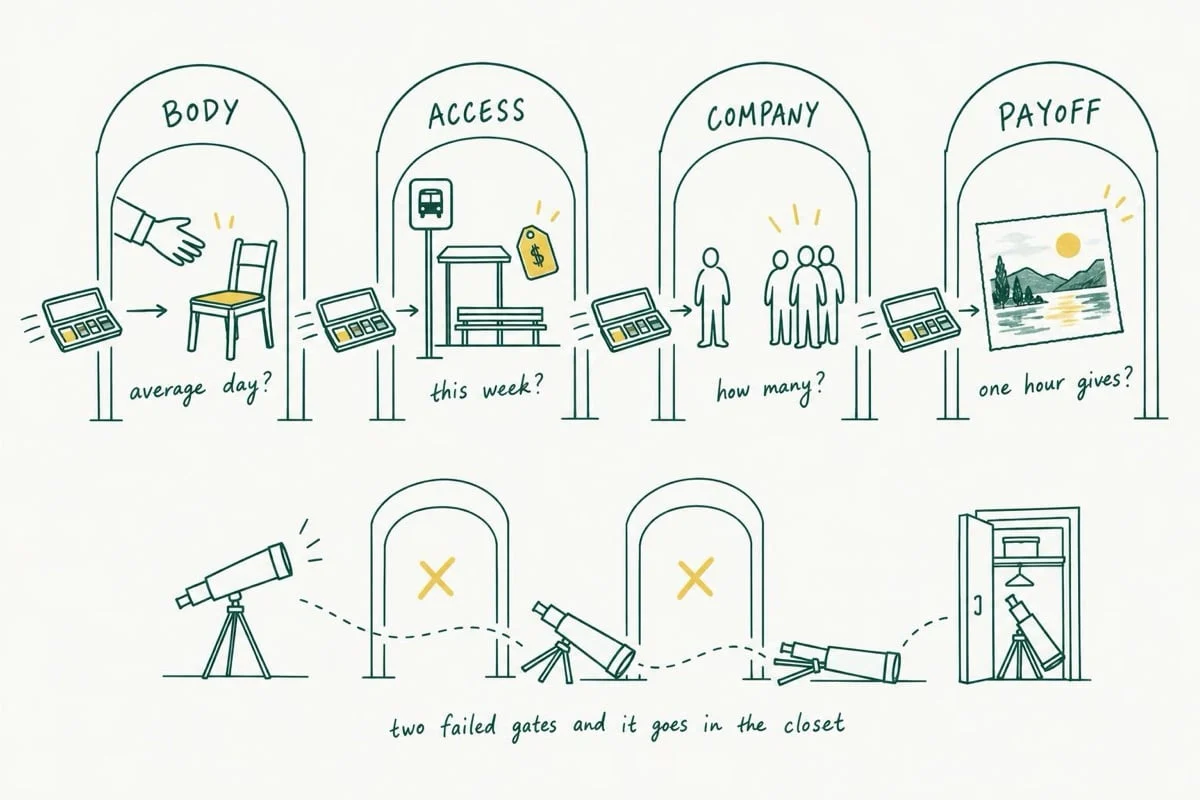
Somewhere in your home, there is a monument to an intention. It might be a watercolor set with only three dried-up pans of pigment, a guitar gathering dust with a snapped high-E string, or a high-end telescope that cost more than you care to admit. When these items were purchased, they represented a vision of who you wanted to be. Today, they represent storage.
The conventional wisdom suggests you simply "lost interest." However, this narrative reads the situation backward. It implies a failure of character or a lack of focus. In reality, the issue isn’t a lack of interest; it is a lack of fit. For those navigating their seventies and beyond, the challenge is not finding something to do—it is finding something that aligns with the reality of an ordinary Tuesday.
The Reality Gap: Why Standard Hobby Lists Fail
Most "hobbies for seniors" articles are written for an idealized version of aging—one with boundless energy, perfect joints, and a wide-open calendar. They rarely account for the subtle friction points that define life after 70: the arthritis that makes fine motor skills a chore, the hearing loss that turns a bustling craft room into an overwhelming sensory experience, or the fatigue that sets in by mid-afternoon.
A 2024 systematic review of 37 studies involving nearly 27,000 adults aged 70 to 101 identified health, fitness, and environmental barriers as the primary reasons for hobby abandonment. Yet, these lists continue to offer generic suggestions like "take up pottery" or "join a hiking club," ignoring that these activities may require physical or logistical leaps that the average person is not prepared to make.
The "abandoned kit" in your closet is not a sign that you are boring or uncommitted. It is a sign that you were sold a fantasy. To find a hobby that lasts, you must shift your focus from appeal to fit.
The Four-Fit Check: A Framework for Longevity
To determine if a hobby will survive past the initial novelty, we propose the "Four-Fit Check." This framework acts as a sieve for your interests, ensuring that before you spend a dime, you understand exactly how an activity integrates into your life.
1. Body Fit: Designing for the Average Day
Do not evaluate a hobby based on your best day. Evaluate it based on a typical Tuesday, complete with stiff joints or varying energy levels.
- The Physics of the Hobby: Does it require sustained standing, fine grip strength, or perfect balance?
- The Mobility Requirement: If you are part of the roughly 27.5% of adults over 65 who have experienced a fall, activities requiring ladders or unstable terrain should be treated as conscious, high-risk decisions, not casual pastimes.
- The "Stop-Start" Test: Can you walk away from the activity in the middle of a session without ruining the work? If not, you may be setting yourself up for frustration on days when your energy wanes unexpectedly.
2. Access Fit: Reducing Friction
Access is the most common "hobby killer." If an activity requires a 30-minute drive after dark, a $400 initial investment, or a reliance on someone else’s schedule, it is fragile. A hobby should be easy to start this week. If you need a favor from a family member to get to a class, or if the commute feels daunting, the friction will eventually outweigh the joy. Start with low-barrier activities—local library groups, home-based research, or neighborhood walks—before scaling up.
3. Company Fit: Designing Your Social Environment
The research on social isolation is clear: loneliness carries significant risks for heart disease, stroke, and cognitive decline. However, "joining a club" is not a one-size-fits-all solution. Some thrive in a room full of people, while others find their recharge in a quiet, solitary hobby.

- The Built-in Socials: If your week lacks human contact, choose a hobby where social interaction is a structural component—choirs, bridge clubs, or volunteer roles where you handle a specific task like check-in sheets. A defined role provides a social "script," which is far easier to navigate than an unstructured room of strangers.
4. Payoff Fit: Creating a Tangible Result
Hobbies that offer no immediate "win" rely entirely on willpower. In the context of life after 70, willpower is a finite resource. Look for activities where a single session leaves something behind: a finished paragraph in a memoir, a bird identified, a bread loaf baked, or a conversation completed. This feedback loop provides the dopamine hit necessary to return to the activity the following week.
Supporting Data: Why Engagement Matters
The link between hobbies and health is not merely anecdotal. A major 2023 study pooling longitudinal data from over 93,000 adults across 16 countries found a consistent association between hobby engagement and lower rates of depression, higher life satisfaction, and better self-reported health.
Furthermore, the "Synapse Project"—a notable study on cognitive aging—observed that participants who engaged in demanding, novel activities like digital photography or quilting showed measurable improvements in episodic memory compared to those in low-demand social clubs. The implication is that while social connection is vital, cognitive engagement—the act of learning something new and difficult—is what keeps the mind sharp.
Chronology of a Successful Transition
To avoid the "abandoned kit" syndrome, follow this chronological approach to starting a new interest:
- Week 0: Identify a candidate activity. Run it through the Four-Fit Check. If it fails two or more filters, discard it immediately.
- Week 1-2: The Trial Phase. Perform the activity four times using borrowed equipment or low-cost alternatives.
- The Evaluation: After the two-week mark, ask: Did I go without talking myself into it? Did my body feel okay the next day? Did I want to book the next session?
- Week 3: Commitment. If you have two "yeses" and one "no," invest in the proper gear. If you have three "noes," you have gained valuable data about your own preferences.
Implications for Retirement and Beyond
The transition into retirement often creates a "time vacuum." Many people attempt to fill this with a flurry of activities, hoping one will stick. However, as noted by retirees who have successfully navigated this phase, a single, meaningful, and consistent weekly slot is worth far more than a "balanced" schedule of five hobbies you barely tolerate.
If you find that nothing appeals to you, do not treat it as a personal failing. Persistent apathy is often a symptom of something deeper, such as burnout or a lack of purpose, which may be better addressed through a life audit or a conversation with a healthcare provider than by purchasing more equipment.
Official Guidance and Recommendations
Federal physical activity guidelines for older adults emphasize that when chronic conditions prevent the standard 150 minutes of moderate aerobic activity, individuals should be as active as their specific conditions allow. This flexibility should extend to your hobbies. If you cannot stand for a pottery class, look for a seated variant or an adapted craft.
Ultimately, the goal is not to become a master of a craft, but to build a life that feels active and connected. As you look at the telescope or the guitar in the corner, view them with compassion. They weren’t mistakes; they were just guesses. Your next choice, informed by the Four-Fit Check, doesn’t have to be a guess at all—it can be a deliberate, sustainable decision that fits the life you actually live.
Summary of Recommendations:
- Prioritize Seated Options: If mobility is a concern, seek hobbies that can be performed at a table (e.g., genealogy, watercolor, model building).
- Avoid "Commitment Traps": Never buy expensive equipment until you have completed at least four sessions of the hobby.
- Define Your Role: If you join a social group, take on a small responsibility (like organizing the books or checking in members) to lower the social anxiety of the first few sessions.
- Treat Boredom as Data: If you cannot find a hobby that fits, look for a person or a place to start instead. Curiosity often follows contact.