It is 9:05 a.m. You sit down with a singular objective: finish the report. Your coffee is warm, your calendar is clear, and your intent is sharp. It is now 11:40 a.m. You check your progress. The document contains four sentences—two of which you wrote yesterday.
Nothing dramatic occurred. There was no fire alarm, no urgent crisis. A message chimed, you opened a browser tab to “check one thing,” you remembered the dentist, and then a colleague pinged you. Each distraction consumed mere seconds, which is precisely why they are so insidious. They are easy to dismiss in the moment, yet they cumulatively cannibalize your morning until it vanishes entirely.
For years, the productivity industry has offered a standard menu of remedies: sleep more, meditate, adopt the Pomodoro technique, install website blockers, or download brain-training applications. These are fourteen distinct tips, all logically defensible, yet none are ranked by efficacy. Consequently, most professionals attempt the top three, struggle for four days, and inevitably find themselves back at 11:40 a.m. staring at an empty page.
The reality is that you likely do not have fourteen problems; you have one binding constraint. Learning how to focus and concentrate effectively is not about adopting a new lifestyle; it is about identifying which specific gear in your mental engine is jammed this month and leaving the others alone.
The Anatomy of the Focus Pipe
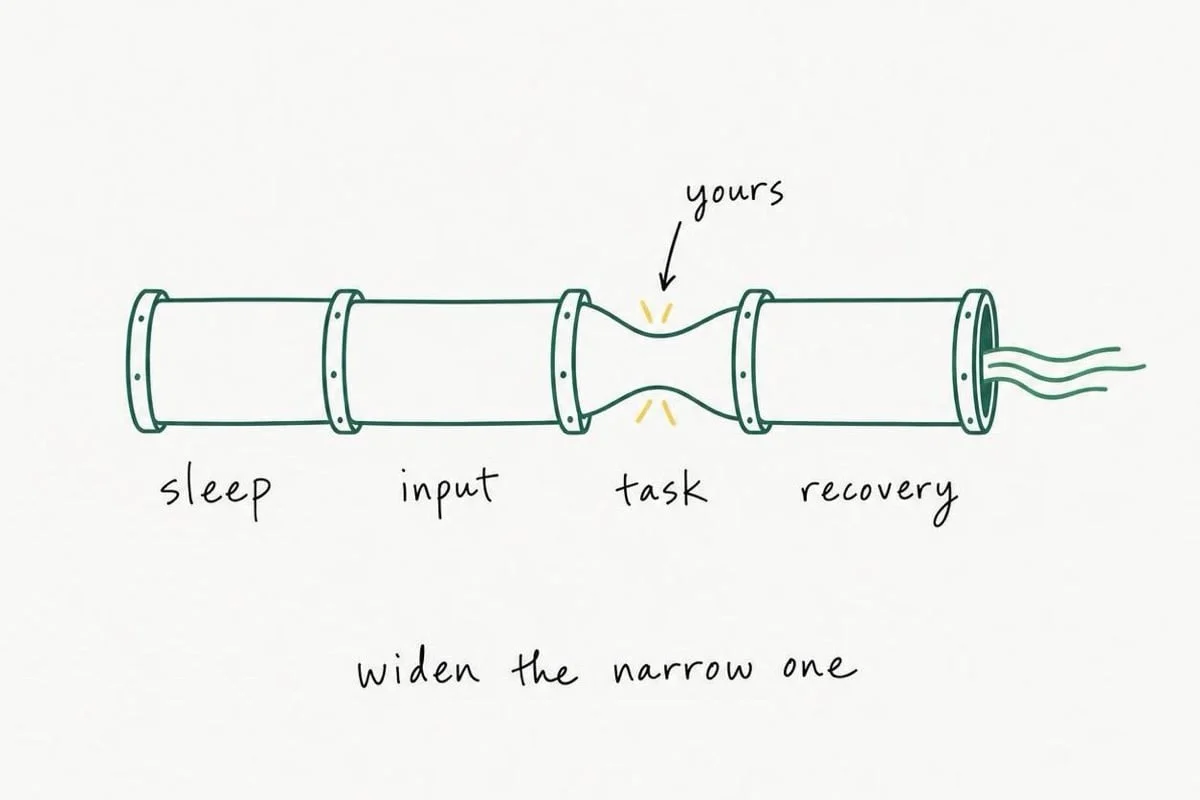
Concentration behaves less like a switch and more like a pipe with four sections in series. The total output of the pipe is limited by its narrowest section. If you widen the three sections that are already functioning perfectly, the flow of your output remains unchanged.
This explains why unranked tip lists are perpetually disappointing. If you are operating on five hours of sleep, adding meditation to your routine is like trying to fix a leak in the roof when your foundation is crumbling. If you are struggling because your project lacks a clear starting point, installing a website blocker will do nothing to solve your paralysis. The first step toward reclaiming your time is not effort; it is diagnosis.
Defining "Normal"
Before pathologizing your lack of focus, it is essential to establish a baseline. In an extensive experience-sampling study involving 2,250 adults and 250,000 individual reports, researchers found that the average human mind wanders during 46.9% of sampled moments. Furthermore, participants reported lower levels of happiness during those drifting intervals.
The takeaway is critical: a mind that drifts is not a broken mind. The objective is not to achieve zero drift—that is a biological impossibility. The objective is to manage the drift so that it does not dominate your professional output.
Debunking the Myth of the 23-Minute Recovery
For years, a pervasive statistic suggested it takes 23 minutes and 15 seconds to return to a task after an interruption. Recent investigations into this figure have failed to verify it as a standardized measured resumption time.
What the evidence does suggest is far more actionable: interruptions as brief as 30 seconds to two minutes produce measurable after-effects on verbal, visual-search, and monitoring tasks. Furthermore, the act of switching between tasks carries a “switching cost” that scales with the complexity of the task.
The distinction here is vital. If recovery truly took 23 minutes, your only defense would be total isolation for hours at a time. Because the cost is instead a “tax” charged on every single switch, the solution is simply to make fewer switches. Multitasking is not a skill; it is a series of recurring, avoidable taxes on your cognitive resources.
The Four Checks: A Framework for Diagnosis
To find your constraint, run all four of the following checks, then focus your energy solely on the weakest link. This framing is designed for immediate application, not academic perfection.
Check 1: Cumulative Sleep Debt
Laboratory studies have demonstrated that adults restricted to four or six hours of sleep for 14 nights show a cumulative, dose-dependent decline in sustained attention and working memory. Crucially, the participants’ own subjective ratings of their sleepiness vastly understated their performance degradation.

The Test: Forget how you “feel.” Look at the last fourteen nights. How many provided you with fewer than 6.5 hours of sleep? If the answer is four or more, this is your constraint. If the lack of sleep is due to procrastination, address your evening routine. If it is due to an inability to sleep, this becomes a medical matter.
Check 2: Environmental Inputs
The mere presence of a smartphone, even face-down and silent, has been shown to reduce available cognitive capacity. While some replication studies on this topic remain contested, the pragmatic solution is undeniable: moving your phone to another room removes the potential for the “switch” entirely.
The Test: During your last work block, how many times did you reach for a device you hadn’t planned to use? If the number exceeds five, your physical environment is the narrowest part of your pipe.
Check 3: The Ambiguity of Tasks
This is the most common constraint among professionals. If you block 90 minutes for “work on the quarterly plan,” you have created a task with no entry point and no finish line. Your brain naturally gravitates toward tasks with clearer “next moves”—like email or instant messaging—because they provide an immediate sense of accomplishment.
The Test: Look at your calendar. Can you articulate the first physical action required for your next task? If the item isn’t defined as a specific, actionable, and measurable step, rewrite it. Difficulty is rarely the enemy of focus; ambiguity is.
Check 4: Scheduled Recovery
A meta-analysis of micro-breaks indicates they reliably improve vigor and reduce fatigue. Additionally, caffeine’s half-life—roughly four to six hours—means that an afternoon coffee can quietly sabotage your sleep for that night, effectively turning Check 4 into a failure of Check 1.
The Test: In the last five working days, how many contained a real, screen-free break? If fewer than three, you are suffering from cognitive overload.
Implementing the Two-Week Focus Test
Once you have identified your worst check, you must run a controlled, two-week experiment.
- Week One (Baseline): Change nothing. Simply track the number of “completed blocks”—any 30-to-90-minute stretch of work finished without task-switching.
- Week Two (The Intervention): Change only the one item identified as your primary constraint. If your phone was the problem, move it to another room for every block. If the task definition was the problem, rewrite every calendar item to include a clear, physical first step.
During this time, use "if-then" planning. If the urge to check an inbox arises, write the thought on a notepad and immediately return to the sentence you were writing. This technique acts as a bridge between the impulse to switch and the commitment to stay the course.
When to Seek Professional Intervention
It is imperative to distinguish between productivity challenges and medical conditions. Trouble concentrating is a broad symptom; when it becomes persistent, worsening, or significantly disruptive to your relationships and career, it ceases to be a “productivity hack” issue.
Conditions such as sleep apnea or undiagnosed ADHD—which the CDC estimates affects approximately 6.0% of U.S. adults—require clinical management. If your inability to focus appeared alongside other changes in your health, or if you find that standard behavioral changes yield no results after a month, consult a medical professional. The two-week test provided here is a diagnostic tool for workflow, not a clinical screening.
Conclusion: Start Tonight
The solution to your distraction is not to add more tools, apps, or complex routines to your life. It is to prune the unnecessary until the narrowest constraint of your cognitive output is revealed.
Count your sleep-deprived nights. Mark your completed work blocks. Identify the one thing that keeps you from the work that matters. By Friday, you will have more than just a list of tips—you will have a clear, data-driven understanding of how you work. That is the only way to transform a fragmented morning into a productive one.