The landscape of home fitness is littered with abandoned intentions. For many, the cycle is predictable: a burst of motivation, a collection of disparate exercises pulled from social media, a few missed sessions due to the realities of daily life, and ultimately, a quiet cessation of the routine. However, the failure of these programs rarely lies in the physiology of the trainee; it lies in the design of the plan.
Strength training at home for women is not about accumulating a random pile of movements; it is about building a scalable, resilient system. A successful program requires five fundamental movements, a consistent frequency, and, most importantly, a "floor" protocol—a safety net for the weeks when life inevitably falls apart.
The Core Philosophy: Why Most Home Programs Fail
Consider the hypothetical reader, "Carla." She has a pair of eight-pound dumbbells gathering dust under her bed, a resistance band tucked away in a kitchen junk drawer, and three failed attempts at a fitness routine behind her. Carla does not need another list of high-intensity exercises or "miracle" movements. She needs a structural framework: a roadmap for Monday, a clear method for increasing intensity by week three, and, crucially, a defined plan of action for the Tuesday after a week when everything went wrong.
The difference between a program that ends in month one and one that persists for years is the inclusion of a recovery protocol. By formalizing what to do when a session is missed, the "all-or-nothing" mentality that destroys most home fitness habits is dismantled.
The 6-Week Progressive Plan
This program is structured to build momentum through consistency rather than sheer intensity. It begins with two sessions per week for the first four weeks, graduating to three sessions in weeks five and six.
The Weekly Schedule
| Weeks | Sessions | Session Structure | The "Floor" (Safety Protocol) |
|---|---|---|---|
| 1-2 | 2 | 2 sets of each: 8–12 reps | 1 set of each: 7 minutes total |
| 3-4 | 2 | 3 sets of each: 8–12 reps | 1 set of each: 7 minutes total |
| 5-6 | 3 | 3 sets of each: 8–12 reps | 1 set of each: 7 minutes total |
Note: The "Floor" column remains static. While your main session demands grow, the fallback protocol does not. This ensures that even after a difficult week, the barrier to re-entry remains low and achievable.
The Five Fundamental Movements
To cover all major muscle groups—the legs, hips, lower back, chest, shoulders, upper back, and trunk—we utilize five foundational movement patterns. These are chosen for their efficiency and their ability to be modified with household items.
1. The Squat
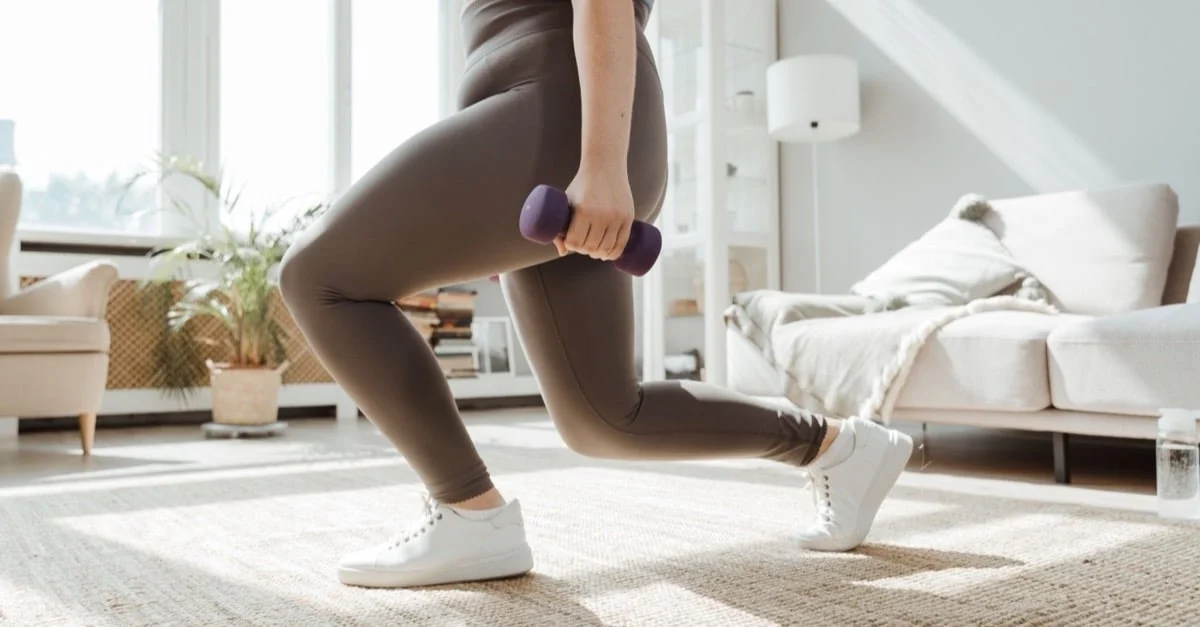
Targeting the quadriceps and glutes, the squat is the cornerstone of lower-body strength. Using a dining chair as a guide ensures consistent depth and provides a safety net. If dumbbells are unavailable, perform the movement bodyweight-only, focusing on a slow, three-count descent to increase time under tension.
2. The Hip Hinge
Often the most misunderstood movement, the hinge is vital for posterior chain health. With feet shoulder-width apart and knees slightly bent, push the hips backward while maintaining a neutral spine. The weights travel down the front of the legs. This is the primary defense against lower back strain in daily life.
3. The Push
Beginning with hands on a kitchen counter, lower the chest toward the surface and press away. As your strength improves, move to a lower surface, such as a sturdy chair, and eventually to the floor. This provides a scalable push-up progression that respects individual starting strength.
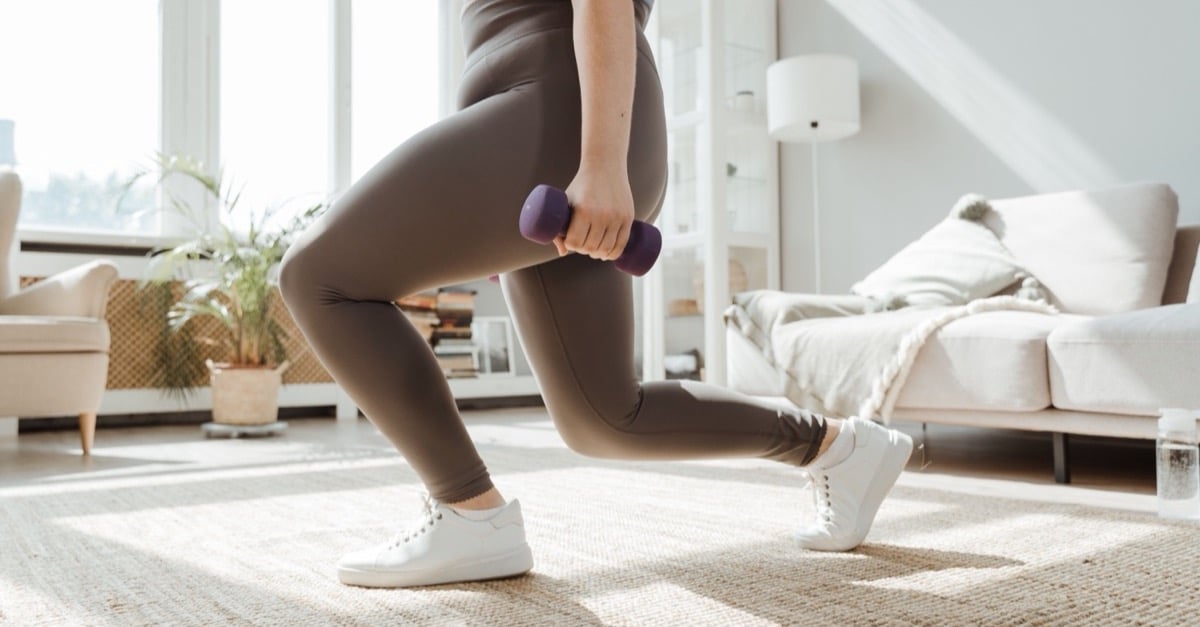
4. The Row
A balanced physique requires pulling. Using a chair for support, pull a dumbbell to the ribcage, keeping the elbow tucked close. If weights are scarce, a resistance band anchored to a banister serves as an excellent surrogate, allowing for consistent upper-back engagement.
5. The Carry
The "suitcase carry" is perhaps the most functional movement in the program. By holding a weight in one hand and walking with a level gait, you challenge the trunk and grip. It is the ultimate exercise for real-world strength, making heavy grocery bags or luggage feel significantly lighter.
Supporting Data and Scientific Context
The efficacy of this plan is rooted in established exercise science, specifically the guidelines provided by the American College of Sports Medicine (ACSM).
The "Two-Session" Baseline
The federal guidelines for physical activity suggest at least two days a week of muscle-strengthening activity. This is not a "beginner’s compromise"; it is the scientifically validated minimum for maintaining health and building foundational strength. When paired with 150–300 minutes of moderate aerobic activity—such as brisk walking—it creates a comprehensive health profile.
Load, Repetitions, and Failure
A common question among home trainees is: "How light is too light?" Research indicates that muscle growth can be achieved with a variety of loads (from 40% to 80% of a one-rep maximum) provided that the set is taken close to the point of mechanical failure. Your 8-pound dumbbells are effective, provided the final two repetitions of each set are genuinely challenging to complete.
The Role of Rest
Recent Bayesian reviews on inter-set rest suggest that while longer rest periods (over 60 seconds) may offer minor advantages, the most practical timer is your own breath. When you can speak in a full sentence without gasping, you are sufficiently recovered for the next set.
Official Responses and Clinical Considerations
Before initiating any new training regimen, it is imperative to acknowledge personal health boundaries.
- Pregnancy and Postpartum: The American College of Obstetricians and Gynecologists (ACOG) advises that any significant change in physical activity should be cleared by a healthcare provider.
- Existing Conditions: Individuals with heart conditions, hypertension, or recent injuries should consult a clinician. If a specific movement—such as the hinge or carry—causes sharp or lingering pain, it should be removed or modified immediately.
- The "48-Hour" Rule: This is a crucial psychological construct. If a session is missed, the "48-hour rule" dictates that you must return to the workout within 48 hours—but you are required only to perform the "floor" version. This removes the performance anxiety associated with "catching up" on missed volume.
Implications: Building a Sustainable Identity
The primary implication of this six-week plan is the shift from "exerciser" to "consistent practitioner." By designing a program that accounts for human fallibility, you decouple your progress from the pressure of perfection.
Busting Myths
- The "Bulky" Fear: Research consistently shows that for women, muscle hypertrophy is a slow, gradual process. It requires years of intentional training to reach the levels of muscle mass that many fear. Strength training will instead provide structural support and metabolic benefits.
- Spot Reduction: There is no physiological mechanism for "toning" a specific body part through exercise alone. While core exercises strengthen the abdominal wall, they do not dictate where the body reduces fat. That is a function of overall caloric balance and systemic health.
- Bone Health: High-intensity resistance training is a powerful tool for bone mineral density. While this program starts at a moderate level, it provides the foundation required to eventually progress into the higher-intensity ranges that offer the most protection against bone density loss.
Final Advice
Do not attempt to overhaul your entire lifestyle on a Monday morning. Start with the "floor" protocol. Perform one set of each of the five movements. By keeping the barrier to entry intentionally low, you ensure that you are still performing these movements in March, April, and beyond.
A "suboptimal" plan that you actually follow will always outperform the "perfect" plan that you abandon after two weeks. The objective is not to build a body for a season, but to build a habit for a lifetime.