The ritual is as familiar as it is futile. Every quarter, employees across the globe sit down to draft their “SMART” goals. They produce four bullet points of corporate-speak, a manager skims them with a distracted nod, and by the third week of the quarter, the documents are buried under a mountain of daily crises. The goals themselves—intended to be beacons of productivity—are quietly abandoned, left to gather digital dust until the next performance review cycle necessitates a frantic, retroactive justification of why they weren’t met.
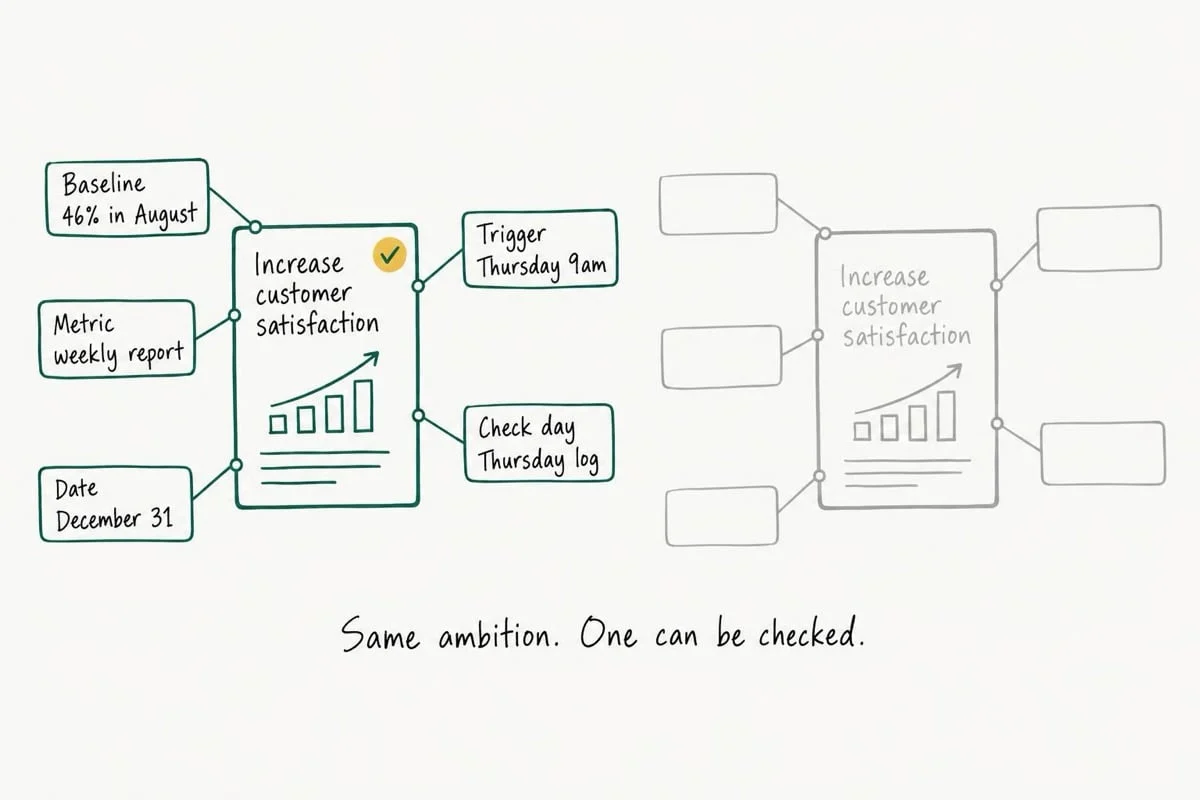
The problem, however, is not a lack of ambition. The reality is that most professional objectives are never designed to survive an "ordinary Tuesday." They crumble the moment a high-priority customer escalates a complaint, a key team member resigns, or a project’s budget is slashed. The fatal flaw in modern goal-setting is that while these objectives may be grammatically correct, they are operationally empty. They lack the essential mechanics—a verified starting number, a named owner, and a recurring check-in cadence—that turn a sentiment into a reality.
The Evolution of a Corporate Standard
To understand why our goal-setting processes have drifted into theater, we must look at the origin of the SMART acronym. George Doran first introduced the concept in Management Review in November 1981. Originally, the acronym stood for Specific, Measurable, Assignable, Realistic, and Time-related. It was a framework designed for managers to delegate tasks effectively within a hierarchy.
Over the decades, the acronym has undergone a subtle but destructive metamorphosis. In many modern corporate templates, “Assignable” has been replaced by “Achievable” or “Relevant.” This shift reflects a change in the user: we are no longer just assigning tasks to subordinates; we are writing our own performance contracts. Yet, by dropping the "Assignable" component, we have lost the core of accountability. A goal like "improve onboarding" is a sentiment that four people can nod at, but for which no single person is truly responsible. To reclaim the efficacy of the original model, we must re-center the goal around accountability and precise measurement.
Anatomy of an Operable Goal
A truly SMART goal is an objective written with such mathematical precision that a colleague could audit your progress without needing to ask for clarification. It requires a measurable delta from a known baseline, a target that accounts for actual available resources, and a specific timeframe.
The structure of a high-functioning goal consists of five pillars:
- The Baseline: A starting number (e.g., 46% current resolution rate).
- The Metric: An objective data point verifiable by a third party.
- The Timeline: A date that isn’t simply the final day of the fiscal quarter.
- The Trigger: An "if-then" plan defining when and where the work happens.
- The Check-Day: A recurring, scheduled time to review the progress.
10 Concrete Examples for the Modern Workplace
To transition from vague intent to operational output, consider these examples across various business functions:
- Individual Reporting: Instead of "Improve report quality," try: "Cut the client report from four revision rounds to two or fewer by December 31, as tracked in the shared file. Check: Friday, 4:00 PM."
- People Management: Instead of "Be more available," try: "Hold a 30-minute one-on-one with each of my six reports every two weeks from October 1 to December 19, missing no more than two sessions. Check: Monday morning."
- Team Delivery: Instead of "Reduce the backlog," try: "Reduce open handoff tickets from 18 to fewer than 8 by November 30, with each of the four engineers closing two per week. Owner: me. Check: Monday standup."
- Customer Service: Instead of "Respond faster," try: "Raise first-reply resolution from 46% in August to 60% by December 31, measured in the weekly helpdesk report. Check: Thursday."
- Sales Pipeline: Instead of "Build a stronger pipeline," try: "Book eight qualified discovery calls a month through Q4 (up from five in Q3) by blocking 90 minutes for outreach every Tuesday and Thursday. Check: Friday via CRM."
- Skill Development: Instead of "Improve data analysis," try: "Complete the four-module SQL course and ship one query that replaces a manual report by February 28, studying 45 minutes on Monday, Wednesday, and Saturday. Check: Saturday."
- Process Efficiency: Instead of "Make month-end easier," try: "Cut the month-end close from nine working days to six by March, automating one of the three slowest reconciliations each month. Check: First Monday after each close."
- Evidence Collection: Instead of "Track my accomplishments," try: "Write two sentences of evidence against each goal every Friday, so the April evaluation draws on 26 dated entries. Check: Friday, 4:30 PM."
- Visibility: Instead of "Communicate more," try: "Send a five-bullet Friday note covering shipped, blocked, and decision-needed items through Q4, missing no more than two. Check: The note is the check."
- Workload Management: Instead of "Get my calendar under control," try: "Reduce recurring meetings from 22 hours to under 15 by December 1 by delegating all meetings where I hold no decision-making power. Check: Monday, calendar audit."
Supporting Data and Behavioral Science
The effectiveness of these structures is backed by extensive psychological and organizational research. A meta-analysis of 138 studies involving nearly 20,000 participants found that the mere act of monitoring progress significantly increases the likelihood of attainment. When progress is reported or made public, that effect size grows even larger.

Furthermore, the "trigger" mechanism—forming an if-then plan—has been shown to have a medium-to-large effect on goal attainment (d = 0.65). By linking a specific action to a specific time and place, you remove the "decision fatigue" that often prevents deep work. When you don’t have to decide when to do the task, the barrier to entry is significantly lowered.
Managing the "Blow-Up": Resilience in Goal Setting
Even the best-laid plans are subject to the volatility of the modern business environment. When a quarter breaks, goals often die in one of three ways: they are quietly abandoned, defended until the team burns out, or renegotiated when they no longer matter.
To prevent this, professionals should adopt the "floor version" strategy. For every goal, define the "floor"—the absolute minimum output that still provides value—and a rule for resuming progress after a missed week. If a manager loses two key staff members, the "floor" might be maintaining current service levels rather than achieving a 60% resolution target. By pre-defining this floor, you eliminate the emotional toll of "failing" and the need for stressful, last-minute goal renegotiations.
Implications for Organizational Performance
The implication for managers and employees alike is clear: stop treating goal-setting as an administrative task to be finished and filed. Instead, treat it as a management system.
The "review version" of a goal is what goes on the official company form—it is concise, aligned with business metrics, and designed for a reader who will spend less than two minutes reviewing it. The "running version" lives in your personal workflow, containing the triggers, the check-days, and the granular data that actually drive performance.
By separating these two, you reclaim the power of the goal. The form version satisfies the bureaucracy; the running version delivers the results.
Final Strategic Checklist
Before the next week begins, perform a simple audit of your current goals. Ask two questions:
- Does this goal have a starting baseline that I can look up right now?
- Does this goal have a fixed, recurring check-day attached to it?
If the answer to either is no, you are not working toward a goal; you are merely holding a wish. Spend ten minutes today grounding these objectives in reality. By shifting the focus from the vague, inspirational language of the 1980s to the precise, operative language of modern high-performance, you don’t just ensure that your goals make it onto the form—you ensure they actually move the needle for your business, your team, and your own professional growth.