Marcus can pinpoint the exact year the trade stopped paying off. He is 49, a veteran of a sales career defined by 60-hour weeks, a smartphone that never went face-down, and a relentless commitment to the grind. Yet, at 11:00 p.m. at his kitchen table, the reality is stark: the raises have plateaued, the physical toll of a long week now requires two days of recovery instead of one, and he no longer remembers how to simply "want" a Saturday.
Marcus is not alone. While the cultural discourse around "hustle culture" is almost exclusively directed at Gen Z and Millennials, warning them against the perils of overwork, there is a silent demographic that has already paid the price: the middle-aged professional who bought the entire package, only to find the market conditions changed while they weren’t looking.
Main Facts: The Myth of Perpetual Returns
Hustle culture is often mischaracterized as a mere personality flaw—a lack of balance or an obsession with productivity. In reality, it is a sophisticated economic ideology regarding time. It posits that ambition is measurable only through the visibility of one’s strain and that any gap in a calendar is a failure of character.
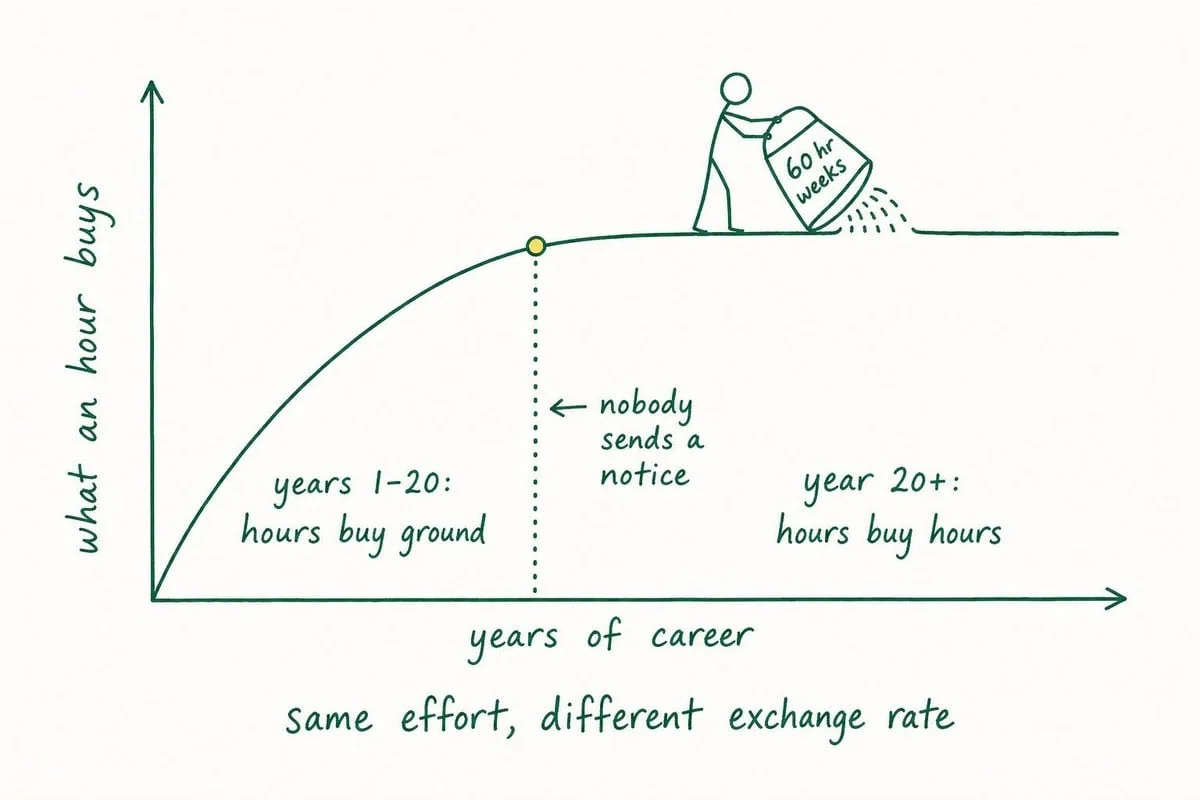
However, the "hustle" is a transaction. For the first two decades of a career, that transaction is often rational. Data indicates that wage profiles rise for the first 20 years of experience before flattening. When a 29-year-old takes the extra shift or the Sunday flight, they are buying at the bottom of a steep growth curve. By 49, however, the exchange rate has shifted. The hours are no longer buying career advancement; they are merely consuming the capacity that the worker needs to sustain their lifestyle. The tragedy of the modern professional is not that they were fooled by a fad, but that they signed a contract that the institutions offering it have no intention of honoring indefinitely.
A Chronology of the Grind
To understand the current malaise, one must look at how the modern "hustle" was codified. While the term "hustle" dates back to the Dutch hutselen (to shake or toss) and gained American commercial traction in the late 19th century, its modern digital iteration was crystallized between 2014 and 2019.
- 2014: The "rise and grind" mantra became a mass-marketed online ritual, with nearly 30,000 tweets per week dedicated to the glorification of early mornings and late nights.
- 2018: The ideology reached its zenith with the publication of books like Daymond John’s Rise and Grind.
- Late 2018: The inevitable backlash began. At the Web Summit in Lisbon, Reddit co-founder Alexis Ohanian famously labeled this mindset "hustle porn," identifying it as a toxic byproduct of the tech era. Shortly after, the New York Times brought the term "hustle culture" into the mainstream, linking it to the performative overwork culture seen in companies like WeWork.
Sociologists, such as Tressie McMillan Cottom, have argued that this era was essentially a massive transfer of risk. Institutions successfully offloaded the burden of uncertainty onto individuals, rebranding it as "personal ambition."
Supporting Data: The Science of Diminishing Returns
The argument for working 60-hour weeks collapses under the weight of empirical evidence when applied to the mid-career worker.
The Output Clock
Research from Stanford’s John Pencavel confirms that productivity is not a linear function of time. Below 49 hours a week, output rises in proportion to effort. Beyond that, the curve flattens significantly. Past 60 hours, the marginal gains to productivity are virtually nonexistent. In modern knowledge work, excessive hours often lead to being "busy" rather than "productive," with a 1% increase in hours yielding only a 0.9% increase in actual output.

The Earnings Clock
Administrative records for millions of American workers show that the probability of significant earnings growth begins to diminish steadily after age 45. For the vast majority of workers, median earnings hold flat through their forties and fifties. Unless one is a graduate-degree holder in specific niche fields, the "hustle" after year 20 is rarely a path to higher compensation.
The Health Clock
This is the hidden cost that hustle culture refuses to price. The World Health Organization (WHO) and the International Labour Organization (ILO) linked 55+ hour work weeks to over 745,000 deaths from stroke and heart disease in 2016 alone. The threshold is precise: 55 hours or more carries a 35% higher stroke risk compared to a standard 35–40 hour week. The hours worked at age 32 are not free; they are financed by the health of the worker at age 50.
Official Responses and Industry Shifts
While individuals are struggling to break the habit, the broader labor market is showing signs of a paradigm shift. According to recent data from Randstad, work-life balance has officially overtaken salary as the primary motivator for job seekers, with 83% of workers citing it as their top priority.
However, a generational divide persists. Data from Pew Research Center (2024) reveals that 84% of workers over 50 report doing "more than is expected" of them, compared to only 64% of those under 30. This suggests that while the culture is shifting, the internal compulsion to grind remains a uniquely difficult burden for the older cohort. They are holding a line that the rest of the workforce has already abandoned.
Implications: The Path to Re-pricing Your Life
The exit from hustle culture is not a resignation letter—it is a re-pricing of one’s own time. The goal is to shift from "working excessively" (a behavioral issue) to "detaching" (a cognitive necessity).
The Four-Step Exit Strategy
- The Hard End: Do not try to change the whole week. Pick one evening—say, Thursday—and make it non-negotiable. Shut the laptop, put the phone in a drawer, and leave it there.
- Activity as Delivery: Choose evening activities that prioritize mental detachment, not just physical absence. A walk spent ruminating on a project is not recovery; it is a continuation of the work.
- Recovery as Input: Stop viewing rest as a reward for a hard week. View it as a necessary input for the following week’s performance.
- Define "Enough": Before the week begins, define two non-negotiable outcomes for Friday. Everything else is secondary.
Overcoming the Internal Compulsion
The hardest part of this transition is that, for many, the pressure is no longer coming from the boss—it is coming from within. Occupational psychologists note that workaholism is an addictive, cognitive state. Even when a professional moves to a "calmer" job, they often find themselves inventing tasks to fill the void.
Marcus, the salesperson, eventually succeeded by treating his time like a finite resource. He didn’t quit his job or move to the country; he simply stopped paying 1891 prices in 2026. He learned that winning at work and winning at life are not the same thing, and that at 49, the most valuable asset he owns is not his title or his hustle, but his capacity to disconnect.
The industry may not always support this, but the math does. You are not losing ground; you are merely refusing to work for a rate that no longer justifies the cost of the labor.