For many, the onset of the mid-40s arrives not with a bang, but with a whisper. There is no dramatic collapse, no cinematic crisis, and no singular catastrophic event to point to as the culprit. On the surface, the life you have spent two decades building remains intact: the mortgage is paid, the career has reached a respectable plateau, and the family unit is functioning. Yet, somewhere between the ages of 44 and 47, a persistent, hollow question begins to echo in the quiet moments of the day: Is this it?
This is not necessarily clinical depression, nor is it a sign of personal failure. It is a specific, textured phenomenon unique to the midlife decade—a period where the structures that once supported your identity have subtly shifted, leaving you feeling untethered in a life that suddenly feels like a suit that no longer fits.
The Anatomy of the "Midlife Drift"
To understand why this feeling is so pervasive, one must look at the reality of the 40s. Sociologists and behavioral scientists increasingly describe this stage as the "engine room" of the adult life cycle. It is the decade where the demands of aging parents, dependent children, professional peak-load, and financial obligations intersect with a body that is no longer as resilient as it was in your twenties.
The U-Shaped Curve of Well-Being
The disorientation many feel is not a personal failing; it is a statistical reality. A landmark study spanning 145 countries identified a consistent "U-shaped curve" of human happiness. Regardless of culture or geography, life satisfaction tends to bottom out in the late 40s and early 50s. This dip is not an indication that you are "broken"; rather, it suggests that you are currently navigating a transition phase where the old, youthful structures of your life have worn thin, but the new, more sustainable structures for the second half of life have not yet been built.
The Myth of the Midlife Crisis
Popular culture loves the "midlife crisis" trope—the sudden, reckless desire to trade a minivan for a sports car or quit a stable career to move to a cabin in the woods. However, data from Cornell University paints a far more grounded picture. Research indicates that only about 23% of midlife adults report a "crisis" experience, and a mere 8% attribute that experience specifically to the process of aging.
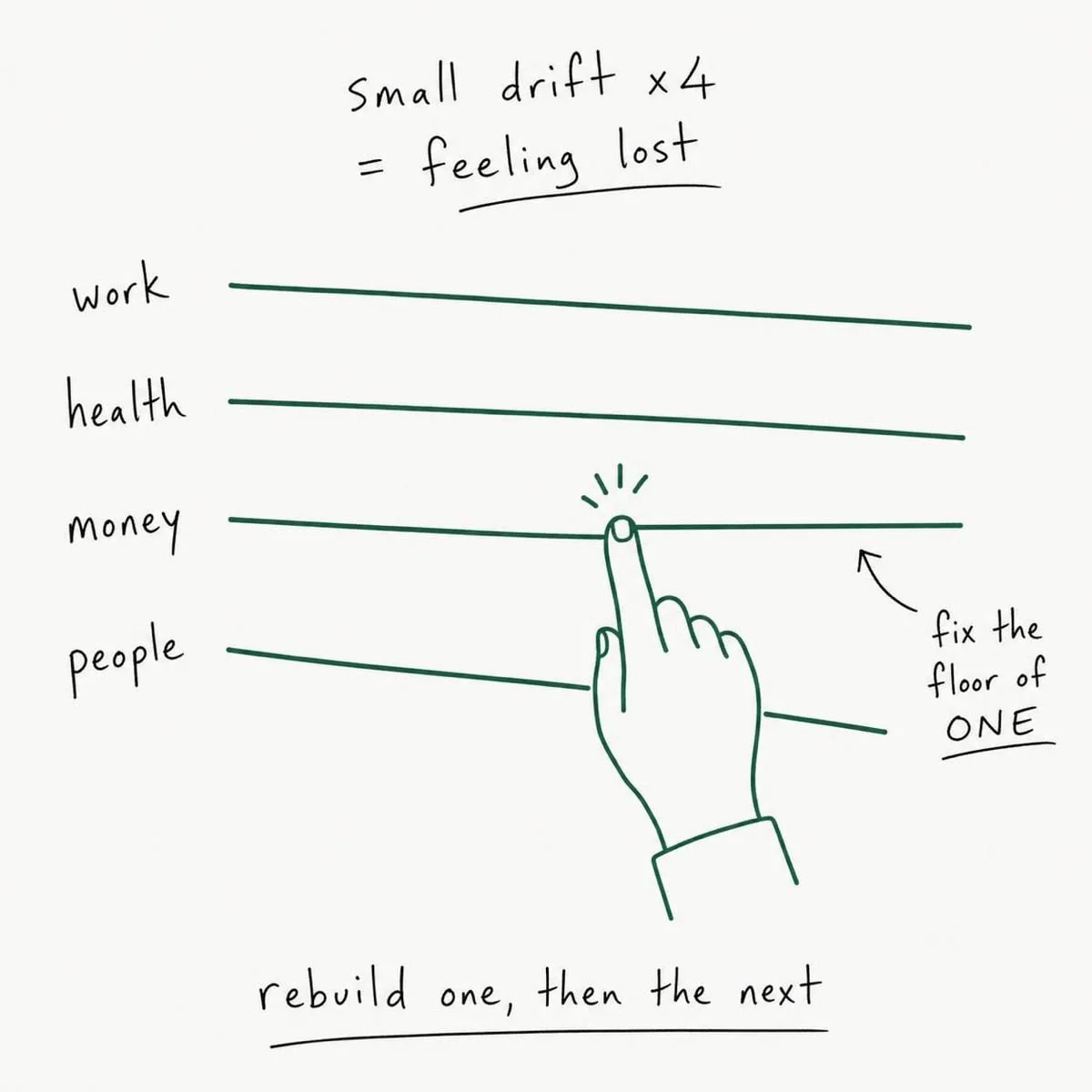
Most of what people feel is not a "crisis" in the explosive sense, but a "drift." It is the accumulation of minor, degrees-of-separation misalignments across work, health, and relationships. Because no single alarm bell sounds—no one is fired, no one is divorced, no one is bankrupt—the anxiety remains a low-grade, 2:00 a.m. hum rather than an emergency.
Chronology of the Disconnect
The feeling of being lost in your 40s often follows a distinct, if quiet, progression. Understanding this timeline can help remove the shame of "being behind."
- The Accumulation Phase (Early 40s): You are operating at maximum capacity. You have become an expert in your field, a reliable partner, and a pillar of your household. You are running more "concurrent processes" than at any other point in your life.
- The Fatigue Threshold (Mid-40s): The biological reality of slower recovery sets in. A bad night’s sleep is no longer corrected by a cup of coffee; it affects your cognitive clarity and emotional regulation for days. This is when the "drift" begins.
- The Recognition (Late 40s): You notice the misalignment. The work you once found invigorating now feels like an autopilot routine. Friendships that were once vital have drifted into "maintenance mode." The dissonance between who you are and the life you are performing becomes impossible to ignore.
The Strategy of the "Floor": Rebuilding One Domain at a Time
The most common mistake made during this phase is the attempt to solve everything at once. Influenced by the desire for a "clean slate," many people try to overhaul their career, diet, marriage, and finances simultaneously. This is the surest way to guarantee failure.
The key to reversing the drift is to pivot from "ceiling" goals to "floor" goals.

Understanding Ceilings vs. Floors
- Ceilings are your aspirational goals: running a marathon, earning a specific salary, or reinventing your personality. They are fragile and require high levels of motivation, which is often in short supply when you are already exhausted.
- Floors are your survival habits: a ten-minute walk, a five-minute review of your bank statement, or one intentional conversation with your partner. A floor is designed to be maintained on your worst day.
The "5-Second Drift Read"
Before attempting to fix your life, you must identify where the foundation has cracked. Conduct an honest, five-second assessment of four domains:
- Work: Does it fit your current values, or are you just going through the motions?
- Health: Are you recovering, or running on fumes?
- Money: Do you have a system, or are you avoiding the numbers?
- People: Is your closest relationship alive and growing, or is it on autopilot?
Whichever area you flinch at first is your "first floor." Do not touch the others until this one is secure.
Implications for Personal Development
The implication of this research is profound: the "lost" feeling is not a sign of failure; it is a signal for transition. When your routines stop firing on autopilot, you are actually in a rare position of high agency. The cues that once governed your life have weakened, making this the perfect window to install new, more intentional habits.
Implementation Intentions
To succeed, you must wire these new habits to situational cues rather than willpower. Use "if-then" planning: If I pour my first cup of coffee, then I will step outside for ten minutes. By anchoring a behavior to an existing ritual, you remove the decision-making process—and the need for motivation—from the equation.
Expert Perspectives and Research Findings
Leading behavior scientists, such as BJ Fogg, have long argued that sustainable change is predicated on simplicity. His research with over 60,000 individuals suggests that habits stick only when they are made small enough to execute even under extreme stress.
Furthermore, meta-analyses on multi-behavioral interventions consistently show that targeting one domain at a time yields superior results compared to "life-hack" overhauls. The science is clear: sequence beats simultaneity. When you successfully stabilize your "first floor," you create a sense of momentum. That initial win provides the psychological capital—and the clarity—needed to address the next domain.
Conclusion: Reclaiming Your Narrative
Feeling lost in your 40s is not a mandate to detonate your life. It is an invitation to renovate it. When you feel the familiar pull of the 2:00 a.m. existential spiral, remind yourself: you are not falling behind; you are simply at the point in the curve where the foundation needs a reset.
Stop trying to solve the riddle of your "purpose." Instead, focus on the architecture of your day. By stabilizing your floors—one domain at a time, anchored to simple, non-negotiable cues—you clear the fog of exhaustion. Once the fog lifts, you will find that the "big" questions regarding your future are much easier to answer from a place of stability than from the depths of a drift.
You are not failing. You are simply in the engine room, and it is time to rebuild the floor.