In an era where news cycles are often dominated by complex geopolitical tensions and technological disruption, a simple act of compassion in East Oakland has captivated the internet. On a Wednesday evening, a routine response to a vehicle fire evolved into a heartwarming rescue mission that transcended the typical duties of a first responder. Members of the Oakland Firefighters Local 55 E29 crew, while managing the aftermath of a localized fire, found themselves providing emergency medical assistance not to a person, but to an avian resident of the city.
The viral footage, which shows a firefighter carefully administering oxygen to a struggling pigeon, has ignited a global conversation about the often-overlooked bond between urban wildlife and humanity.
The Incident: A Routine Response Turns Remarkable
The incident occurred on a typical mid-week evening in East Oakland. The E29 crew of the Oakland Fire Department (OFD) had been dispatched to handle a vehicle fire, a task they perform with practiced efficiency. As the firefighters worked to secure the scene and ensure the blaze was fully extinguished, they noticed an unusual visitor amidst the smoke and chaos.
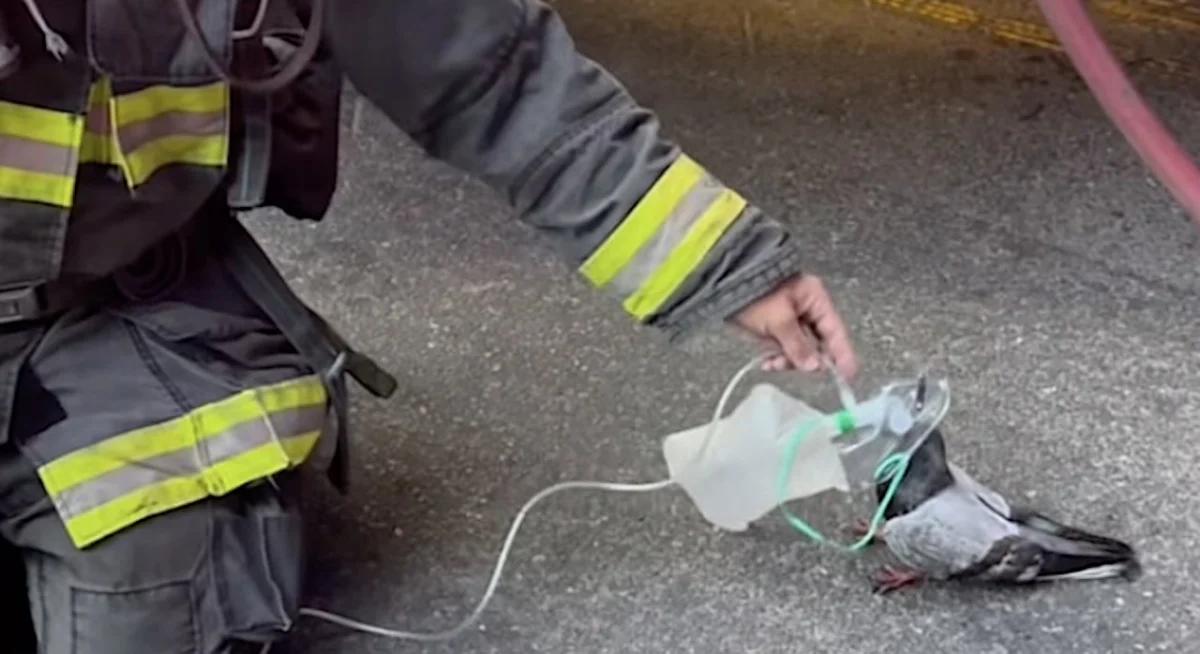
A pigeon, visibly distressed and struggling to breathe, approached the firefighters directly. According to the crew’s official report, the bird did not display the typical flight-or-fright response expected of wild animals in the presence of humans. Instead, it appeared to be actively seeking assistance. Recognizing the signs of smoke inhalation—a common hazard for both humans and animals in fire environments—the firefighters decided to intervene.
Using specialized equipment typically reserved for human patients, the crew gently applied a small oxygen mask to the bird’s beak. The video, now circulating widely across social media platforms, captures the tender moment the firefighter stabilizes the bird, allowing it to recover from the toxic fumes of the vehicle fire. Within minutes, the treatment proved effective. After the bird had sufficiently cleared its lungs and regained its strength, it took flight, returning to the skies of Oakland as if acknowledging the life-saving intervention.
Chronology of the Rescue
The timeline of the event highlights the rapid decision-making skills inherent in fire service training:
- 18:00 (Approx): The E29 crew arrives at the scene of the vehicle fire in East Oakland. Fire suppression efforts commence.
- 18:20: As the fire is brought under control, firefighters notice the pigeon hovering near the perimeter, displaying lethargy and respiratory distress.
- 18:22: The bird approaches the crew. Realizing the creature is suffering from smoke inhalation, a firefighter makes the decision to provide supplemental oxygen.
- 18:25: The oxygen administration begins. The scene is recorded by a bystander, capturing the patient interaction.
- 18:30: The pigeon shows immediate signs of improvement, moving its head and clearing its airways.
- 18:35: The bird is released, successfully taking flight and departing the scene.
The Science of Smoke Inhalation in Avian Species
While the sight of a firefighter assisting a pigeon is inherently heartwarming, there is a serious biological context to the rescue. Birds possess a highly efficient, yet sensitive, respiratory system. Unlike mammals, who use a diaphragm to breathe, birds rely on a complex system of air sacs that allow for a unidirectional flow of air.
This efficiency makes them particularly vulnerable to airborne toxins. In the context of a vehicle fire, the smoke is often thick with carbon monoxide, cyanide, and particulate matter from burning plastics and synthetic materials. For a small creature like a pigeon, even a few minutes of exposure to these concentrated pollutants can lead to rapid respiratory failure or neurological impairment.
The firefighters’ choice to administer oxygen provided the pigeon with the essential concentration required to displace carbon monoxide from its hemoglobin. Without this rapid intervention, it is highly probable that the bird would have succumbed to hypoxia, a testament to the crew’s situational awareness.
Domesticated or Wild? The Human-Pigeon Connection
The viral nature of the story has sparked a lively debate in the comment sections of the Oakland Firefighters Local 55 Facebook page. Many users have pointed out a historical reality that often goes unacknowledged: the common pigeon (Columba livia domestica) is, in fact, a domesticated species.
A Long History of Coexistence
Pigeons have been human companions for thousands of years. They were one of the first birds to be domesticated, utilized by ancient civilizations for food, religious offerings, and, most famously, as messengers. This long-standing relationship has fundamentally altered the bird’s psychology.
"We domesticated pigeons—they come to us for help because we trained them to," wrote social media user Katherine Linville. This perspective is supported by ornithological studies, which suggest that urban pigeons have adapted to human behavior, learning to interpret human gestures and recognize the proximity of humans as a source of food or safety.
The Trust Factor
The incident in Oakland highlights a profound level of interspecies trust. Taj-Ma R. Carter, another commenter, observed, "The trust that pigeon has for him… It knows the man is a life saver." This observation aligns with behavioral studies showing that pigeons can distinguish between individual human faces and are capable of forming associations between specific humans and positive or negative outcomes. In this instance, the bird clearly identified the firefighters as a source of relief rather than a threat.
Implications: The Role of First Responders in Animal Welfare
The actions of the E29 crew raise important questions about the evolving role of first responders in modern society. Increasingly, fire departments are viewed as community hubs that handle more than just fires; they are the frontline for public safety, which often includes animal rescue.
Training for Compassion
Many fire departments are now integrating animal rescue protocols into their standard training. Whether it is a cat trapped in a tree, a dog in a burning house, or, as in this case, a wild bird in distress, the ethical mandate to protect life is being interpreted more broadly.
"Firefighters are public servants in the truest sense," says a spokesperson for urban wildlife advocates. "When they take the time to save a creature that many consider a pest, it signals to the community that every life has value. It reinforces the ethos of empathy that defines the fire service."
The "Good News" Effect
In a digital landscape often dominated by negative headlines, stories of empathy—what psychologists call "moral beauty"—have a significant impact on public morale. The video of the Oakland firefighter has been shared tens of thousands of times, serving as a reminder that human beings are capable of profound kindness toward other species.
Historical Context: Pigeons and Human Utility
The narrative of this rescue is bolstered by the historical utility of the pigeon. As noted by the Good News Network, there is a deep-seated connection between humans and these birds, as evidenced by the recent discovery of a WWII pigeon parachute used to carry messages to the French Resistance.
Pigeons have served in wars, acted as scouts, and provided companionship. Their resilience and their ability to navigate complex urban environments have made them a permanent fixture of human civilization. When a modern firefighter saves a pigeon, it is, in a sense, a continuation of a multi-millennial partnership. The pigeon is not merely an "urban pest," but a creature that has evolved alongside humanity, relying on our infrastructure and, on rare occasions, our mercy.
Conclusion: A Lesson in Empathy
The rescue of the pigeon by the Oakland Firefighters Local 55 is more than just a viral clip; it is a profound reflection of the human capacity for compassion. It reminds us that in the middle of a high-stress, dangerous environment, the impulse to help another living thing—regardless of its size or species—is a defining trait of the human experience.
As society continues to grapple with environmental challenges and the loss of biodiversity, the image of a firefighter gently administering oxygen to a pigeon serves as a poignant symbol. It suggests that our role as stewards of the planet is not limited to grand policy gestures, but is found in the small, quiet moments of care we extend to the creatures that share our streets.
The E29 crew of Oakland didn’t just save a bird that day; they performed an act of public service that touched the hearts of millions, proving that even in the smoke of a fire, there is room for a breath of kindness.