For millions of individuals striving to balance health goals with the realities of a high-pressure lifestyle, the final hours of the day often represent a psychological minefield. Whether it is a bowl of cereal, a handful of chips, or a raid on the refrigerator, the ritual of nighttime snacking has become a ubiquitous, yet frequently misunderstood, behavioral pattern.
Recent data from the health and wellness community, specifically Nerd Fitness Coaching, reveals that over 70% of clients identify emotional eating or late-night snacking as a primary obstacle to their fitness and nutritional goals. While the immediate urge is often attributed to a lack of willpower, experts argue that the issue is rooted in biological, environmental, and psychological triggers that require a more sophisticated solution than simple dietary restriction.
The Core Facts: Understanding the Nighttime Phenomenon
The fundamental misconception surrounding nighttime snacking is that the act itself is inherently "bad." In nutritional science, the body’s metabolic processes do not operate on a strict "cut-off" time based on the clock. If an individual has not met their caloric requirements or nutrient needs throughout the day, eating late in the evening is not only acceptable but often necessary for recovery and metabolic health.
However, the problem arises when the act of eating becomes a mechanism for emotional regulation rather than a response to physiological hunger. When we eat because we are stressed, bored, or exhausted, we are essentially using food as a pharmacological tool to soothe our nervous system. This habit loop—where the stress of the day is followed by the reward of a snack—creates a deep neurological pathway that is difficult to break through sheer force of will.
A Chronology of Habit Formation: How We Get Here
The transition from a healthy eater during the day to a "snacker" at night is rarely a sudden development. It typically follows a predictable trajectory:
- The Accumulation of Cognitive Load: Throughout the workday, an individual expends significant mental energy. By the time they reach the evening, their "willpower reservoir"—the psychological capacity to regulate impulses—is depleted.
- The Cue: The individual enters their living space. The brain, having learned that this specific time and place is associated with rest, triggers a craving for dopamine.
- The Reward: The individual consumes a high-palatability, high-calorie snack. This provides a temporary spike in dopamine, creating a brief sense of comfort or relief from the day’s stress.
- The Reinforcement: This cycle repeats for weeks, months, or years, until the act of snacking is no longer a conscious choice but an automatic, subconscious behavior triggered simply by the act of sitting on the couch.
Supporting Data: The Limitations of "Cold Turkey"
Behavioral psychologists have long noted that "cold turkey" methods—the abrupt and total cessation of a habit—suffer from extremely high failure rates. When an individual attempts to eliminate nighttime snacking overnight, they are removing a primary coping mechanism without providing a substitute.
Data indicates that the human brain abhors a vacuum. By removing the snack without addressing the underlying need for decompression, the individual creates a state of internal tension. This tension inevitably leads to a "rebound effect," where the individual eventually succumbs to the urge, often consuming more than they would have had they not attempted to restrict themselves in the first place.
The "Decompression Menu" Approach: An Official Strategy
Instead of prohibition, experts are increasingly advocating for the development of a "Decompression Menu." This strategy shifts the focus from restriction to replacement.
Developing Alternative Coping Mechanisms
The objective is to identify activities that provide a similar level of emotional relief to food but are aligned with long-term health goals. A robust decompression menu might include:
- Tactile or Creative Hobbies: Knitting, drawing, or assembling models can engage the hands and the mind, breaking the subconscious connection to eating.
- Sensory Regulation: Taking a hot shower, practicing guided meditation, or utilizing aromatherapy can down-regulate the nervous system, reducing the "fight-or-flight" response that often triggers stress eating.
- Intellectual Engagement: Reading a book or listening to a podcast requires cognitive focus, which can interrupt the mindless grazing cycle.
The Role of Choice Architecture
The environmental design of one’s home—often referred to as "upgrading the Batcave"—is perhaps the most effective tool in changing behavior. By modifying the physical environment, one can reduce the friction required to make a good choice and increase the friction required to make a habitual, negative choice.
Practical strategies include:
- Strategic Storage: Moving high-temptation foods to less accessible locations (such as the back of a high pantry shelf or a locked cabinet).
- Visual Cues: Placing positive alternatives, such as a book, in the exact spot where the snacks are usually kept.
- Environmental Cues: Changing the lighting or the seating arrangement to signify that the "nighttime snacking zone" has been transformed into a "relaxation zone."
Implications for Long-Term Wellness
The shift toward a more compassionate, evidence-based approach to eating carries significant implications for public health. By acknowledging that snacking is often a response to environmental and emotional stressors, we move away from the toxic narrative of personal failure.
Shifting from Willpower to Systems
The primary implication for those struggling with these habits is a shift in perspective: stop relying on willpower and start relying on systems. Willpower is a finite resource; it is easily exhausted by the stresses of modern life. Systems—such as pre-planning a decompression menu or redesigning your kitchen environment—are sustainable.
The Power of Iteration
Success in habit change is rarely linear. The process involves experimentation, observation, and refinement. If a specific alternative (like reading) does not work, it is not a failure; it is simply data. By treating these attempts as experiments, the individual removes the shame associated with "falling off the wagon" and instead adopts the mindset of an engineer troubleshooting a machine.
Conclusion: A Roadmap for Change
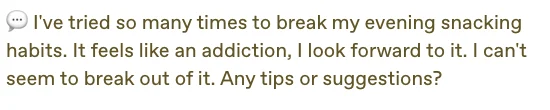
For individuals like Rick, who reached out for guidance, the message is clear: do not attempt to solve a complex behavioral issue with a simple, unsustainable restriction.
Instead, adopt a three-tiered approach:
- Identify the Trigger: Understand that you are seeking decompression, not nutrition.
- Create a Menu: Curate a list of non-food activities that provide genuine relaxation.
- Modify the Environment: Use your surroundings to nudge yourself toward your preferred choices.
The journey toward a healthier lifestyle is not defined by one night of perfection, but by the gradual expansion of your choices. By understanding the psychology of the habit loop, you gain the agency to design a routine that serves your goals rather than hindering them. This is not about white-knuckling your way through the night; it is about building a life—and an environment—where the healthy choice becomes the easy choice.
As you navigate this transition, remember that consistency over the long term far outweighs the intensity of a single week of restriction. Experiment, observe the results, and continue to refine your process. With time, the automatic, subconscious urge to snack will be replaced by a conscious, rewarding routine that supports your overall well-being.