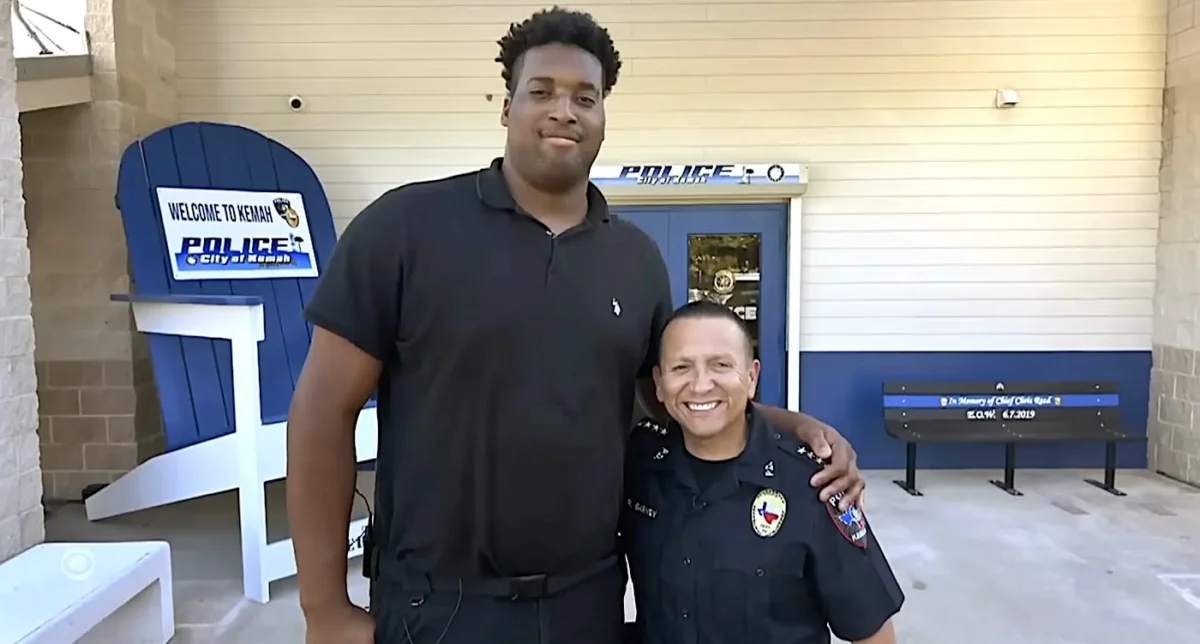
Standing at an imposing 7-foot-3 inches, Jordan Wilmore was long viewed by scouts, coaches, and peers as a prototypical basketball powerhouse. Throughout his collegiate career, the narrative surrounding him was singular: he was destined for the professional hardwood. Yet, beneath the jersey and the expectations of a sports-obsessed culture, Wilmore harbored a different ambition—one defined not by slam dunks, but by public service.
In a move that has captured national attention, Wilmore recently turned his back on the allure of professional athletics to be sworn in as a police officer in Kemah, Texas, a serene waterfront community located just 35 miles southeast of Houston. His story is not merely one of a career pivot; it is a profound testament to the power of following one’s internal compass, even when the world is pointing in the opposite direction.
The Weight of Expectation: A Life on the Court
For most athletes of Wilmore’s stature, the trajectory is linear: high school dominance leads to collegiate recruitment, which culminates in the NBA Draft. Wilmore was, by all accounts, on that path. His height made him a defensive anchor and a unique offensive threat on the collegiate circuit. Coaches spoke of his wingspan, his potential to alter the trajectory of a game, and the inevitability of his professional future.
However, the "giant man" label often obscures the person behind the physical attributes. While basketball provided Wilmore with a platform, it did not provide him with a sense of purpose. As he progressed through his collegiate years, he found himself increasingly drawn to the idea of community protection. While the roar of the crowd was consistent, it failed to resonate with the values he held most dear: the desire to help others and to foster safety within a community.
Chronology of a Career Pivot
The transition from student-athlete to law enforcement officer was not an impulsive decision, but rather a calculated shift in focus that occurred over several years.
The Formative Years
During his tenure in college, Wilmore excelled in his academics while simultaneously balancing the rigorous demands of an elite basketball program. It was during these years that he began volunteering, seeking opportunities to understand the complexities of civil service.
The Decision Point
As graduation approached, the pressure to sign with agents and pursue professional basketball intensified. The "what-if" scenarios posed by coaches and teammates weighed heavily on him. Yet, Wilmore began to engage with local law enforcement programs, realizing that the discipline he learned on the court—teamwork, high-pressure decision-making, and physical endurance—were directly transferable to the field of policing.
The Endorsement of a Legend
Perhaps the most surreal moment in his journey occurred when he received encouragement from NBA icon Shaquille O’Neal. Shaq, who has long been involved in law enforcement initiatives and honorary deputy programs, recognized the unique potential in Wilmore. During an interaction, the legend validated Wilmore’s decision, effectively giving him the "green light" to trade his sneakers for boots. This endorsement served as a bridge between his two worlds, proving that strength and size can be channeled into public safety just as effectively as they can be used for sport.
The Swearing-In
The final transition occurred earlier this month in Kemah, Texas. Standing before his family and fellow officers, Wilmore took the oath of office. He is now officially one of the tallest police officers in the state of Texas, a distinction that adds a unique visual element to his role but is far overshadowed by his commitment to the badge.
Supporting Data: The Intersection of Athletics and Public Service
The phenomenon of athletes transitioning to law enforcement is rare but not unprecedented. However, the sheer physical profile of Wilmore makes his case unique.
- Physical Advantages: Standing at 7’3", Wilmore possesses a presence that can act as a natural deterrent in high-stakes situations. Beyond intimidation, his athletic training provides him with the cardiovascular endurance necessary for foot pursuits and the physical coordination required for crisis management.
- Psychological Resilience: Professional-grade athletics requires a level of mental fortitude that is strikingly similar to the requirements of police work. The ability to remain calm under extreme pressure, execute complex strategies in seconds, and work in a high-stakes team environment are skills that Wilmore has been honing since adolescence.
- Community Integration: Kemah, a city known for its vibrant boardwalk and tourism, requires a police force that is both approachable and firm. Wilmore’s background as a public figure and a team player positions him well to serve as a bridge between the police department and the local community.
Official Responses and Local Reception
The Kemah Police Department has welcomed Wilmore with open arms, emphasizing that his arrival brings more than just physical height to the force.
"We are looking for individuals who bring integrity, dedication, and a heart for service," said a representative from the Kemah department. "Jordan’s background is fascinating, but his desire to protect the residents of our city is what truly matters. He has completed the same rigorous training as every other officer, and we are proud to have him."
The community reception has been equally positive. Residents of the waterfront town have expressed enthusiasm about having such a recognizable figure patrolling their streets. "It’s not every day you see someone who could have been in the NBA walking the beat here," noted one local business owner. "But when you talk to him, you realize he’s here for the right reasons. He’s here to help."
The Implications: Redefining "Success"
The story of Jordan Wilmore serves as a powerful case study in redefining success. In modern society, we are conditioned to equate talent with purpose—if you are good at something, you must do it for a living. Wilmore challenges this narrative. By choosing a path that prioritizes service over stardom, he highlights a shift in priorities that is increasingly relevant for young people today.
The Importance of Mentorship
Wilmore’s interaction with Shaquille O’Neal underscores the importance of mentorship. When young, high-profile individuals are encouraged to seek fulfillment beyond the immediate rewards of fame, it changes the cultural dialogue. O’Neal’s support validated that a career in law enforcement is not a "downgrade" from professional sports, but rather a noble and impactful alternative.
Bridging the Gap Between Police and Community
There is a growing need for law enforcement officers who are deeply embedded in their communities. By choosing to serve in a city like Kemah, Wilmore is positioning himself to build genuine, long-term relationships with residents. His visibility serves as a constant reminder that those who wear the uniform are human beings with diverse backgrounds and histories.
The "New" Role Model
Wilmore represents a new type of role model: the person who realizes their potential is not defined by the limitations of a game. By pursuing a career in law enforcement, he is providing a blueprint for others who may feel trapped by the expectations of their natural talents. He is proving that while you may have the height to reach the hoop, you may have the heart to reach the community.
Conclusion: A Path Less Traveled
As Jordan Wilmore begins his career in the Kemah Police Department, the eyes of many will remain on him—not for the shots he blocks, but for the lives he protects. He has traded the spotlight of the arena for the steady, often quiet, work of maintaining public peace.
In doing so, he has taught us that true greatness is not found in the statistics of a game, but in the intentional choices we make about who we want to be. The basketball world may have lost a potential star, but the residents of Kemah have gained a dedicated servant. As the video shared by CBS News’ Steve Hartman demonstrates, Wilmore’s smile and his quiet confidence suggest that he has made the right choice—not for the glory, but for the greater good.
His journey serves as a poignant reminder: when you listen to your own internal calling, the path forward—no matter how tall—is always the right one.