It is 9:40 p.m. You have spent the day oscillating between professional demands, your teenager’s academic needs, a trip to the pharmacy for an aging parent, and an exasperating phone call with an insurance company from a grocery store parking lot. As you collapse onto your sofa, a well-meaning acquaintance suggests you "make time for self-care."
While the sentiment is rooted in kindness, it is fundamentally inadequate for the scale of the burden. For millions of caregivers, the load is not merely a collection of chores; it is a structural reality that encroaches on work, sleep, financial security, and personal health. When the entire week feels impossible, the standard advice to "take a bath" or "meditate" feels not only insufficient but potentially insulting.
Caregiver burnout is not a sign of character failure, nor is it a lack of love. It is a state of cumulative depletion caused by sustained, high-stakes demands that have outpaced an individual’s available resources.
The Anatomy of the Caregiver Crisis
Caregiver burnout is defined as a pattern of physical, emotional, and mental exhaustion resulting from prolonged caregiving without sufficient support or recovery. Unlike clinical depression, which is a formal medical diagnosis, burnout describes an experience—a state of being that manifests through irritability, detachment, dread, and a diminished capacity to manage daily existence.
Recent research underscores that this is a systemic issue. In 2025, estimates from AARP and the National Alliance for Caregiving indicated that roughly 63 million U.S. adults—nearly one in four—are providing ongoing care for a loved one with a medical condition or disability. This statistic reveals that caregiving is a quiet, massive pillar of the national economy. When this pillar begins to crack, the resulting burnout is not a "private attitude problem," but a public health necessity that remains largely invisible until a crisis occurs.
Distinguishing Stress, Burnout, and Compassion Fatigue
The terminology surrounding emotional exhaustion is often used interchangeably, yet distinct definitions help in identifying the appropriate path forward:
- Caregiver Stress: This is the immediate, acute strain of managing daily tasks. It is a reactive state.
- Caregiver Burnout: This is the chronic, long-term depletion that occurs when demands continue unabated without recovery. It is a systemic state.
- Compassion Fatigue: Often termed "the cost of caring," this is the emotional and physical impact of witnessing another person’s prolonged suffering.
- Clinical Depression: A diagnosable medical condition. While symptoms may overlap with burnout, depression requires professional clinical intervention.
Experts emphasize that these categories are not rigid. They frequently overlap, and in the absence of a standardized clinical definition for burnout, the most important metric is not the label, but the impact on safety and daily function.
The Capacity Bottleneck: A Chronology of Escalation
The trajectory toward burnout rarely happens overnight. It follows a predictable, albeit tragic, chronology:
- The Accumulation Phase: Initially, the caregiver manages the "extra" tasks with resilience. The parent’s appointments, the child’s school messages, and professional duties are balanced through sheer effort.
- The Erosion of Recovery: As demands persist, the time once used for sleep, exercise, or personal reflection is cannibalized to meet care requirements.
- The Cognitive and Emotional Toll: "Small" tasks begin to fall through the cracks. The caregiver experiences irritability, a sense of dread when the phone rings, or, conversely, a chilling sense of emotional numbness when a new crisis arises.
- The Systemic Breakdown: At this stage, the caregiver may find themselves unable to perform basic functions or, in severe cases, unable to ensure the safety of themselves or the person in their care.
Data and Professional Perspectives
The medical community has struggled to classify burnout as a formal diagnosis. A 2023 review in The BMJ noted that, despite decades of study, no universally accepted clinical diagnostic criteria exist. While some may interpret this as a dismissal of the suffering involved, experts argue the opposite: the lack of a label should not prevent access to care. If symptoms like hopelessness, persistent sleep disruption, or substance use emerge, the absence of a "burnout diagnosis" should not stop a person from seeking professional medical or psychiatric help.
Peer-reviewed frameworks, such as the CARE model, suggest that burnout is the result of interacting factors: the care setting, the resources available to the caregiver, the environment, and the nature of the relationship. By viewing burnout through this lens, the problem shifts from "not being strong enough" to "lacking the necessary infrastructure to survive."

The "Sandwich Generation" and Financial Implications
The burden is often most acute for the "sandwich generation"—those individuals in midlife who are concurrently raising children, caring for aging parents, and maintaining a career. A national study highlights that these individuals face a unique compounding of financial strains, including child-rearing costs, elder-care expenses, and "opportunity costs"—the salary or career growth lost due to the time-intensive nature of caregiving.
This environment renders the "just meditate" advice obsolete. When the bottleneck is capacity—time, money, and structural support—adding a self-care routine is effectively adding another item to an already impossible to-do list.
Operationalizing the "Care Load Triage"
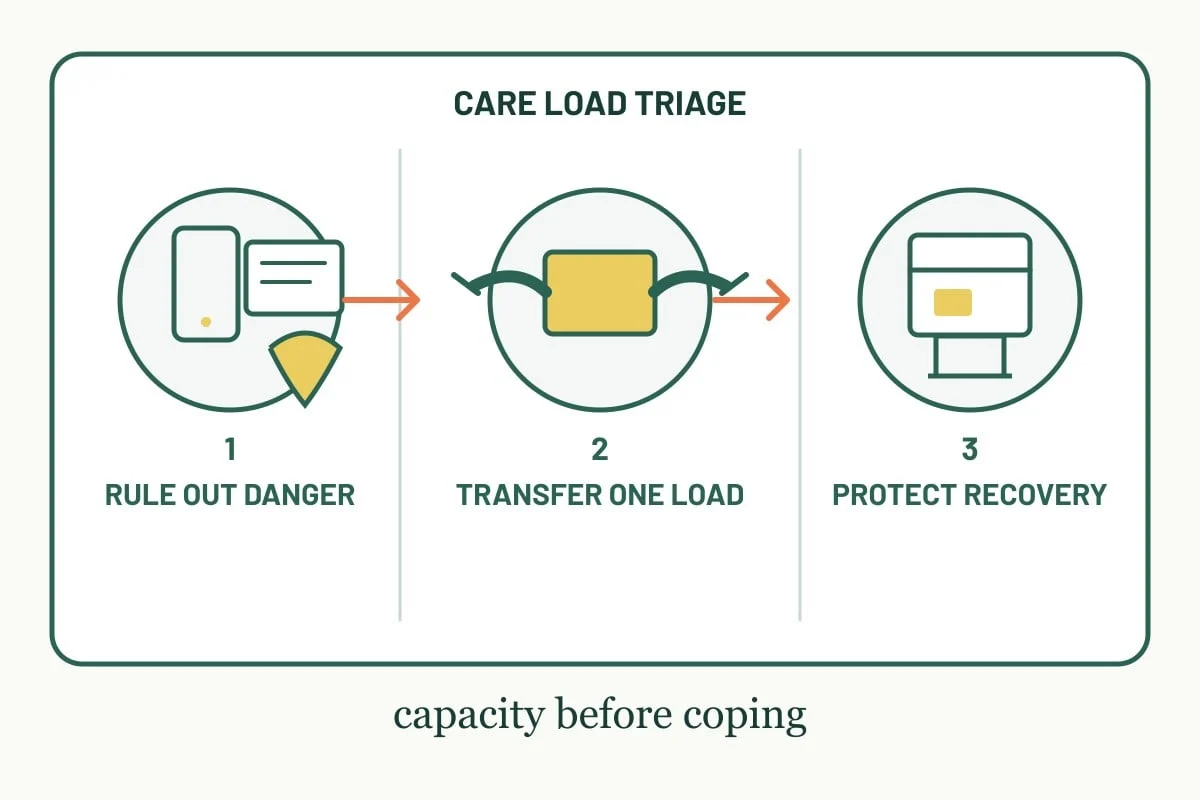
To move beyond the cycle of guilt and exhaustion, caregivers must transition from passive endurance to active management. The "Care Load Triage" is an editorial and operational tool designed to prioritize safety and sustainability.
Phase 1: Rule Out Immediate Danger
Before any adjustments are made, assess the fundamental safety of the current arrangement. Are the basic requirements for survival (medication, food, mobility, and urgent appointments) being met? If the answer is no, or if exhaustion is leading to unsafe behaviors—such as improper medication administration or dangerous driving—this is a medical emergency. In such cases, professional intervention is mandatory.
Phase 2: The Transfer of Power
"Let me know if you need anything" is a common but useless phrase. To reduce the load, the caregiver must convert help into concrete, assigned tasks.
- The Audit: List every recurring task. Identify the three that would have the most severe consequences if missed.
- The Delegation: Approach family, friends, or community resources with specific, time-bound requests. Instead of "I need help," use: "I need someone to handle transportation for the Tuesday appointment from 2:00 to 4:00 p.m."
- The Utilization of Services: Utilize resources like the Eldercare Locator or the ARCH National Respite Locator to find professional support. These are not signs of failure; they are the logistical components of a sustainable care plan.
Phase 3: The Protected Recovery Block
A recovery block is not the time leftover after everyone else’s needs are met. It is a scheduled, non-negotiable window. Whether it is 20 minutes of silence or two hours of uninterrupted sleep, this block must be treated with the same priority as a medical appointment.
Implications for the Future
The current approach to caregiver burnout is reactive and often pathologizes the individual rather than the system. Moving forward, the focus must shift to structural support. This involves:
- Employer Flexibility: Recognizing that caregivers are a significant portion of the workforce and implementing policies that allow for flexible caregiving hours.
- Policy Reform: Advocating for state-level access to long-term care services that do not rely solely on family members.
- Cultural Reframe: Shifting the narrative from "self-care" (which places the responsibility on the individual) to "community care" (which acknowledges the shared responsibility of supporting the vulnerable).
Conclusion: Reclaiming Capacity
Caregiver burnout is not a moral failing; it is a signal that the current care arrangement has become structurally unsustainable. If you are experiencing exhaustion, dread, or a sense of hopelessness, recognize that these are indicators of an overloaded system, not a broken spirit.
By performing a "load reset"—auditing tasks, delegating, and protecting recovery blocks—you are not trying to "be better" at being overwhelmed. You are, instead, making a strategic, calculated effort to preserve your own health and the safety of those you care for. You do not have to prove your love by making your own capacity invisible. The most loving thing you can do for your family and yourself is to ensure that the care you provide is sustainable, safe, and supported by a structure that doesn’t demand you break in the process.
If you are in crisis, help is available. In the United States, call or text 988 to reach the 988 Suicide & Crisis Lifeline, or contact local emergency services immediately if there is an immediate risk to your safety or the safety of those in your care.